

Breaking Bad And Better Call Saul Share The Same Glaring Weakness
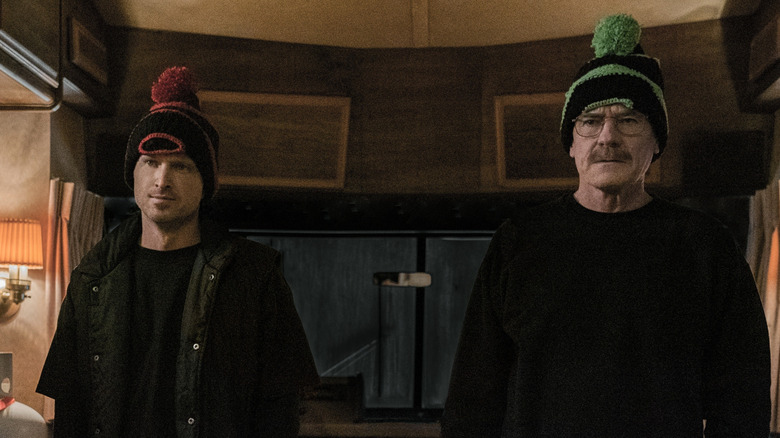
Both "Breaking Bad" and "Better Call Saul" stand out as two of the most universally acclaimed television series of the 21st century. With a combined 125 episodes — along with "El Camino: A Breaking Bad Movie," – this universe created by Vince Gilligan is subject to much adoration from critics and audiences alike. However, both series share a major point of criticism: their use of the Spanish language.
This shared universe is primarily set in Albuquerque, New Mexico, with numerous characters featured in both "Breaking Bad" and "Better Call Saul" speaking Spanish. The Salamancas, in particular, are a Mexican crime family at the center of a drug cartel featured on both series, while Gustavo "Gus" Fring (Giancarlo Esposito), the calm and calculated meth kingpin and co-founder of Los Pollos Hermanos, is of Chilean American descent. Both series feature dialogue-driven scenes revolving around the exploits of these drug lords, often with conversations in Spanish featuring English subtitles.
Although the writing team and casts of both shows continue to receive praise to this day, the written Spanish dialogue and certain actors' delivery are subject to significant admonishment, particularly from viewers fluent in Spanish.
The Spanish-driven scenes in both series are of inconsistent quality
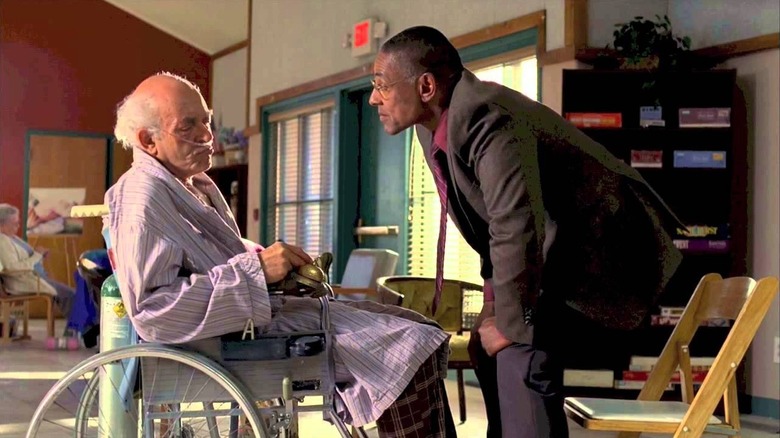
One of the major wars that carries on through both "Breaking Bad" and "Better Call Saul" is between Hector Salamanca (Mark Margolis) and Gus Fring. Gus has dedicated over 20 years of his life to avenging the murder of his business partner and lover, Maximino "Max" Arcinega (James Martinez), whom Hector shot. Given that "Better Call Saul" is primarily a prequel series, we get to see some of the early years in which Gus plans his revenge against Hector, adding further context to his arc in "Breaking Bad," which ultimately culminates in their mutual demise in Season 4.
Despite playing characters of Spanish descent, both Mark Margolis and Giancarlo Esposito have no Spanish cultural ties, with Margolis being of Jewish descent and Esposito being of African American and Italian lineage. Both actors reportedly required dialect coaches to learn their Spanish dialogue, but lacked the proper accents to accurately capture their characters' nationalities.
Regarding Margolis, his character is primarily nonverbal in "Breaking Bad," and since he is wheelchair-bound, his only mode of communication is through a bell strapped to his armrest. To his credit, his nonverbal performance is extremely intimidating, although his Spanish dialect in his one flashback scene and throughout "Better Call Saul" is still lacking.
Tony Dalton's Lalo Salamanca is the Spanish MVP of the Breaking Bad universe
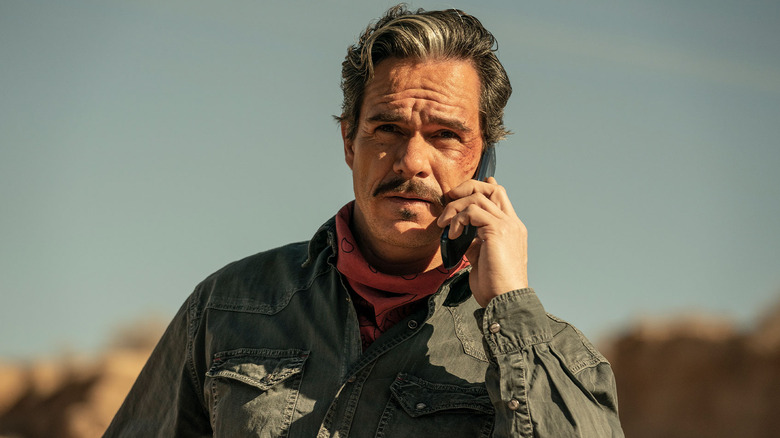
The Spanish-speaking characters featured in the "Breaking Bad" universe are often scrutinized, given that many of the actors involved do not project a Mexican dialect accurately. Even those who speak fluent Spanish in real life deploy Cuban and Colombian-sounding accents rather than a Mexican one. However, the performance of Tony Dalton, who portrayed Eduardo "Lalo" Salamanca in "Better Call Saul," is widely considered to be the most accurate on both a linguistic and cultural level.
Tony Dalton is a Mexican American actor who grew up in Mexico City. Naturally bilingual in both Spanish and English, his real-life experiences showcase the most natural, authentic dialect possible for the enigmatic Lalo. His bilingual performance is brilliantly showcased in his first appearance, in the "Better Call Saul" Season 4 episode, "Coushatta," which he prominently shares with Ignacio "Nacho" Varga (Michael Mando). The latter also speaks Spanish but lacks the effortless accuracy of Dalton's accent.