

An Oscar-Winning Crime Thriller Is Based On An Overlooked British Series
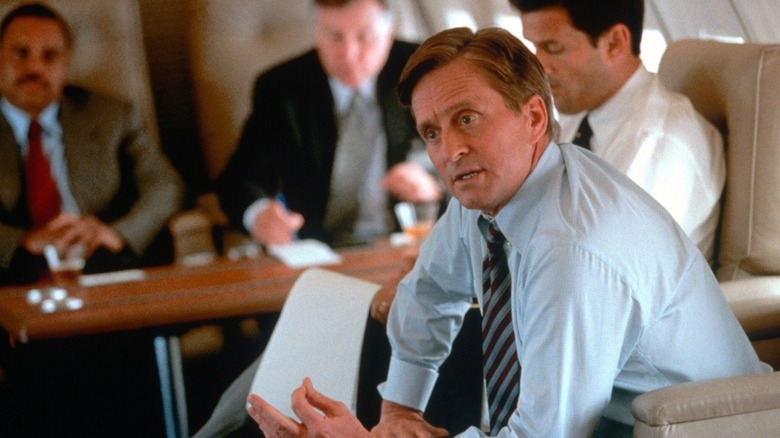
Steven Soderbergh's film "Traffic" broke new ground upon its release in 2000. The film is a triptych of interlocking storylines that explores the War on Drugs in both the U.S. and Mexico. It stars Michael Douglas as a newly minted drug czar leading the battle against the Mexican drug cartels, Benicio del Toro as a Mexican police officer battling corruption within his own ranks, and Don Cheadle and Luis Guzmán as Drug Enforcement Administration partners in San Diego arresting the drug lord husband of a character played by Catherine Zeta-Jones.
The stories build off each other, painting a portrait of a dysfunctional war that hardly, if ever, accomplishes its goals. Critics hailed the film for its nuanced depiction of a real-world issue that Hollywood usually renders in unrealistic black-and-white morality, but few moviegoers knew that Soderbergh's story was based on an overlooked British miniseries of the same (albeit differently spelled) name: "Traffik."
What is Traffik about?
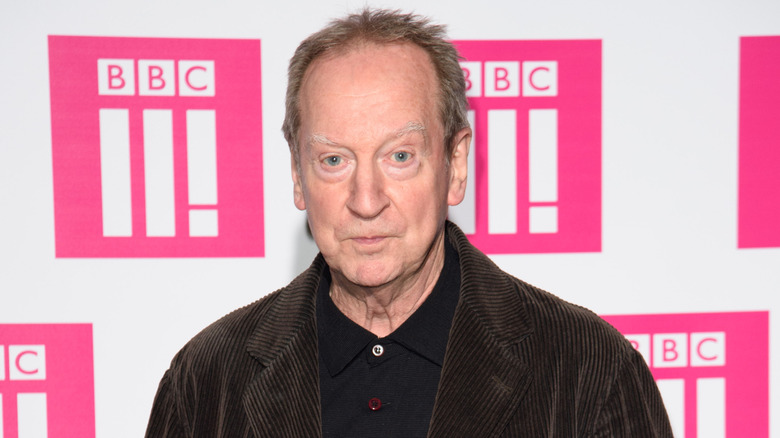
"Traffik" debuted on the United Kingdom's Channel 4 in 1989. Like Soderbergh's "Traffic," the series follows three interwoven stories about the illegal drug trade in the U.K. The first of the three is the most similar to Soderbergh's "Traffic," with Bill Paterson playing a Scottish home minister tasked with blocking heroin imports from Pakistan, while unbeknown to him, his daughter struggles with her own addiction. But the series' two other storylines are different and specific to the U.K. There is the story of Fazal (Jamal Shah), an opium grower whose home is taken away from him by the British government, and Karl Rosshalde (Juraj Kukura), a German drug smuggler trying to stay one step ahead of the German police.
The series was lauded for going out of its way to humanize the poppy growers victimized by the British government. It won the International Emmy Award for best drama, plus four BAFTAs.
Soderbergh's adaptation of 'Traffik' preceded his own voluminous work in TV
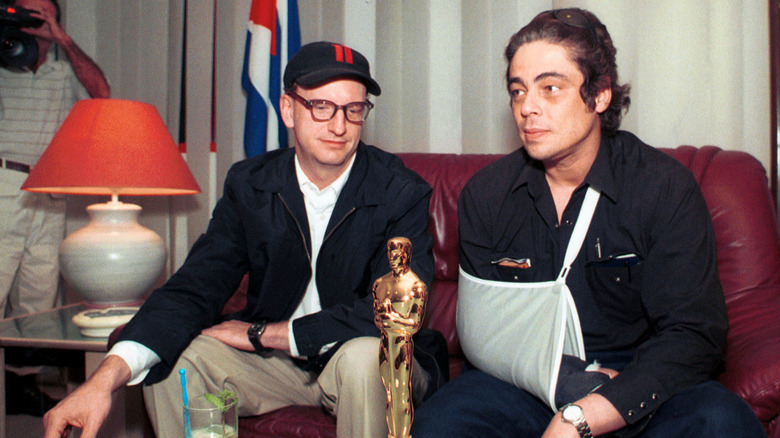
"Traffic" got even more rapturous praise than its source material, winning Oscars for Benicio del Toro, its writer Stephen Gaghan, and editing. It also netted Soderbergh an Oscar for best director, which he won over nominees who included, among others ... Steven Soderbergh for "Erin Brockovich."
Taking the structure of the TV series and adapting it to film was a difficult process, considering Soderbergh had about one-third the amount of screen time that the six-episode miniseries did. To help audiences keep up with the interlocking stories, Soderbergh used a unique form of color grading to give each storyline its own distinct look. The San Diego scenes were in green; the Washington, D.C., scenes were in blue; and most influentially, the Mexican scenes were in a sepia yellow, a trope that has been used to this day in just about any TV show or movie that takes a trip to Mexico.
In the years that followed, Soderbergh only became more prolific, often making multiple films in a single year. He's now produced and directed more TV shows than most other filmmakers. The most notable of these might be the Clive Owen period medical drama "The Knick;" Soderbergh directed every episode of the Cinemax series' two seasons. He's also produced even more shows, like the adaptation of his film "The Girlfriend Experience" and Gregg Araki's "Now Apocalypse" for Starz.