

The Pitt's Isa Briones Reflects On Santos' Trauma-Driven Response To The Kylie Connors Case In Episode 3
From the moment Dr. Trinity Santos discovered additional bruising on the body of 9-year-old patient Kylie Connors in "The Pitt" Season 2 premiere, she suspected the worst — that the girl was being abused by her father, whose girlfriend had brought her to the emergency room.
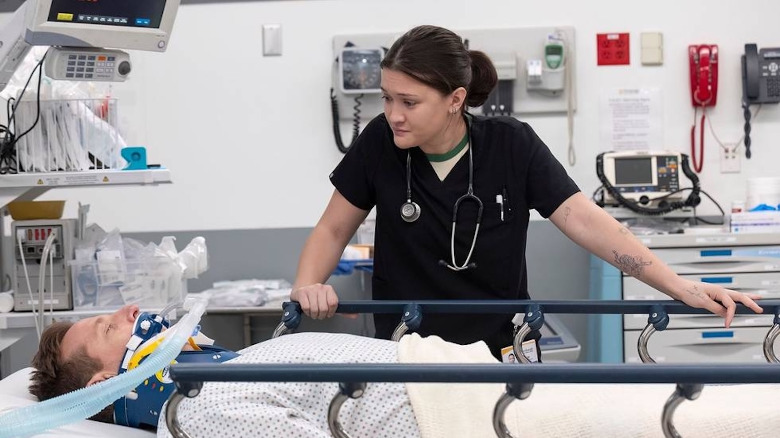
That suspicion lands differently because of what viewers learned about Santos in Season 1, Episode 7, when she discovered that a patient's wife had been drugging her husband to prevent him from molesting their teenage daughter. The revelation led Santos to confront the man directly, unleashing a harrowing monologue that made clear she was speaking not just as a doctor, but as a survivor of sexual trauma herself.
 Warrick Page/HBO Max
At the time, Isa Briones told TVLine that the moment was meant to add context for Santos' guarded nature and her instinct to challenge authority. That history looms large over the early stretch of Season 2. At one point, Robby asks Santos if she's spoken to PTMC's trauma counselor that week — a subtle reminder that her need for support predates Pittfest, even if it's never explicitly stated aloud.
So when Kylie's father, Benny, arrives in Episode 3, his short fuse immediately puts Santos on edge — and nudges viewers toward the same conclusion she's already bracing for. But during a particularly heated exchange with social worker Dylan, Dana steps in with the results of Kylie's bloodwork, revealing that an autoimmune disorder — not physical abuse — is the source of her bruising.
That scene ends on a shot of Santos, eyes widened — but what, exactly, is going through her head in the immediate aftermath?
Inside Santos' Reaction
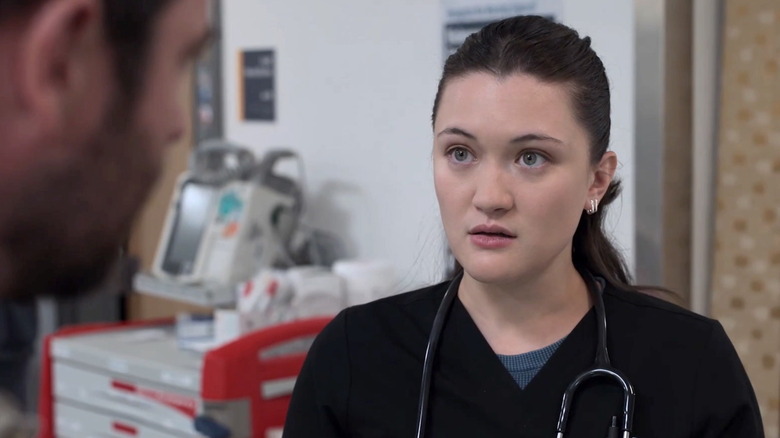
When I sat down with Briones to unpack Season 2, Episode 3, I asked whether Santos, beyond her relief, is reckoning with how much her own trauma continues to cast a shadow over her clinical judgment in moments like this.
"Yeah, I think it's complicated," Briones says. "There's no world where she was hoping that that was the case. But unfortunately, it does happen — it comes into the ED — and it's not out of the realm of possibility."
From Santos' perspective, she's doing what the job demands.
"As a doctor who is caring for this child, you have to rule out the worst possible things," Briones continues. "For her, it was trying to be a good doctor, trying to make sure that this wasn't happening, and really addressing that first."
At the same time, Briones acknowledges that Santos' past inevitably shapes how quickly her mind goes there.
"I do think she can sometimes go to some dark places and assume some dark things of people because of where she's come from, what she's been through," she says. "And I think, in that moment, it can feel like a weakness — like, 'Oh, I got it wrong.' But it's not necessarily that she got it wrong. It's more like, 'Thank God that's not happening.'"
It's also why cases like this are never handled in isolation, she explains, adding: "That's why multiple doctors work on one case. Everyone has a different point of view. Maybe another person wouldn't have immediately thought [abuse]. But what if that was what was happening?
"Everyone comes from different walks of life and brings that to work, for better or worse," Briones says. "There are always pros and cons. But it makes sense that she would immediately think of that — because she's seen some of the worst of humanity. That conclusion comes from experience."