

Why Liam Neeson Agreed To Cameo In Atlanta Season 3
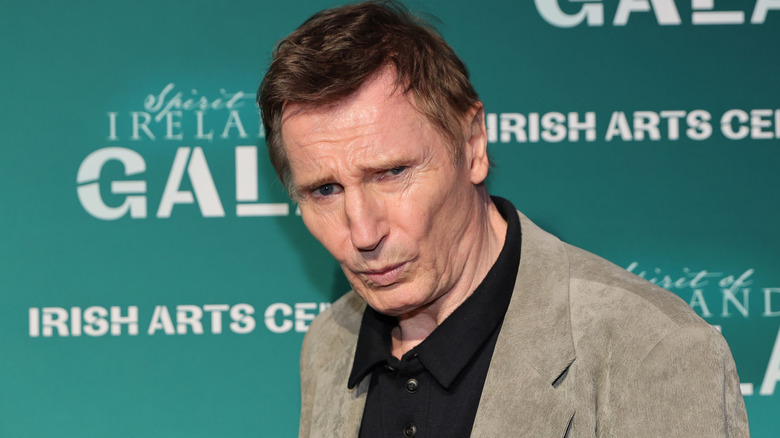
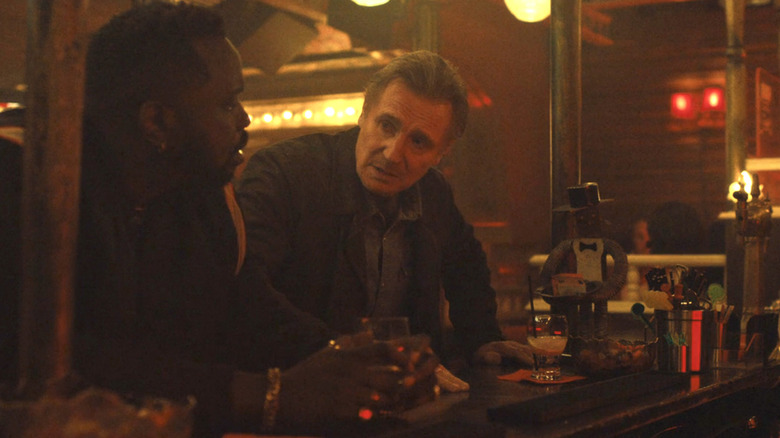
Fans of Donald Glover's comedy-drama series "Atlanta" got a surprise in Season 3, when Liam Neeson made an unexpected cameo in the episode "New Jazz." In the episode, which followed the characters Alfred (Brian Tyree Henry) and Darius (Lakeith Stanfield) as they explored Amsterdam, Neeson appeared as a fictionalized version of himself in a club named Cancel Club. The episode came out following Neeson's controversial 2019 admission that, at one point in his youth, he had harbored a racist revenge fantasy after his friend was sexually assaulted by a Black man. His appearance on "Atlanta" gave Neeson an opportunity to apologize, albeit in a comedic context.
Given the level of controversy that arose from Neeson's statement, which he had shared in order to show remorse for his past actions, the actor was understandably uncertain about appearing in "Atlanta" and making reference to his comments. In fact, when he was initially asked to make a cameo appearance by Glover, Neeson declined, believing it would be a bad idea. Glover was determined, though, and turned to a celebrity friend to get Neeson involved with the show.
Glover has revealed that the deciding factor in getting Neeson to appear on "Atlanta" was the endorsement of director Jordan Peele. A renowned director in his own right, Peele is known for addressing racism and the Black experience through his work. His suggestion to Neeson, at Glover's request, that the "Atlanta" appearance was a good idea was enough to convince the "Taken" star to shoot the cameo.
Donald Glover revealed Jordan Peele's role in securing Liam Neeson's Atlanta cameo
In a 2023 interview with GQ, Glover spoke about the difficulty of getting Neeson to agree to appear on "Atlanta." He said that when he first contacted Neeson about the part, which would involve addressing his earlier revenge comments, "Liam poured his heart out." Glover said that "He was like, 'I am embarrassed. I don't know about this. I'm trying to get away from that.' And I was like, 'Man, I'm telling you, this will be funny! And you'll actually get a lot of cream from it because it'll show you're sorry.' ... [H]e asked me to let him think about it. Then he sent me an email saying, 'I don't think I can do it and best of luck with "Atlanta," blah-blah-blah.'"
While Neeson initially refused to appear, Glover soon figured out a way to change the actor's mind. "Liam said [after the incident] he talked to Morgan Freeman, Jordan Peele, and Spike Lee. So I was like ... Jordan Peele! I hit Jordan Peele up and I was like, 'Look, man, I got this idea. He said that he trusted you. Tell him it's a good idea!'"
Fortunately, Peele was on board and managed to convince Neeson to reconsider. "Jordan thought it was hilarious!" Glover said. "So Jordan talked to him. Liam hit me back and said he talked to Jordan and his son and thought it'd actually be a good thing."
How Liam Neeson's Atlanta cameo addressed his past controversy
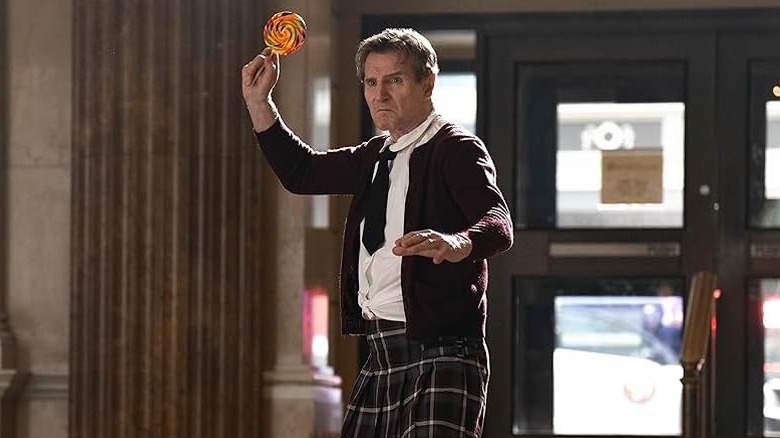
Liam Neeson went on to shoot a cameo that — as well as adding to the surreal world of "Atlanta" — gave him a chance to apologize for his earlier comments. True to form for "Atlanta," however, the apology was undercut with the series' own brand of irreverent humor.
Speaking to Alfred in Cancel Club, a club for people who had been canceled, Neeson said in the episode, "You might've heard or read about my transgression. You know, what I said about what I wanted to do to a Black guy. Any Black guy, when I was a younger man in London. A friend of mine had been raped, and I acted out of anger."
Neeson then went on to reflect, "I look back now and it honestly frightens me. I thought people knowing who I once was would make clear who I am, who I've become. But with all that being said, I am sorry. I apologize if I hurt people."
The heartfelt apology was followed by Alfred admitting, "I still f*** with 'Taken,'" before saying it was good to know Neeson didn't hate Black people. Neeson then responded, "What? No, no, no, no. I can't stand the lot of you. Well, now I feel that way, because you tried to ruin my career. Didn't succeed, mind you." The scene ended with Neeson claiming that being white means "we don't have to learn anything if we don't want to."