

Malcolm In The Middle's Hal Was Written Differently Until Bryan Cranston Showed Up
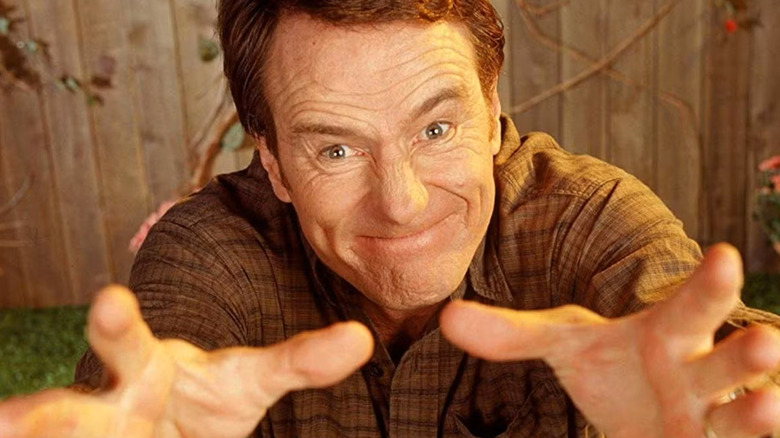
One of the most popular sitcoms of the early 2000s, Linwood Boomer's Fox comedy "Malcolm in the Middle" was also the first truly successful series to feature Bryan Cranston in a starring role. Cranston famously played the central family's father, Hal, who is often just as likely to indulge in absurd antics as his own children.
Cranston, of course, went on to explore a very different career path by playing Walter White on Vince Gilligan's crime drama "Breaking Bad" — but still, the memorable and goofy Hal is a significant role in Cranston's résumé. Interestingly, this might not have been the case if the actor himself hadn't taken agency, ultimately shaping a better version of the character than Boomer had originally written. In an interview with the Independent, the "Malcolm in the Middle" creator described the impact Cranston had on Hal.
"I didn't write [the role] correctly. Bryan's take was so much better," Boomer said. "I originally envisioned this incredibly remote, almost ghostly presence. Bryan's take was someone who was always building a rocket ship in his head. Instead of being this actively disengaged person, he was just busy thinking of other things. It was completely different and so much funnier, while still functioning the same way."
Bryan Cranston's work has influenced another creator, too
Cranston's clear vision of Hal and willingness to go all in (remember the time he got covered in bees?) made the character memorable, but it also ran the risk of typecasting. That became an issue when he was later considered for the part of Walter White, as executives struggled to imagine him in a serious role. Fortunately, Cranston had already pulled a version of his "Malcolm in the Middle" trick by influencing Gilligan, ultimately convincing the creator to champion him for "Breaking Bad."
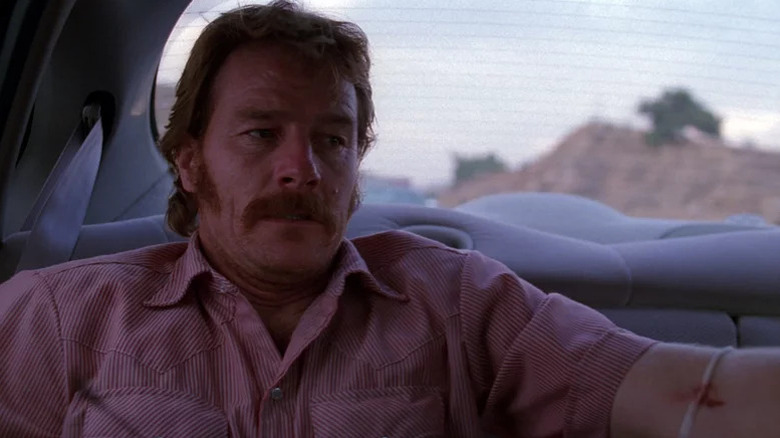
Cranston's unwitting "Breaking Bad" audition came in Gilligan's "The X-Files" Season 6 episode "Drive," where he played Patrick Crump, a terrified man subjected to experimental extreme low frequency waves that wreak havoc unless he keeps moving west. As Gilligan told The New York Times, the performance revealed Cranston's ability to convey both ruthless and sympathetic traits. "We had this villain, and we needed the audience to feel bad for him when he died," Gilligan shared. "Bryan alone was the only actor who could do that, who could pull off that trick."
Once cast in one of the best shows of the 2010s, Cranston continued shaping his character and sometimes even challenging writers to match his vision. "It's up to them, but I won't bend unless I'm convinced it's the right thing to do," Cranston said in The New York Times article.