

Ted Lasso's Tanya Reynolds And Abbie Hern Unpack Alice And Gemma's Pasts And Newfound Trust Ahead Of Finale
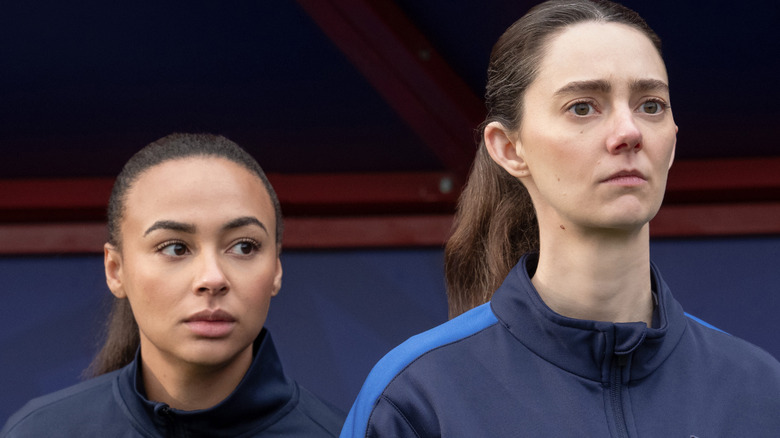
The Lady Greyhounds may have defeated Bristol City 4-2 during the penultimate Season 4 episode of "Ted Lasso," but the team still suffered a tremendous loss: Mae Green, one of their staunchest supporters — played since Season 1 by Annette Badland — died in the stands shortly after watching them pull off a miraculous comeback.
"It's devastating," Tanya Reynolds, who plays Alice, tells TVLine. Abbie Hern, who plays Gemma, calls Mae's death "absolutely heartbreaking," particularly after the pub owner revealed that she'd once dreamed of becoming a professional footballer herself, at a time when women weren't afforded that opportunity. "I think the team will be absolutely devastated — but, in a way, also so thankful that the game ended the way that it did, and they got to give her those moments," Hern says — including riding on the bus with the ladies and joining them in the locker room ahead of the match.
Mae's words about the path that wasn't available to her carry particular resonance for Alice and Gemma, whose complicated relationships with football — and with each other — have come into sharper focus.
After Gemma was injured in Episode 8, Alice explained to Rebecca how quickly an injured player can go from being surrounded by concerned teammates to watching everyone move on without them, strongly suggesting that she'd experienced that isolation herself when her own playing career abruptly ended. Alice also opened up to Gemma about how much she still misses playing, while a visit to Gemma's home shed new light on why the footballer had struggled to choose between law school and the sport she loves.
Their newfound understanding was put to the test in Episode 9, when Gemma took a scary fall but insisted on taking — and scored — a crucial penalty kick. When Alice subsequently told her she shouldn't return for the second half of the game, Gemma listened.
In the Q&A below, Reynolds and Hern unpack Alice's vulnerability and unresolved grief, Gemma's decision to commit to football, and the trust that's finally developed between the former teammates.
Alice Opens Up
TVLINE | Alice is at her most vulnerable when Ted finds her having a panic attack in Episode 8. Rather than press her to explain what's wrong, he simply joins her in a series of deep breaths. What does it mean for Alice to have someone understand what she needs in that moment without her having to say it?
REYNOLDS | Oh, it was huge. To be caught crying at work was probably her absolute worst nightmare. It was her in her most vulnerable state. It's probably the most exposed and the most honest that she's been, and [she was] thinking she's completely alone. And so for Ted to walk in was mortifying for her. But by that point, it's too late. She's there. Her skin has been peeled off.
And the best possible thing he could have done was just sit with her and not try to talk to her, because she wouldn't have wanted to. She does say, "I don't even know why I'm crying," and obviously she knows, but she doesn't want to lift the lid on it. She doesn't want to go into it. And so for him to just sit there next to her and be there for her, and with her, and not judging her at all, is the best thing that he could have done. And then to speak to her indirectly through the team meant a lot to her as well.
TVLINE | When Alice described to Rebecca what it's like to be injured and slowly watch everyone move on without you, it gave us such a clear sense of what losing football did to her. How much of Alice's wall — her anger, her defensiveness this season — came from grief over a career that she hasn't fully processed?
REYNOLDS | Oh, God, so much! She's not really processed it at all. Being in that coaching position and being around all these players that have so much potential and have the opportunity that she now no longer has and would do anything for, she probably wasn't prepared for how much it would all hurt. Because she's not over it. She's not ready to not be a player anymore.
If she was comfortable and at ease with where she was in her life and with her new path as a coach, she'd be a much softer, warmer, easier person. But you can feel it. It's right beneath the surface — this grief that she's not living the life that she always thought she would be, and that she always wanted, and that she was so, so close to.
What Drives Gemma

TVLINE | We got our first real glimpse into Gemma's home life in Episode 8. She comes from a wealthy family, her mother is eager for her to pursue a law internship, and her father was a footballer. How much did that context help you understand why Gemma had been torn between law school and football?
HERN | It absolutely explains it. We had that conversation early on: "Well, why is she doing this? Why is she committing to two things that deserve 100% of her commitment?" Because she's not necessarily an indecisive person. She's just faced with a challenge that's a lot deeper than not being able to pick one thing.
It's really nice to have that and to be able to explore that in that episode. She joined the team because she missed football, she thought, but actually, the reasons are much more vast. And Alice knows that. [She] knows that it's much more than you just being good at it and wanting to do it because you're good at it. It really means something to her.
TVLINE | Gemma takes a scary fall in Episode 9 but still insists on taking that penalty kick herself. Is she facing her fears, ignoring what her body is telling her, or simply determined to prove that she can keep going?
HERN | She has spent the whole episode convincing the coaches that she's good. She's good, she's great, and she's able to come back on. And so taking the penalty was like, "I told you I could score a goal. I'm ready. I told you." That's that part of Gemma's drive and her motivation to prove to everyone what she's made of. And even after the twinge, if Alice didn't say to her, "Are you OK?" and make her really admit it, she probably would have carried on even further. She's got a lot to prove.
Alice and Gemma Find Common Ground
TVLINE | When Alice tells Gemma at halftime that she shouldn't play the second half, Gemma accepts it without putting up a fight. Why is she willing to listen to Alice in that moment, after pushing back against her for so much of the season?
REYNOLDS | Because, just in the last two episodes — if you think about all the stuff that happens in Episode 8 — Alice really redeems herself in Gemma's eyes. The last time you see them in Episode 8, they're at the hospital, and Alice has been really vulnerable with Gemma in a way that she hasn't been before. She's opened up with that whole speech about how she misses playing football so much and why she's so envious of Gemma and her f–king knees. And so they've softened quite immensely, because by the time they're in the hospital, Alice goes with her to her MRI. You don't see it, but you see us leaving together when you're in the wheelchair. She's with her, and her own mother isn't there. Alice has worked really hard to earn a place of trust in Gemma's eyes.
HERN | I completely agree. She's not just there for her when she's playing well. She's there regardless.
REYNOLDS | And she's also demonstrating that she's in it for the long game with Gemma. She's like, "Don't f–king play this half, because we're in it for the long haul, and I'm going to be here for the long haul as long as you are." It just shows that she has faith in her entire career, which probably means a lot to her.