

15 Best Simpsons Couch Gags, Ranked
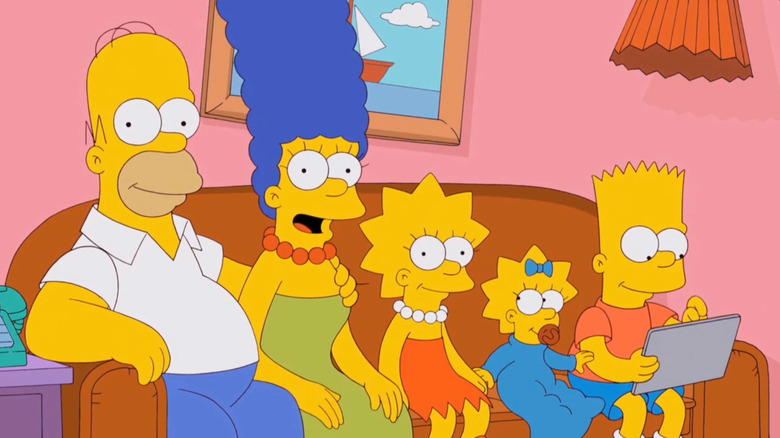
As of this writing, "The Simpsons" has been on the air for 37 seasons. With all of that time and all of those episodes following everyone's favorite nuclear family (pun very much intended), loyal "Simpsons" viewers have gotten to know so many characters and enjoy a number of running gags. Fans have also been introduced to plenty of familiar traditions. One of these traditions is ubiquitous to the point of introducing just about every episode: the couch gag.
In the couch gag's most traditional form, "The Simpsons" theme song ends with a simple scene of the titular family heading into their living room to sit on their couch together and watch television, ostensibly mimicking the audience members at home. But throughout the show's 37 seasons, this vignette has given writers and animators ample room to explore self-contained comedic ideas that riff on this very simple idea, though sometimes in very complicated ways.
Let's celebrate this iconic show's legacy by counting down and ranking the 15 best "Simpsons" couch gags. Go ahead and pull up a, well, maybe not a couch, but whatever seat is closest to you.
15. Moms I'd Like to Forget
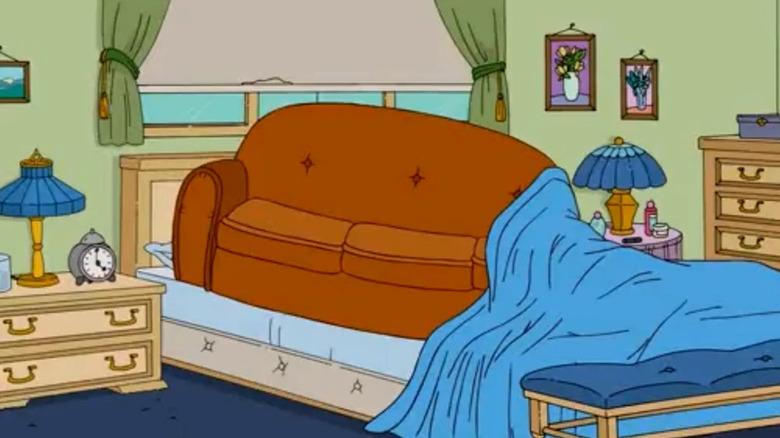
This Season 22 episode begins with a couch gag that asks an essential question: What of the couch these Simpsons keep sitting on? What is that iconic piece of furniture's story? Who couches the couchman?
Well, this couch gag shows us, in a clever and delightful montage showing a day in the life of the couch before the Simpsons take their seats. While the couch isn't a literal animal, it reminds one of the classic animated sitcom "The Flintstones," where the human characters' household items have a life of their own (and "The Simpsons" has paid homage to "The Flintstones" many times before, including in a couch gag).
The gag begins with the couch hitting its alarm and getting out of a nice bed that is clearly not in the Simpsons' Evergreen Terrace home. It takes a shower, shaves in the mirror, and has breakfast with a family full of different pieces of furniture. It takes a subway to work with other pieces of furniture, reading a newspaper with furniture-specific headlines (which makes one want a Pixar-styled movie all about furniture). And finally, it punches in, does some stretches, and welcomes the Simpsons as they sit down and watch TV. All in a day's work.
14. Whistler's Father
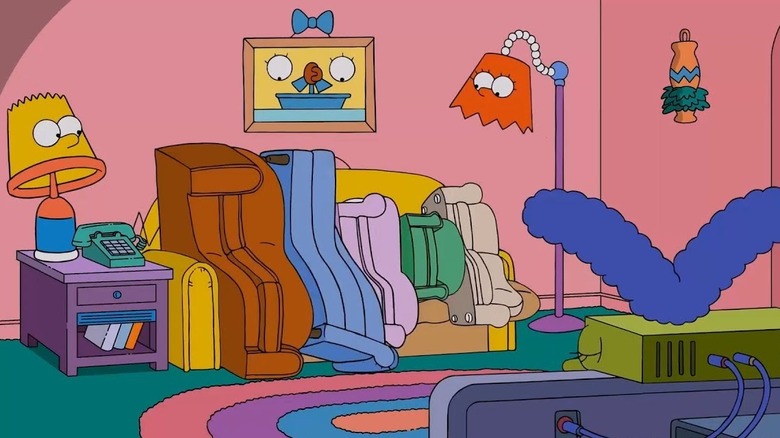
Speaking of personifying furniture: "Whistler's Father," originally airing in 2017 in Season 29, turns every Simpson into a kind of furniture-human hybrid creature. Big Dr. Moreau vibes, if Dr. Moreau were less interested in playing God and more in playing mid-century modern.
The opening tableau features Bart as a spiky-haired lamp, Maggie as the sailboat picture on the wall, Lisa as a taller lamp with a string of pearls as a connector, and Marge as the TV itself, her blue hair poking upwards as the antenna. All of these are immediately recognizable and a testament to the brilliant iconography of the Simpsons. And of course, Homer, the man who probably spends the most time on the couch, gets his karmic reward as being the couch itself.
Then a bunch of other couches run in and sit on the Homer-Couch, who, to his credit, does not protest (though perhaps in this version he has no mouth in which to deliver an annoyed grunt). The Maggie-Painting sucks its "pacifier," and off to the opening credits we go.
13. The Ziff Who Came to Dinner
Season 15's "The Ziff Who Came to Dinner," co-written by the voice of Homer Simpson, Dan Castellaneta, begins with a couch gag brimming with ambition, specificity, imagination, and a reminder of the possibilities of animation, especially when compared to the oft-grounded content of a typical "Simpsons" plot.
The gag riffs off of "Powers of Ten," a series of documentary films by Charles and Ray Eames originally released in 1977. In these films, which you might've watched in a science class, the basic building blocks of the universe, including the universe itself, are observed by zooming inward and outward by a power of ten. It moves from Earth up through the vastness of space, and it moves from a human into the specificity of an atom. It's heady stuff!
And "The Simpsons," often a gateway to interesting pop cultural references, plays its homage pretty straight, starting from the Simpsons' house and zooming out through the sky, the country, the globe, the universe, the atom, the molecule, the DNA double helix, and finally, out through Homer's head himself as he sits on the couch the whole shebang started with.
12. Homer the Great
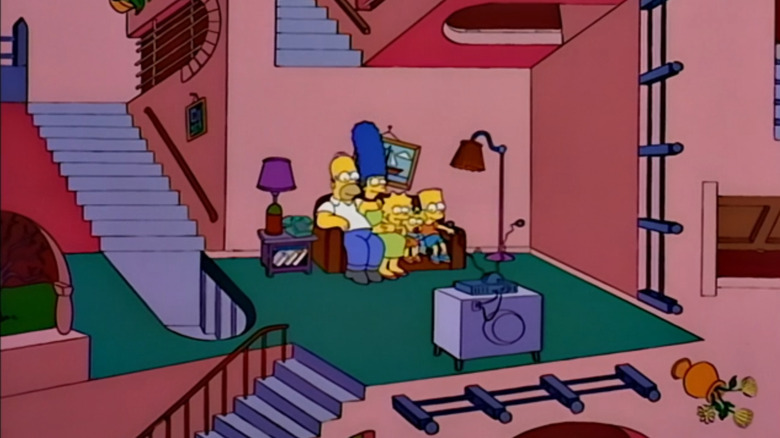
Speaking of perspective-shifting, visually trippy works of art that might give you a panic attack under certain circumstances: M.C. Escher was a Dutch artist who used, bent, and broke mathematical and geometric ideas and theories to depict the impossible. A self-portrait of Escher in an unfeasibly depicted reflective sphere, a series of lizards that start to blend into each other, a house where staircases somehow exist over multiple floors despite moving in a linear straight line – all of these and more are quintessentially Escher.
So, naturally, "The Simpsons" had to bow down to the master, paying tribute to an artist who may have influenced the surreal tendencies of animated comedies more than we give credit for.
Season 6's "Homer the Great," which originally aired in 1995, turns the Simpsons' living room into a replication of Escher's "Relativity," a painting that shows a house where different sections have different centers of gravity, and staircases jutting through them all paradoxically. For the Simpsons, who have TV to watch, this ain't no thing, and they all run through each "broken staircase" easily, ending on the same couch on the same plane.
11. Lisa's Date with Density
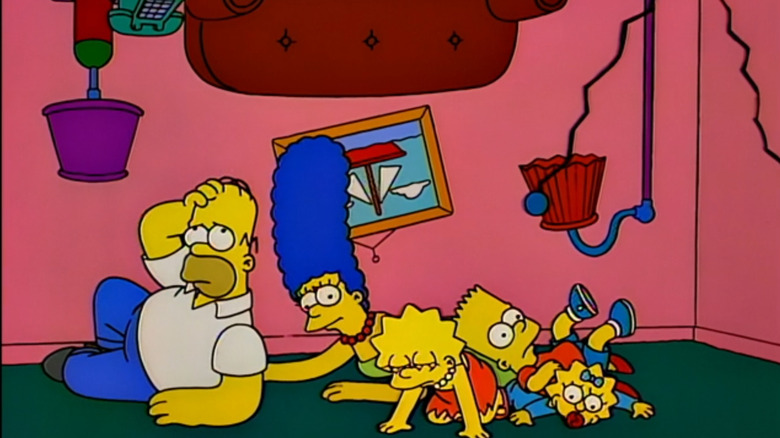
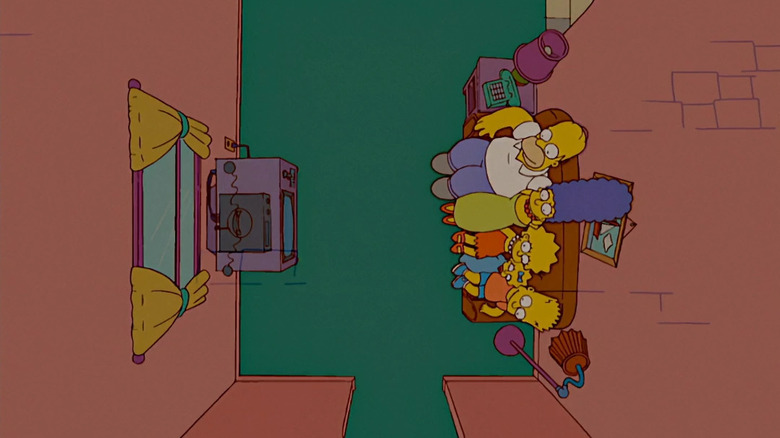
Unlike the Escher or educational short-referencing couch gags on this list, Season 8's "Lisa's Date With Density," which originally aired in 1996, plays a simple gag to a punchy effect, with no previous knowledge or cerebral appreciation necessary. Though, like an M.C. Escher painting, it does bend the space-time continuum a bit to get you to laugh.
The image of the Simpsons' living room begins upside down, and we watch the family scramble to the couch as normal — they're just on the ceiling, which we assume is still their floor, since they're sitting there normally and unbothered. So in this couch gag, everything's upside-down. Were that all, this wouldn't make the list, and would provoke a curious eyebrow-raise more than a laugh.
But then, simply, stupidly, and effectively, the Simpsons fall from the ceiling-floor down to the floor-ceiling. This does beg some immediate logical questions (Is everything actually upside-down? How'd they get up there in the first place? How were they able to stay in place briefly?), but if you give in to the Wile E. Coyote-esque pleasures of the gag, you won't stop laughing.
10. The Parent Rap
After seeing enough "Simpsons" couch gags, you start to identify the elements of the Simpsons' living room pretty quickly. There's a couch in front of a TV, a couple of lamps, and a generic sailboat picture behind the couch. Therefore, some of the best and most surprising couch gags come when the "Simpsons" animators play on our familiarity, reminding us that nothing is off limits.
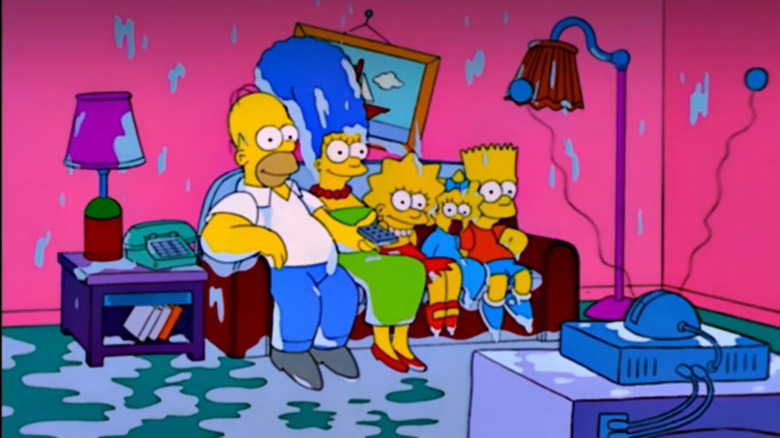
Which brings us to Season 13's "The Parent Rap," which originally aired in 2001. The titular family doesn't run into the living room from some undefined "off-screen" space — they're in the dang sailboat picture itself, something we've seen countless times before.
The Simpsons look like themselves, which highlights the silly simplicity of the sailboat picture in contrast to the relatively "realistic" family. They jump off the boat into what sure seems like a body of water, as we see a resulting splash. And then, in a wide shot, we see they've actually jumped from the reality of the picture into "normal reality," having landed on the couch, although their living room is now covered in the water from the sailboat reality.
9. Rosebud
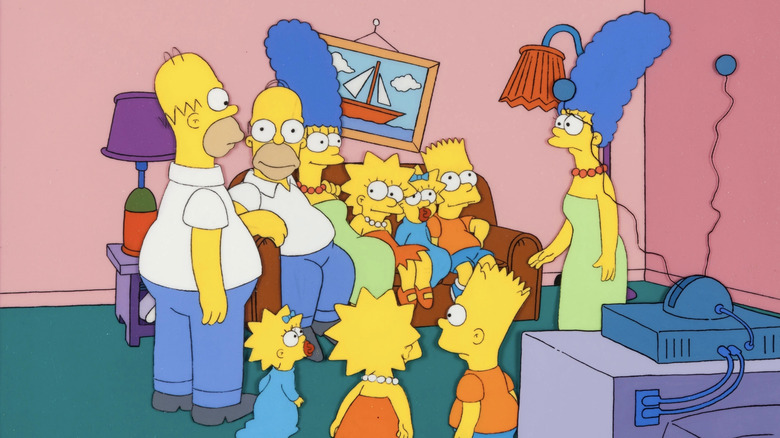
Here's another concise gag that completely devastates what we know about our corporeal reality in the service of a very stupid, cartoon-logic belly laugh. Season 5's "Rosebud," a gem from 1993 that's often deemed one of the best "Simpsons" episodes ever made, begins with the Simpsons running into their living room, per usual. There's just one problem preventing them from sitting on their couch: there's already a Simpson family sitting there.
Or, from the perspective of the Simpsons already on the couch, ready to watch TV: there's another Simpson family who just rushed into their living room! What gives? Which family is real? Do the clones have nefarious purposes? And most importantly, who gets to sit on the couch?
Thankfully, the couch gag answers none of these questions. Instead, the two separate Simpson families look at each other puzzlingly, and then the episode cuts to the credits. Comedy resists neat resolution, and it's deeply funny to keep imagining these split-reality Simpsons forever stuck.
8. Homer Badman
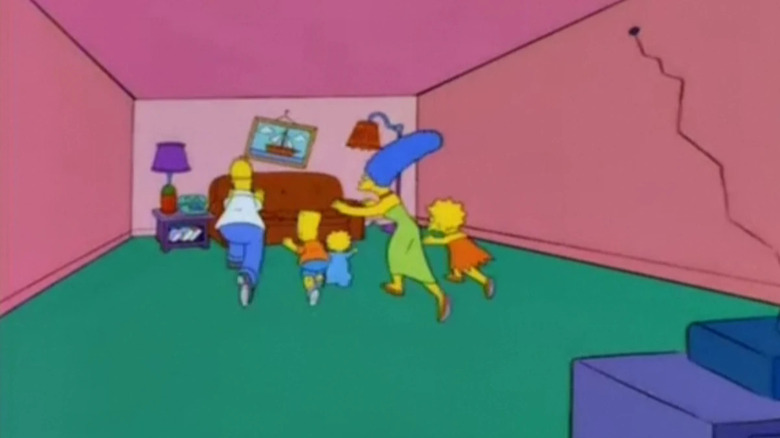
Another couch gag that destroys any semblance of reality, exists forever unresolved, and is using all its high-falutin' comedy smarts to deliver a simple, stupid gag. Are you sensing a pattern?
The Season 6 premiere, 1994's "Homer Badman," written by TV comedy maestro Greg Daniels ("King of the Hill," "The Office"), begins with the Simpsons running into their living room toward the couch. But the couch — and the hallway it juts up against — suddenly moves backward. The walls of the hall extend backward, zooming and distorting ad infinitum, forever unable to be caught. It's like the endless stairs from "Super Mario 64," except with a couch.
But the Simpsons don't stop to wonder why their living room is suddenly getting a never-ending annex. Instead, they pursue their mission — to sit on the couch and watch TV — without question. It's the perfect distillation of comedy logic trumping reality's logic: a comedy character must pursue their goal no matter the absurd cost.
7. Lisa's Pony

Do you prefer "The Simpsons" to be a silly, exaggerated, joke-a-second festival of comedy, or a more heartfelt, earnest look at a working-class family struggling to get by? In this couch gag, you can have both. The couch gag for Season 3's "Lisa's Pony," a 1991 episode that also finds a perfect balance between goofs and genuineness, starts with Homer arriving in the living room first, by himself. So, he lies down, ready to rest, as he is wont to do.
But the rest of the Simpsons are close behind him, desiring some couch and TV time as well. Do they ask Homer to make some room, find other furniture, or simply sit on the floor so their patriarch can enjoy his alone time?
They do not. They sit on Homer himself, as if he were the couch. And while he flails and grunts with the comedy the moment deserves, there's a certain sweetness to the family using their father as a literal foundation.
6. Mr. Plow
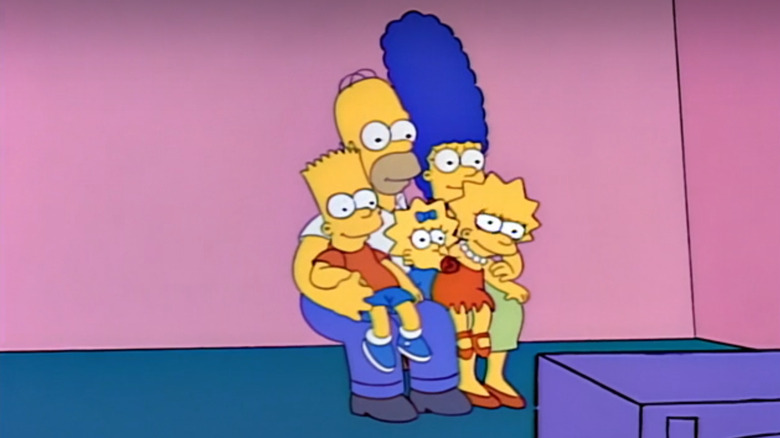
Here's another excellent couch gag that hits the intersection between nonsense and heart with aplomb, illustrating the charms of the early "Simpsons" episodes purely and concisely.
Season 4's "Mr. Plow," which originally aired in 1992, is one of the best "Simpsons" episodes, so it stands to reason it has one of the best couch gags, too. The titular family rushes into their living room, but instead of seeing their typical couch, big enough for all of them, they see a tiny, tiny wooden chair. There's no way they could all fit on that, right? Also, where the heck is their couch?
The Simpsons don't care about either of those questions. All they care about is watching television together. So, they pile onto this tiny, tiny wooden chair together, making sure even Maggie has room and a view. And most tellingly, they don't gripe or frown or deliver any d'oh. In fact, they smile, so happy are they to spend time together, no matter how impractical it may be.
5. Itchy & Scratchy & Marge
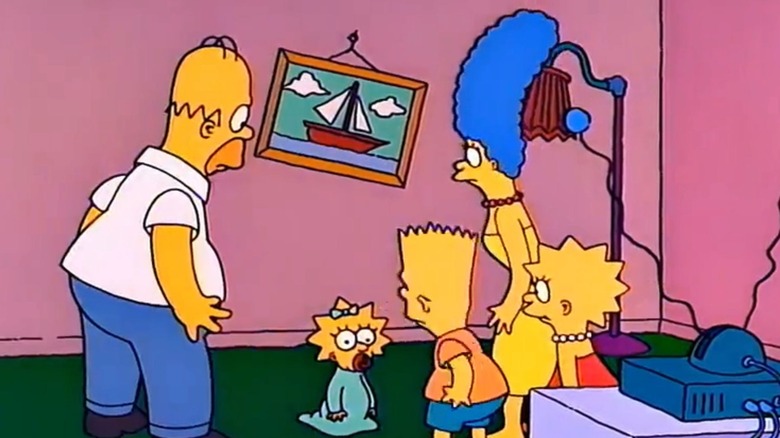
Let's stop talking about "Simpsons" couch gags for a second and clumsily, broadly define what comedy is. At its simplest, comedy is, to this writer's opinion anyway, the decisive subversion of expectation; an unusual element intruding on a base reality. A "Simpsons" couch gag, to bring it back, works as a repeatable piece of comedy because the viewer immediately understands the expected base reality: the Simpson family will rush into their living room, sit on their couch, and watch TV. Thus, any subversion of that base reality will register as comedy.
For Season 2's "Itchy & Scratchy & Marge," which originally aired in 1990, the subversion is about as elemental as it can get. The Simpsons rush into their living room... and there is no couch. We, the audience, are pretty much expecting a couch. But there isn't one. So the Simpsons can't sit down. All they can do is look confused and remain standing. And all the audience can do is laugh.
4. One Fish, Two Fish, Blowfish, Blue Fish
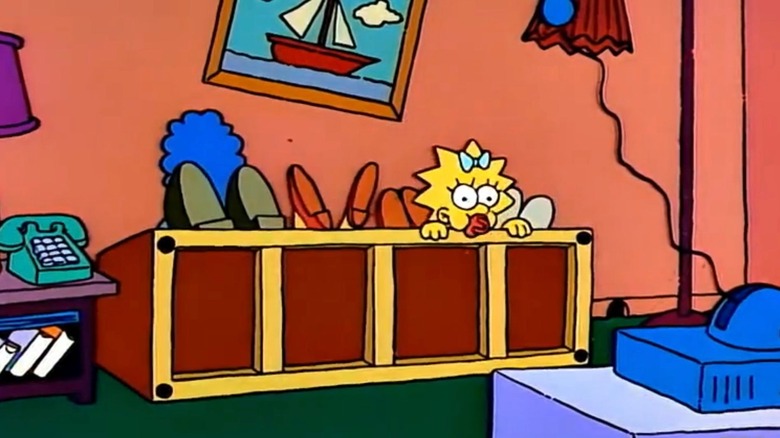
Have you ever noticed how aggressively the Simpsons rush into their living room?
When you enter your entertainment-consuming area to consume your entertainment, be it in a living room in front of a TV or on your bed in front of a device, we'd have to imagine you're not running in violently, the force of your steps causing calamitous sound effects. Yet here the Simpsons are, scrambling clumsily to catch the tube as if their lives depended on it. Typically, this verve doesn't affect their final destination. But in the couch gag for "One Fish, Two Fish, Blowfish, Blue Fish," a classic from Season 2, the quick-moving chickens come home to roost — with an excellent button to boot.
It begins as normal, with the Simpsons running as fast as their hand-drawn legs can carry them. But when they plop down on the couch, their brute force causes the couch to tip over and fall backward, because of course, it did! What did they expect? And then, popping over her upended family members, is Maggie, who's gonna watch TV no matter what's going on around her.
3. Marge vs. The Monorail
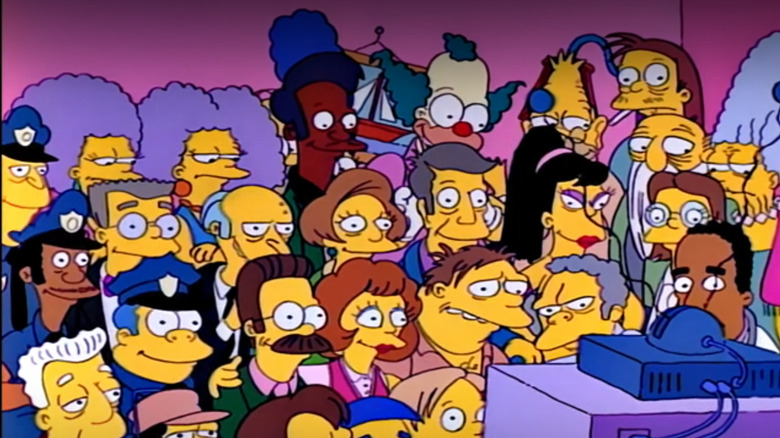
One of the keys to the longevity of "The Simpsons" is its deep bench of supporting characters. Springfield is one of the great TV towns, and every character who resides therein makes for one of the great TV ensembles. Beyond the titular nuclear family, you've got all kinds of neighbors, friends, family members, local celebrities, and one-joke characters we love to see, whether given a superficial pop-in or a deepening focus.
"Marge vs. The Monorail," the famous Conan O'Brien-penned episode from Season 4, which many deem the best "Simpsons" episode ever, starts its half-hour of bliss by paying homage to these beloved supporting characters. The couch gag begins, as it does quite familiarly, with the Simpsons rushing into their living room and sitting on their couch.
But this time, they've got company. Rows of fellow Springfield denizens rush in afterward, taking their spot in the Simpsons' living room as though they've been there every time. Patty, Selma, Flanders, Kent Brockman, Dr. Hibbert — all of these folks and more completely block the titular family's view, and we're happy to see them regardless.
2. Bart Gets an 'F'
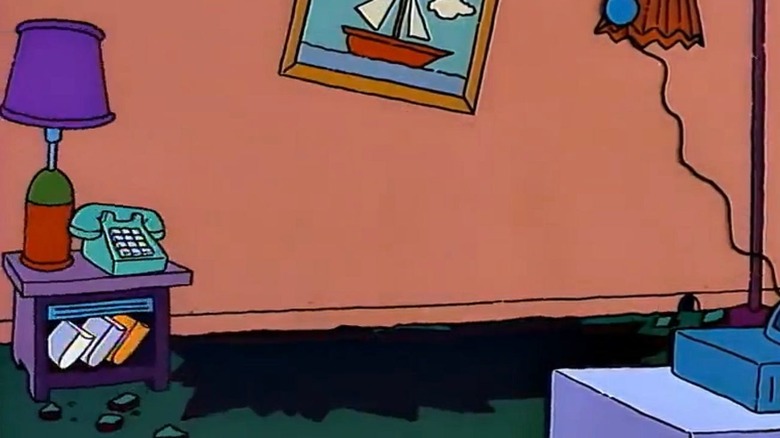
How about another fundamental lesson of comedy? A single question can help move the comedy football down the comedy football field (sorry). "If this is true, what else is true?" This question is helpful because it works in lockstep with the previous idea of a base reality being disrupted by an unusual element. If we assume something about the base reality is true, what's a natural but unusual thing that could occur as a result?
Season 2's "Bart Gets an 'F,'" which originally aired in 1990, answers this question quite explosively and hilariously. Our beloved family runs into their living room, with an aforementioned intense level of force, and plops brusquely onto their couch.
So, if that's all true, what else might be? Well, their intense and brusque level of force might cause the couch to literally fall through the floor. And if a surprising descent through the floor is true, what else might be true? Well, Homer might say, "D'oh!"
1. Lisa's First Word
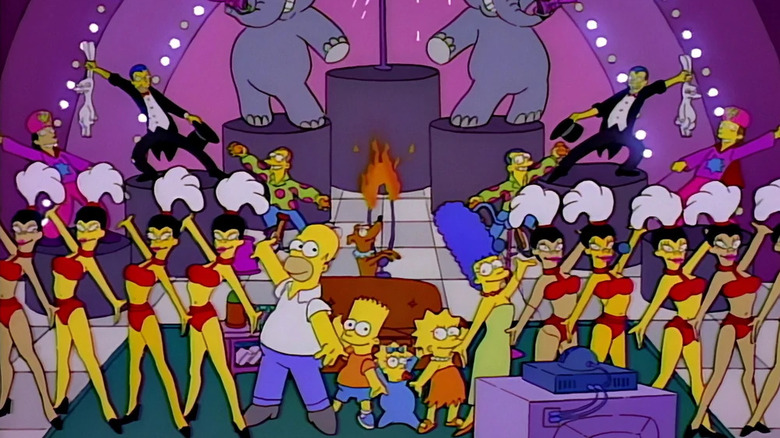
Season 4's "Lisa's First Word," which originally aired in 1992, ends with a heartwarming celebration of family: Maggie, voiced surprisingly by the late Elizabeth Taylor, takes out her pacifier and says her first word, "Daddy." But it opens with a heartwarming celebration of family, too — especially if you, like this author, consider "The Simpsons" an extended part of your television family.
The Simpsons, as they have in the 14 other episodes featured on this list, run into their living room. But instead of taking a seat on their couch, they lock arms and start a kickline, Rockettes-style!
And in a grand "yes, and" to this comedy idea, a cavalcade of Las Vegas-ready performers rush in to turn this quotidian, suburban activity into a grandiose celebration. Showgirls join the kickline, magicians pull rabbits out of hats, trapeze artists fly through the sky, and a couple of damn elephants do a balancing act. The vignette ends with everyone posing for the camera, and the audience is wholly invited into the world of "The Simpsons."