

Scrubs Shocker: John C. McGinley Unpacks Life-Altering Dr. Cox Twist — 'It's The Alpha Trying To Deal With Fear'
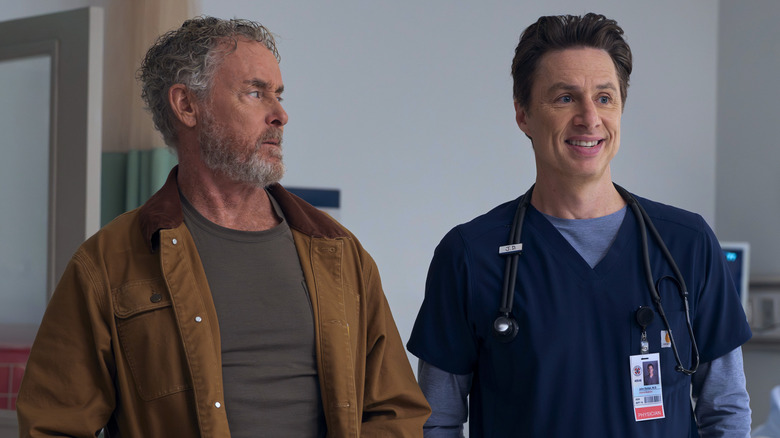
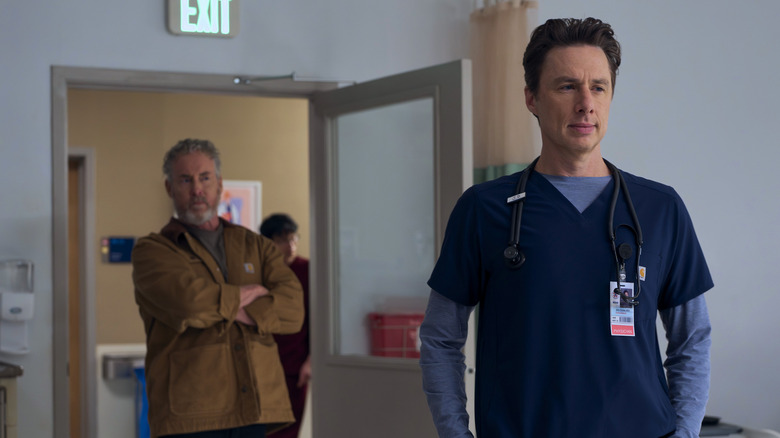
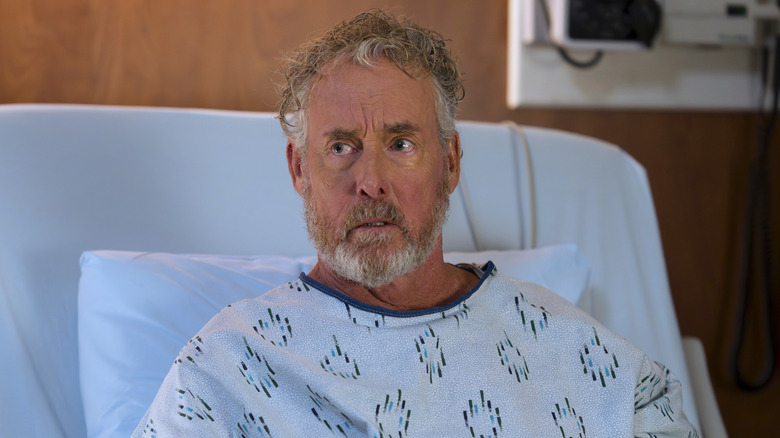
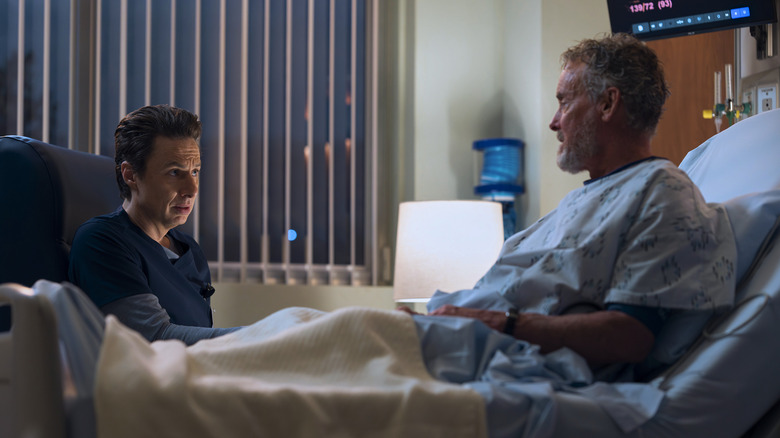
During the penultimate episode of the "Scrubs" revival's inaugural run, J.D. warns, "It doesn't matter how many people you save. When one of your own falls, it hits deep." That proves all too true when his longtime mentor — and Sacred Heart's former chief of medicine — Dr. Perry Cox (played by John C. McGinley) collapses at the nurses' station. He is quickly admitted and diagnosed with microscopic polyangiitis, a rare autoimmune disease that can lead to rapidly progressive, multi-organ failure driven by severe vasculitis.
"It isn't great, but it could be worse," J.D. says, attempting to put on a brave face.
"Worse than my own body attacking itself?" Cox counters. "There is no cure for this. It's a matter of managing crises that are gonna be thrown my way in the bottom of the ninth."
J.D., however, remains optimistic: Aggressive treatment can help stave off renal failure — and, when caught early, the disease can even go into remission.
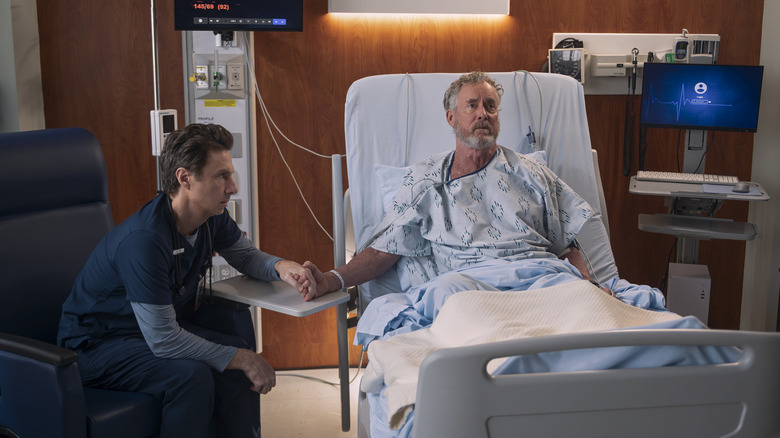
"Did you really think that this couldn't happen — that just because we're out there taking care of all of them, we'd get some kind of karmic immunity to protect us from what's coming for us all?" Cox asks, as both his and J.D.'s eyes begin to well.
He has J.D. promise "that you'll keep me alive for a very long time, because I don't want my death to be the thing that makes you cynical... I tried to protect you from this, with everything I had... but I am so scared."
"I have a plan," J.D. assures him. "And I don't care if you don't like it. It is the best path forward."
That's when J.D.'s voiceover cuts in: "Turk had asked me when I'd stopped needing Dr. Cox's approval. It was now, because now he needed me."
McGinley will be back for the April 15 finale, along with fellow legacy cast members Christa Miller (as Jordan), Judy Reyes (as Carla), and Neil Flynn (as the Janitor). In the meantime, TVLine hopped on Zoom with McGinley to unpack Cox's shocking diagnosis and what comes next.
'The mentor now has to be served by the mentee'
TVLINE | When we spoke at the "Scrubs" junket, you warned me that Dr. Cox would be dealing with "much bigger problems" than retirement — but I'll admit, I wasn't expecting this.
Me neither. Zachy called me up with this pitch. I wanted to know how Cox was going to be integrated back into the landscape of the revival, and he said, "Here's the pitch: Cox has a organ malady and he has to come back. And the mentor now has to be served by the mentee." And I was like, that is so rich because writers can write that landscape. And [showrunner] Aseem [Batra], who is the new executive producer on "Scrubs," just wrote the heck out of 108. It's as good as the Brendan Fraser episode. It's as ambitious a half hour of television as we've done.
TVLINE | You and Zach Braff had a lot of great scenes together during the original run — but the scene at Cox's bedside might be my favorite you two have had together.
I agree with you. And Zachy and I felt that it was on the page. I had it long enough to— I can turn stuff around like anybody who's done this a long time, but it sure is nice to be able to drag the text down into the rehearsal space [in my home] here and do all my processes, and then go up to Vancouver and have it all over me. I like to get it all over me, and then the camera suffers that. And I was telling the truth in that scene — that was Cox functioning from fear, inadequacy, and mortality, and trying to reconcile some things he did wrong or not as well as he could have. It's the alpha trying to deal with fear.
Why this diagnosis (and what it sets up for Season 2)
TVLINE | This is such a specific and serious condition. Do you know what went into choosing this illness for Cox, as opposed to something more broadly familiar like cancer?
I do know. They wanted a treatable malady that will bring Cox back a lot next season — so that he can function, but be in jeopardy up front until Zachy saves the day. Or aspires to save the day. But we can integrate Cox into Season 2 more than Season 1 because the "Rooster" and "Scrubs" schedules won't be at such loggerheads next year [if renewed], and that thrills me to no end.
I really missed, as a consumer of "Scrubs" content — and I can separate myself, I can go third person — I missed Cox a lot this season. I know it was a huge lift to introduce the five or six new principles, who I love, from Vanessa [Bayer, who plays Sibby] to David [Gridley, who plays Blake], and I think they're all fantastic — Vanessa being a personal favorite because I think she walks on water — but I missed Cox.
I don't know if you're familiar with Joseph Campbell, but Joe did a lot of work with myth and mythology, and the storytelling that all tribes share. And whether it's an Aristotelian theater actor [or a sitcom actor], the hero needs conflict. There has to be jeopardy for the hero on his journey. We meet the hero, he meets his jeopardy, and the jeopardy is resolved.
I think J.D. needs more consequence and more jeopardy in Season 2. We had to meet all these people, and there are only 21 minutes and 30 seconds to do it, and they're so magnificent. But I think, selfishly for Zachy right now, the jeopardy right now is that the protagonist's underlings can fail — and I get it, but that's not a direct jeopardy to [J.D.]. That's a jeopardy to them.
Cox, Kelso, and the Janitor represent kind of a murderer's row of threat and jeopardy to J.D.'s character, and I think Cox will somehow be cycled back into a position of jeopardy or threat or consequence. I'm making this all up, but as a viewer, that's what I want for J.D.
'A brush with mortality'
TVLINE | Over the years, we've seen Cox carry a lot — professionally and personally. Do you see this as a kind of reckoning for him?
I think what Cox has been doing since we saw him leave in Episode 1 is not dissimilar to what I, John McGinley, was doing for a couple of years when I quasi-retired.
I went to a shrink and I said, "Barry, I'm micromanaging the family too much. I'm getting in everybody's way." And he said, "Here's the thing: Your objective for the last 28 years was Max," my son who was born with Down syndrome. He was born 28 years ago — he's doing great — then the girls were born 18 and 15 years ago. He goes, "What was your objective?" And I go, "That's easy. It was to provide for the family and create a sense of safety and protection."
And he says, "Okay, well, you've done it. So now what do you want to do? Because you can't go fussing with everybody all the time. You've set them on a path to flourish. Here's what I want you to do — and there's no wrong answer: I want you to start finding out things that make you, Johnny C., happy. I'm not talking about going off to an ashram and doing peyote. What can you do organically in your journey here that fulfills you now that everyone is provided for, and everyone is safe? Go ride a bike, go learn falconry, start painting" — I'm making this up — "but go find things that not only get you out of everybody's hair, but make you get out of bed in the morning and go, 'I can't wait to experiment with that nuance of purple on the canvas.'"
I think I have succeeded at it, and I think Cox is failing miserably at it, and it makes me laugh that he can't find anything that can fill his cup the way going in and saving lives for 16 hours a day and teaching young people how to do it did. And if that's where his cup is half empty, then to have that compounded by a possible brush with mortality — writers can write that, and they did. When I have that talk with Elliot about regret, and reconciling what might've been a profound wrong and I was the catalyst for it... The fact that [that scene] didn't go sideways is a tribute to [Sarah Chalke] being so amazing.
When your friends and mine, who have unfortunately checked out in a moment, for whatever the horrible circumstances were, that's one way [to go out]. But your friends and mine who have stuck around for a second, and have been able to reconcile things with us — or with their brothers or sisters, their aunts or uncles — that's both a privilege and a responsibility, and I think Cox is taking this on. I don't know if he's a fatalist as much as he knows that this challenge can go south.
And trying to protect... it's so funny that verb just keeps coming up. I told Aseem that Cox protecting J.D., telling everybody that I want the other doctor to take care of me because I'm trying to protect him from this at the expense of getting the best doctor in the hospital — rational thought would be, "I want you to take care of me. You give me the best shot."
"I'm going to protect you from taking care of me" is so deliciously a— backwards and wrongly selfless. That scene is one of the richest scenes I've ever gotten to play on "Scrubs."
TVLINE | I don't think Cox would have accepted J.D. overseeing his care during the original run. Both in that scene, and in the scene you referenced where Cox makes amends with Elliot, I felt like we were seeing Cox in a whole new, more vulnerable light.
I agree. I think we saw it ever so briefly at [Ben's] funeral, but it was silent film time. There were no words other than Zachy saying, "Where do you think we are?" And then it was silent film time for Cox. This is an articulate exploration of mortality. Fear, inadequacy, and reconciliation. Call action, and get out of my eye line.
A peek into the finale (and beyond)
TVLINE | You're back for the finale, along with Christa Miller, Judy Reyes, and Neil Flynn. How much do Jordan, Carla, and the Janitor factor into Cox's storyline?
Christa agreed to come up, and Aseem and Zachy played to her strengths. One of her greatest strengths whether she knows it or not — and I've told her this a million times — is her capacity to cycle right into screwball. What she does is tantamount to what Rosalind Russell does in "His Girl Friday" with Cary Grant, and I mean that as the biggest compliment in the history of the world — when you can go right back into the Preston Sturges of it all, with "The Palm Beach Story," and Claudette Colbert in "It Happened One Night." When you can cycle in screwball in 2026, which she can on a dime, when she drives those scenes, it's heaven. It becomes volleying in ping pong. The syncopation is that quick. And she's a really disciplined actor who has worked her tail off, and she can generate screwball on action, and that's what happens.
The storyline is I tell J.D. under no conditions are you to let Jordan know that I'm sick, and the lens doesn't suffer her as a sucker. She's too bright, intellectually, spiritually, emotionally... you're not going to hide something from her. That's preposterous. So these two knuckleheads trying to hide something from Jordan is the stuff of Preston Sturges — that's "The Miracle of Morgan Creek." And for Christa to be able to do that — and she can do it on a dime — that's thrilling in the frame.
TVLINE | At this point, Cox and Jordan's kids would be college age or a little older now. Do they factor into this storyline? Are they referenced at all?
No. It's too crowded a room. I mean, on the page, that finale I thought was about 45 minutes. I didn't know how Zachy was going to chop it down to 21 minutes and 30 seconds, but Zachy has become so skilled at this. And then you bring your cut to Billy, and Bill Lawrence is the Norman Lear of his generation. I mean, for there to be an A-, B-, C-, and possibly a D-story in 21 minutes and 30 seconds is insane, and Billy and Zachy make it look easy. That's the stuff of wizards, man.
TVLINE | Cox accepts that J.D. is going to lead his treatment, and that he needs to trust his mentee to care for him to the best of his ability — but saying he will accept his care is easier said than done. How do you expect Cox to respond to J.D. in a hypothetical second season?
I think he'll be a hall of fame, first ballot pain in the a–. The worst patient in the history of worst patients — and the writers can write to that.
Want more scoop on "Scrubs"? Got questions or tips about another TV show? Email us at asktvline@tvline.com!