

One Of The Twilight Zone's First Episodes Adapted An Orson Welles Radio Play
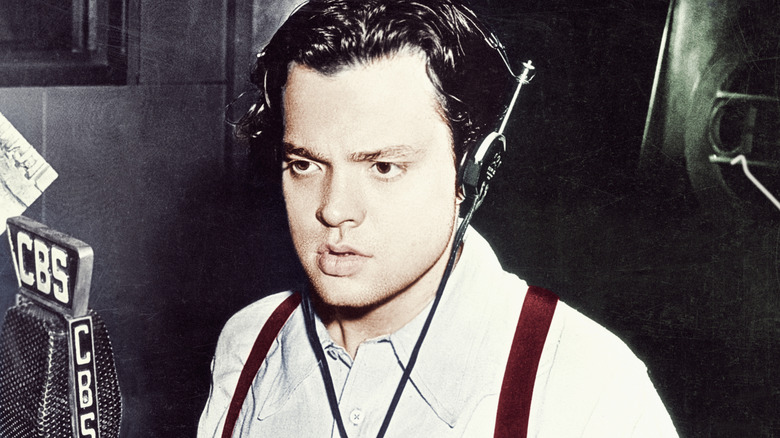
Most episodes of "The Twilight Zone" are original tales that were written for the series, though some were adapted from existing stories. One early episode of the iconic show (which TVLine ranked as the best anthology series of all time) came about after creator Rod Serling heard a radio play being performed by none other than Orson Welles and thought it would be perfect for television. The episode in question is "The Hitch-Hiker," the 16th episode of the first season of "The Twilight Zone."
"The Hitch-Hiker" stars Inger Stevens as Nan Adams, a woman who survives when her car veers violently off the road. When she resumes her cross-country journey, Nan starts seeing a strange, shabbily dressed hitchhiker over and over again, always somehow ahead of her and always seeking a lift from her. The episode concludes with one of the best plot twists in the history of "The Twilight Zone" — Nan realizes she didn't actually survive the accident at all and the hitchhiker she keeps seeing is Death, who has come to collect her soul.
Before it was adapted for "The Twilight Zone," "The Hitch-Hiker" was a radio drama written by Lucille Fletcher for Orson Welles. Welles first performed it in 1941 on "The Orson Welles Show," and he would perform it again on the radio shows "Suspense," "The Philip Morris Playhouse," and "The Mercury Summer Theatre of the Air." Having heard Welles perform the play on the radio, Serling bought the rights from Fletcher. He changed the lead character to a woman and moved the crash from New York to Pennsylvania, but otherwise remained true to Fletcher's original plot.
The Hitch-Hiker was inspired by a real incident
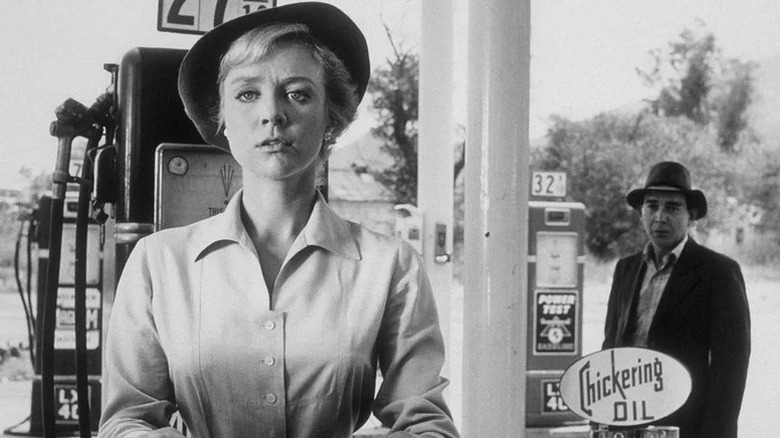
Fletcher was originally inspired to write "The Hitch-Hiker" after an incident that occurred when she was moving from New York to California with her then-husband, the composer Bernard Herrmann. "We saw an odd-looking man, first on the Brooklyn Bridge and then on the Pulaski Skyway," Fletcher said for the book "The Twilight Zone Companion," adding, "We never saw him again. However, I didn't quite know what to do with the idea until a year later, when, shortly after my first daughter was born, I conceived the idea of doing it as a ghost story."
She knew right away that Orson Welles would be the perfect person to tell the spooky tale, so she wrote it with him in mind. "It was designed to provide a vehicle not only for his famous voice but for the original techniques of sound which became associated with his radio presentations," Fletcher said in a preface she penned for the published version of "The Hitch-Hiker." Herrmann wrote the music for the radio play, which would then be reused for the TV adaptation on "The Twilight Zone."
Although Serling purchased the rights to the play before adapting it, Fletcher claims she was not told the story was going to be used on television, nor was she consulted on the change of the protagonist's gender. In her interview with "The Twilight Zone Companion," Fletcher expressed disapproval over the unauthorized gender swap, claiming that "the dramatic effect was minimized" as a result. She said: "I would never have approved of it, for good though Inger Stevens' performance was, I don't think a female in the part added anything to my play."