

Why Netflix's East Of Eden Made Florence Pugh's Cathy The Central Character
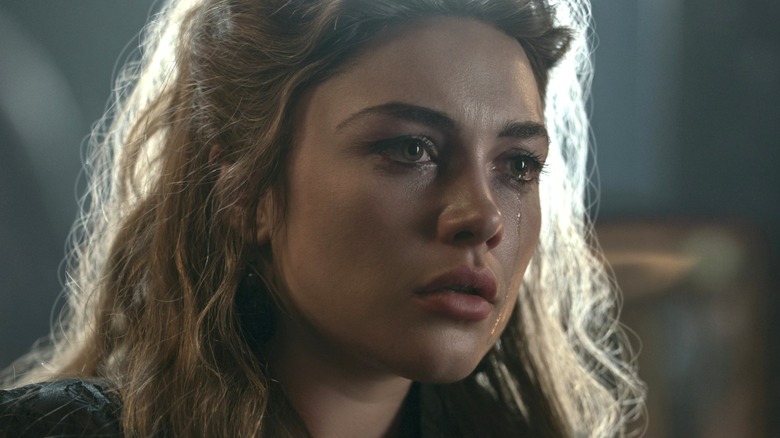
The most striking change in Netflix's adaptation of "East of Eden" is the way it frames Cathy Ames (Florence Pugh). While this version of Cathy still commits most of the crimes her literary counterpart does, she's afforded a bit more humanity by the show's writers. In the series, Cathy's father is portrayed as explicitly abusive and misogynistic, making Cathy's decision to kill him go down a bit smoother.
One of Cathy's earliest moments of evil in the book — when she seduces two neighborhood boys as part of a sadistic scheme to frame them for sexual assault — is also written instead as a genuine sexual assault that traumatized her at an early age. The Netflix series' showrunner, Zoe Kazan, explained to Variety that she saw the books' portrayal of that event as more open to interpretation than John Steinbeck may have intended.
"It says that she couldn't speak afterwards — that when she did speak, no one believed her," Kazan explained. "It is impossible for me, as a person who grew up in a body that was sexualized and targeted from my earliest memories, not to read that as maybe not what Steinbeck intended. Very late in the book, she describes her memories of being a child and being frightened and alone ... What I saw was a portrait of disassociation, and I profoundly understood that."
Zoe Kazan thinks Cathy is the novel's most exciting character
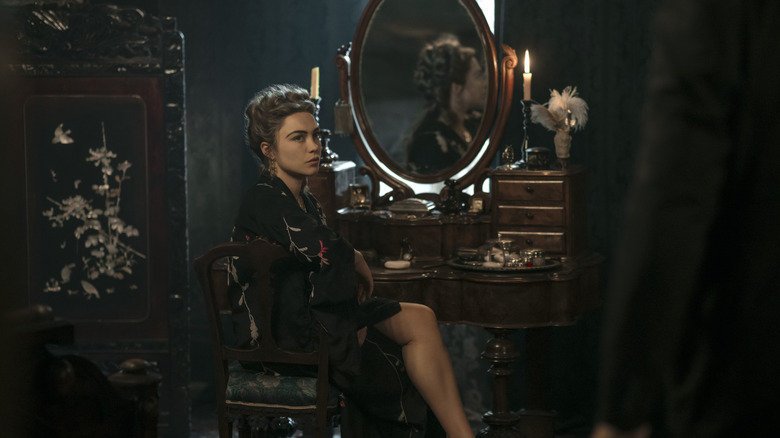
Adam Trask, who's played by Christopher Abbott in the Netflix series, is typically viewed as the main character of "East of Eden," with Cathy Ames acting as a villain who's sidelined for large sections of the novel. The Netflix miniseries, however, lets Cathy narrate the show and makes her a major presence in every single episode. "Cathy is the plot engine of this book," Zoe Kazan told Variety. "She is the troublemaker. She fascinated me from the start."
Sure enough, in both the book and the show, Adam only moves to California after he meets Cathy, and nothing about the storylines of Adam, Lee, or his two sons, Aron and Cal, would work without Cathy's decisions. Perhaps most importantly, Cathy is the book's most proactive character. Both Adam and his brother Charles are often defined by their passivity, choosing to stay in unpleasant situations out of a varying mix of inertia, guilt, and sorrow. Cathy is the only one who seeks a different life for herself and actively works to achieve it.
Book Cathy may be evil, sure, but her competence and drive make her fun to follow. It also makes her the most intriguing character in the show. "I'm so curious about her," Kazan said, "and I think Steinbeck was too — so I don't see it as being quite as revisionist as maybe some of the articles have been framing my take as."
Is the novel's version of Cathy more sympathetic than some assume?
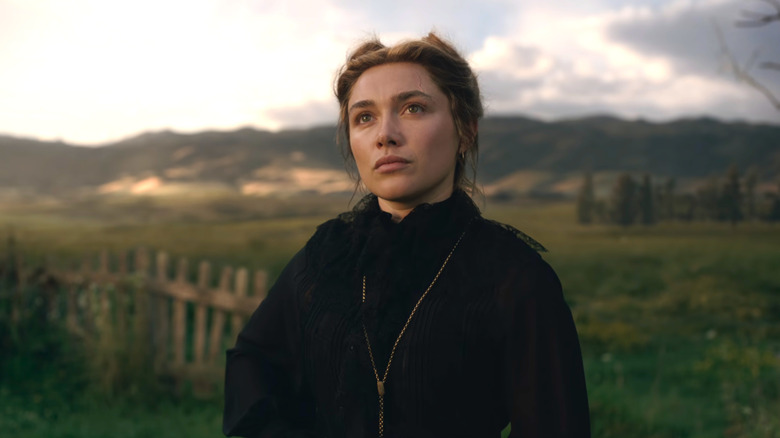
An oft-quoted line from the book is an early description of Cathy, in which the narrator describes her as a "monster" who was born "without kindness or the potential of conscience." Later lines from the book, however, return to this quote with more nuance. The narrator of "East of Eden" wonders if he oversimplified Cathy, and Zoe Kazan thinks Steinbeck wondered the same thing.
"[Steinbeck's] viewpoint of her changed as he wrote," Kazan explained. "He goes from saying, 'Oh, I'm going to write a monster unlike any you've ever seen,' to saying, 'I think we all have a little monster blood in us, and people will hate her not because she is foreign, but because she is familiar.'" It's telling that Cathy's final sequence is one where she seems to show remorse for the impact she's had on her son, Aron (played by Joe Anders); it's an emotion the book's early passage claims she isn't capable of feeling.
Kazan told Variety she thinks Steinbeck grew more empathetic towards Cathy as the book went on, but he didn't quite know "what to do" with that feeling. She explained further about Cathy's arc in the book's final act, "It felt to me a little bit underdeveloped. I was curious about: What's the more fully embodied version of what happens to Cathy? ... How do we get there?"