

Jimmi Simpson: Leading Man In The Making
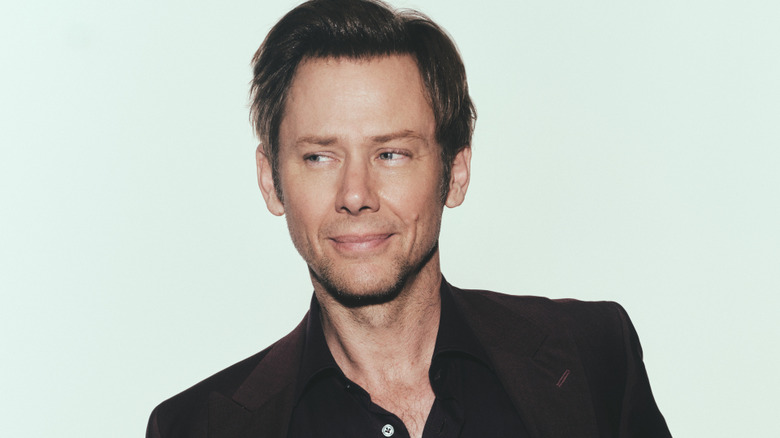
Early in his career, Jimmi Simpson was walking to an audition in a studio lot, running lines and trying to predict what producers might be looking for. He had been working small supporting roles in television, but hadn't yet landed the gig that would take him to the next level. All of a sudden he had an epiphany... in the form of Cosmo Kramer.
Michael Richards' "Seinfeld" character "just popped in my head, and I thought to myself, 'That wasn't what they were looking for. He was doing himself,'" Simpson tells TVLine. "He was bringing a lot of his own things that only he could do, and then he was hanging all the adornments of this character on top of that."
That realization has served him well to this day. Throughout his nearly three-decade career, Simpson has morphed from a quirky character actor ("Rose Red," "24," "My Name Is Earl") to a guy whose steady supporting stints made him one of the most underrated hires of his generation.
Fast-forward to today. In addition to his extensive voice-acting resume (which includes dabbling in the worlds of "Star Trek: Prodigy," "Star Wars: The Bad Batch," and "Twisted Metal," among others), Simpson's also juggling sizable roles on some of TV's biggest and boldest shows. This year, he was seen in AMC's "The Walking Dead: Dead City," where he played an eccentric survivor who thinks he can converse with zombies. He also plays a prominent role in Apple TV's underrated sci-fi spectacle "Dark Matter" (which wraps Season 2 October 30) as a neuroscientist who goes on a strange trip through alternate realities. And the multitude of hats the actor can wear at once has been turning heads in the industry.
"There's something so magnetic about his eyes and his presence," says "Westworld" co-creator and executive producer Lisa Joy. "It's easy to find the appeal and vulnerability in him. He can be incredibly comedic, and he's not worried to make a fool of himself. And he can also be a leading man, handsome and charming. He can be introspective. He can be so many different flavors. He really is a chameleon, and he has no fear about going where he needs to go and committing to that goal. I really don't think there's anything that Jimmi can't do."
From early stage beginnings to the big screen
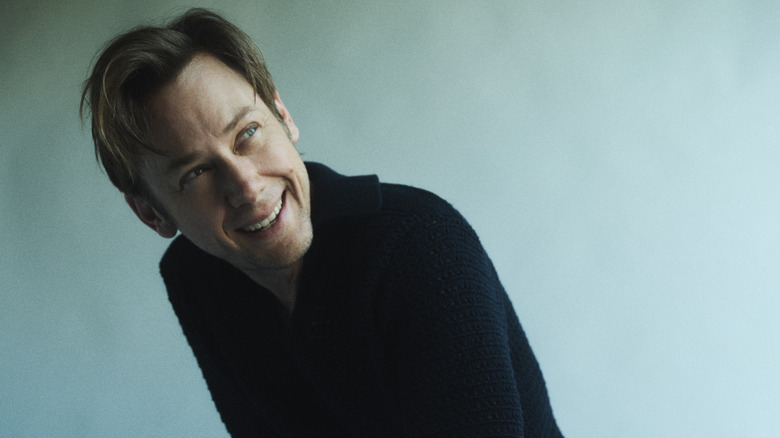
Simpson grew up in a small New Jersey town called Hackettstown. He had never crossed paths with a professional artist, nor did he think acting could ever be a way to pay his rent. That all changed when he enrolled at Bloomsburg University (now known as Commonwealth University — Bloomsburg), where his love of stories led him to pursue English. His first stage role was in a local community theater production of "Jesus Christ Superstar." He had only one line — 'Hey, cool it, man!' — but he fondly remembers the experience as "a great introduction into this community of artists working really hard together to make a thing."
After college, a professor pointed Simpson toward the Williamstown Theater Festival, held each summer in the Berkshires. "That's where I learned how to process being a theater actor," he says, recalling being in the company of New York-based actors who'd flock north for the festival. "They even gave you a class of, 'This is how you file for unemployment when you're not working,' so it was a really holistic way to take a look at this field and decide, because I had no illusions of fame. I'm not really a spotlight guy, so theater seemed to fit right."
After moving to New York City, he landed his first movie role in Amy Heckerling's 2000 film "Loser." Simpson credits the director — who cast him as Noah, Jason Biggs' "druggy guy" roommate — with giving him the shot that became his "portal" to bigger auditions.
"He had good instincts," the director tells TVLine, "and he was just such a fun character in contrast to the other people. There was a joy. It wasn't just like, 'Oh, I'm doing drugs,' or getting high. It was like he was on another level. He was just enjoying it so much, and that's just fun to see."
Throughout the film's shoot, Heckerling noticed "something supernaturally good about him."
"When you see him, he's just the person that you gravitate to," she adds. "You want to know, 'Oh, what's with this guy?' You automatically care."
Stepping into the spotlight
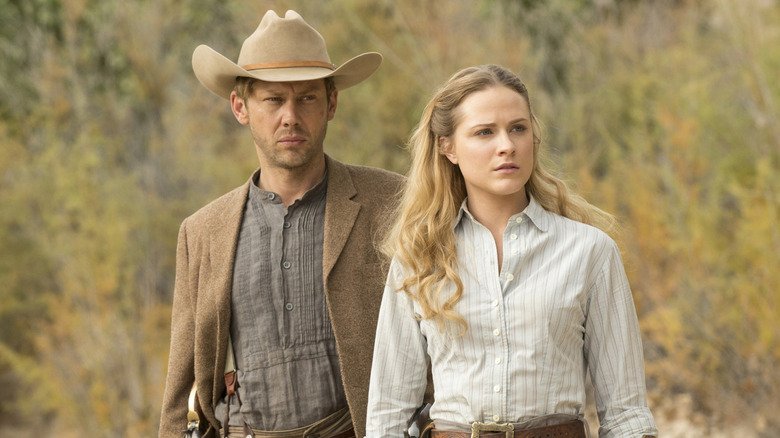
Simpson has been booked and busy ever since. He guest-starred in comedies like "It's Always Sunny in Philadelphia" and "Party Down," and flexed dramatic muscle in shows like "House" and "House of Cards." But it was the role of William in HBO's dystopian western sci-fi drama "Westworld" that changed everything.
"That was the first time that a show was really asking me to be part of the story, part of the reason why people are tuning in, and part of the narrative heart that runs through," he says.
Heading into his audition, Simpson only had a couple of scripts. He had no idea what the character's arc would be or that he'd be a love interest for Evan Rachel Wood's leading lady, Dolores Abernathy. He also didn't know that William would play such an important role in the show's big Season 1 twist either. (William is revealed to be the younger version of the series' elusive Man in Black, played by Ed Harris.)
But he did figure it out along the way. When head make-up artist Christien Tinsley asked if it was OK to change the shape of his eyebrows, Simpson's gears started turning. He deduced that the only reason they'd want to change a detail like that would be to make him look like someone else.
"I wasn't even clear on the timelines yet, so I just thought, who could I end up being? And Ed was the only one that I could imagine," he says.
After randomly running into Joy, Simpson asked her point blank: "Am I Ed?"
"Her face fell because we didn't get scripts until the day of, everything was secret, but her face balked and she said, 'Don't tell anybody,'" the actor recalls.
"I do remember that they knew something was up," says Joy. "He and Evan were always talking and coming up with theories about what twists would happen... I think Evan actually guessed it first and kept it a secret. But yes, it was a surprise to him, but he was very excited about it, and the eyebrows probably did give it away."
Exploring sci-fi helped shape Simpson's career
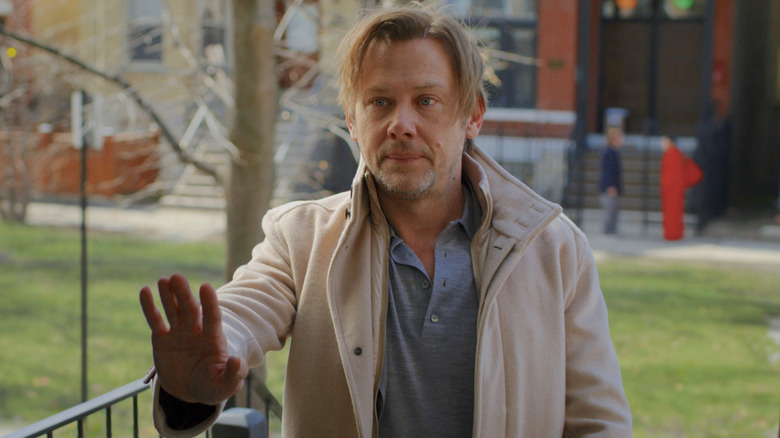
Simpson has been into sci-fi ever since he was a child; Isaac Asimov's "The Robots of Dawn" was one of his early favorites. "I'm really drawn to predictive sci-fi because a good writer like ["Black Mirror" creator] Charlie Brooker or ["Dark Matter" creator] Blake Crouch, or ["Westworld" creators] Jonah and Lisa Nolan, they're really smart and they're really into that human condition. That's what they're unpacking," he says. "I've just been fortunate enough to work with predictive sci-fi that is deeply human and deeply personal, and also deeply resonant to those who are watching."
For instance, take Simpson's "Walking Dead: Dead City" character, Mason Dillard, who is a mysterious and quirky survivor in the show's post-apocalyptic world. In the third season, it's unclear whether Dillard could actually speak to the dead or was just losing his marbles. Simpson isn't sure, but he notes that the off-putting character's hallucinations may have had a purpose: self-soothing while the world crumbles around him.
"The reality is, he does see the human echo in each one of the walkers he interacts with," Simpson says. "All of the feelings that Dillard has, and the love, it is real. Yes, a lot of it is projection, but he doesn't treat it that way, and that's why he doesn't treat the walkers like they're less-than. His projection feels real to him."
Simpson brings similar insight to his performance in "Dark Matter" where he plays Ryan Holder, a neuroscientist who is forced inside a box that transports its inhabitants to alternate realities. He eventually crosses paths with another version of himself, giving Simpson the opportunity to play two similar, yet distinct versions of the same character. It's a challenge that works, Simpson says, thanks to the sturdy writing of Crouch and Jacquelyn Ben-Zekry.
"That stuff could get pretty tricky if the writer doesn't know what they're doing," says Simpson, "I've never met a showrunner/writers who are so planted on the ground, so heart-forward. They understand what humans are and what our deepest desires are, and what our deepest fears are."
As Crouch recalls, Simpson's name came up pretty early in the casting process during the summer of 2022. The author-turned-creator had always been a Simpson fan.
"It was just an immediate connection," recalls Crouch about his first Zoom meeting with Simpson. "He's got so many interesting muscles as an actor and I thought, wow, if we can get him, what a score that would be for Ryan."
He adds: "Half the stuff he does is just a total shock and surprise to me as I'm sitting in video village, so it's a blast to watch. He's a wonderful collaborator. He's pretty fearless in terms of what he'll do. He'll do whatever it takes to bring this character to life."
Looking ahead to the future
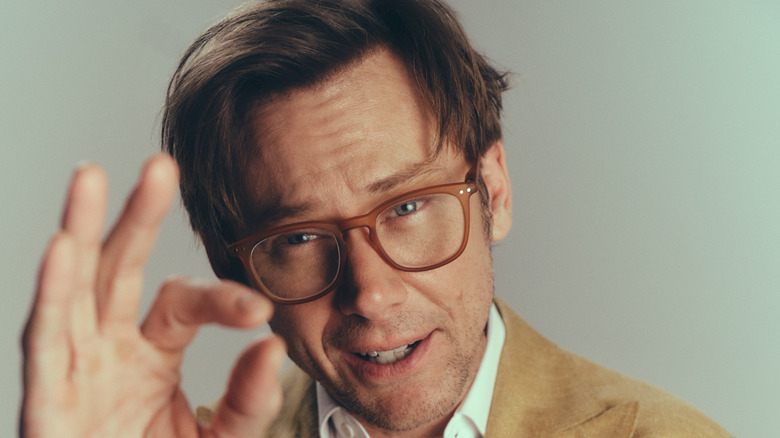
Simpson's latest project, Season 2 of Netflix's animated "Haunted Hotel," is now available to stream. The actor voices an ancient demon trapped in the body of a 1700s child. And currently, he's filming legal drama "Conviction" with "The Handsmaid's Tale" star Elizabeth Moss. The series, created by "House" vet David Shore," follows a lawyer (Moss) who takes on a big murder case, only to find herself compromised by a mysterious blackmailer who threatens to air all of her deepest secrets. Simpson calls the project "a dream come true," stating that Moss (who also executive-produces) is "so generous, so inclusive," and at "the top of her game."
From there, Simpson shows no signs of slowing down. (Dream job: Playing George in a new rendition of "Who's Afraid of Virginia Woolf?")
"I want to just keep expanding," he says. "It sounds maybe a bit trite, but I deeply, deeply believe it. I think the minute you're like, 'Yeah, I'm good,' you stop being an artist. I want to be tested more. I want to see what else I can do."