

Curb Your Enthusiasm's Seinfeld Reunion Included Some Subtle Easter Eggs
The reunion special is a tried and true tradition in TV sitcom history. The point is rarely to do something unique or groundbreaking in the form, but rather to milk a bit of goodwill and nostalgia from a longstanding fan base. And hey, there's nothing wrong with that.
The tradition has expanded into a whole reboot industrial complex in the streaming era, with shows like "Full House" and now "Malcolm in the Middle" getting second chances at life. But when "Seinfeld" co-creator Larry David put his own spin on the reunion special in 2009, he did it in a way that only "Curb Your Enthusiasm" could — and he included some Easter eggs for longtime fans of the "show about nothing."
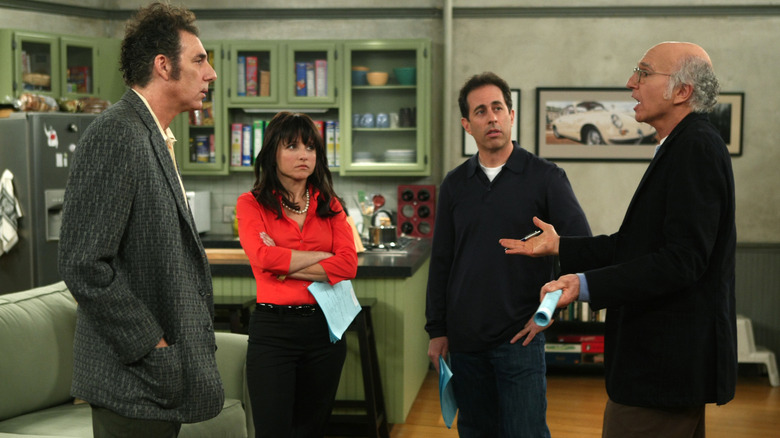
The task was not an easy one — bringing together the original cast of one of the most acclaimed sitcoms ever, but in the context of a separate comedy series with its own version of reality. "Curb Your Enthusiasm" Season 7 is a reflection of a reflection: A "Seinfeld" reunion special dragged out across several episodes, with the original actors each playing dramatized versions of themselves, as well as older versions of their "Seinfeld" characters.
Like most seasons of "Curb," it's a beautiful, carefully crafted disaster, and the amount of time spent on the "Seinfeld" reunion storyline left room for some clever references hidden across the season. The scenes of David and Jerry Seinfeld spitballing ideas for the fictional reunion special, for instance, were designed to accurately emulate their original brainstorming style, right down to the building they take place in and their desks being pressed up against one another. Those scenes also include some more subtle Easter eggs via the whiteboards full of ideas in the background — ideas that were taken from actual rejected "Seinfeld" episode storylines.
Curb Your Enthusiasm Season 7 hides unused Seinfeld storylines
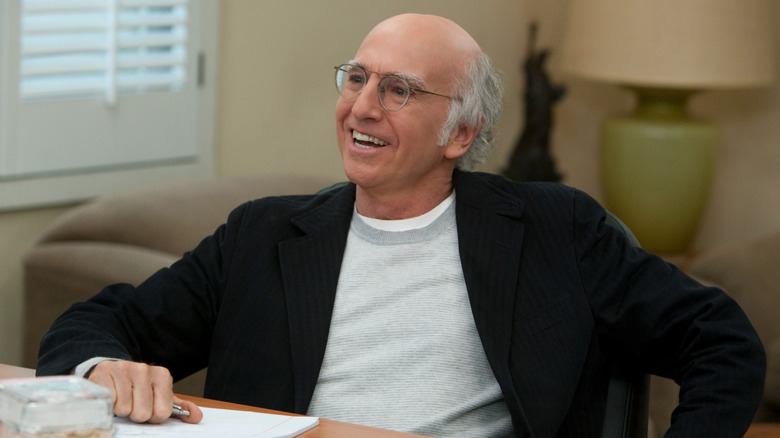
In the book "No Lessons Learned: The Making of Curb Your Enthusiasm," David and various other cast and crew members detail the process of making the long-running HBO series, including the "Seinfeld"-centric Season 7. The authenticity began with the set itself, which David had tracked down and rescued from its resting place in a San Fernando warehouse for the reunion on "Curb." The writing seasons with the fictionalized versions of David and Seinfeld presented other opportunities to wink at the original series.
"There's also a dry-erase board on the wall in those reunion scenes, and you'll see ideas written on there," executive producer Jeff Schaffer explained in the book. "Those were actual ideas that Alec [Berg] and I had pitched when we worked on 'Seinfeld' that Larry said no to, so we never used them."
This sort of deeply meta joke is one of many in the season, which turns the real-world logistics of bringing a reunion together into the actual material of the reunion special itself. "I knew that doing a conventional network-type reunion show was never going to be appropriate for us," Seinfeld said in his "No Lessons Learned" interviews. "So being on Larry's show was a perfect way to do it."
Curb was the perfect venue for a Seinfeld reunion
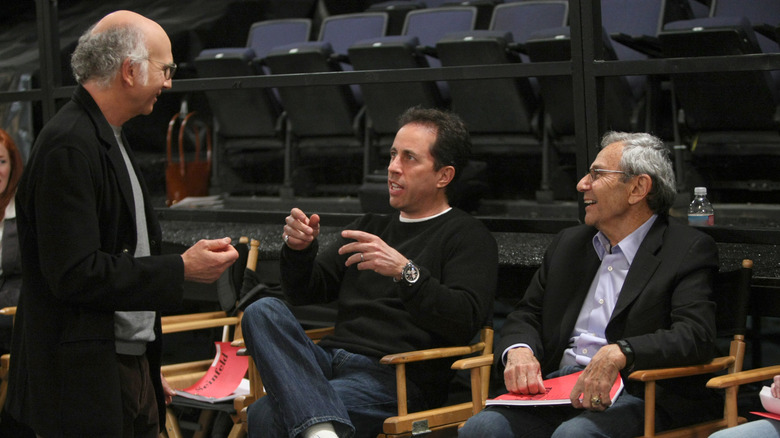
"Initially, I had concerns that a reunion show wouldn't be a good thing to do, or a fun thing to do," George Costanza actor Jason Alexander shared in "No Lessons Learned" — the same concerns his fictionalized version expresses to Larry David in "Curb Your Enthusiasm" Season 7. "But the experience was glorious; the ensemble feeling that we had, the affection that we had for each other, it was immediate. And walking back onto those exact replicas of our sets was like a time tunnel. It was just astonishing."
Though "Curb" ran for another five seasons and 15 years (with a major gap between Season 8 in 2011 and Season 9 in 2017), the "Seinfeld" season will always be particularly special. It gave fans a bit more of the show about nothing in the way only David could deliver — a calculated mess of self-satire and meta humor poking fun at the whole enterprise.