

15 TV Shows Like Lost

It's hard to overstate just what a huge deal "Lost" was after it premiered on ABC in the fall of 2004. Created by J.J. Abrams, Jeffrey Leiber, and Damon Lindelof — with Carlton Cuse joining Lindelof down the line as a co-showrunner — the series focused on the survivors of Oceanic Flight 815, which crash-landed on a mysterious and remote island during a routine flight from Sydney to Los Angeles.
A sort of hybrid of "Survivor" and "Cast Away" with some serious supernatural elements, "Lost" created a whole host of mysteries within its narrative as characters like Jack Shephard (Matthew Fox), Kate Austen (Evangeline Lilly), and James "Sawyer" Ford (Josh Holloway) tried to figure out why they were drawn to this island ... and whether or not they could ever get home.
Throughout the years since it ended in 2010, "Lost" has inspired some lackluster copycats as well as some truly great "mystery box" shows that slowly dole out answers to viewers while bringing up tons of new questions. So what should you watch if you love "Lost"? Here are 15 picks.
Yellowjackets
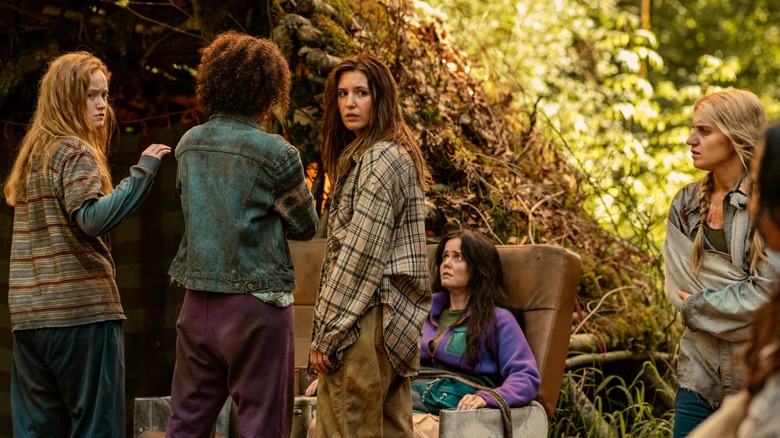
Showtime's "Yellowjackets" uses a similar conceit to "Lost" in that it kicks off with a plane crash ... but instead of a group of total strangers, we watch as a soccer team comprised of teenage girls ends up stranded in the wilderness. This adds a pleasant twist to the proceedings — because teenage girls can be particularly vicious — but we also get to see the titular adult Yellowjackets deal with the aftermath of the crash years after the fact.
The cast of "Yellowjackets" makes this series sing even when its plotlines go a little haywire. The teenage versions of the girls are played by rising stars like Sophie Nélisse, Sophie Thatcher, Jasmin Savoy Brown, Liv Hewson, and Samantha Hanratty as Shauna Shipman, Natalie "Nat" Scatorccio, Taissa Turner, Vanessa "Van" Palmer, and Misty Quigley, respectively; luminaries Melanie Lynskey, Juliette Lewis, Tawny Cypress, Lauren Ambrose, and Christina Ricci play those same characters as adults. "Yellowjackets" is twisted, sexy, and focuses on a plane crash in a remote location that might have supernatural forces, so it's pretty close to "Lost" at the end of the day.
The Good Place
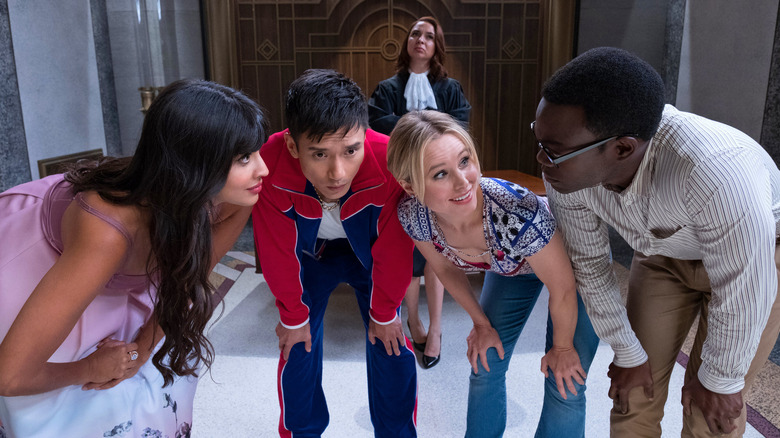
Damon Lindelof serves as a bit of connective tissue between "Lost" and Michael Schur's NBC afterlife comedy "The Good Place," because early in the process, Schur took Lindelof out for lunch to pick the "Lost" boss' brain. "I took him to lunch and said, 'We're going to play a game. Is this anything?'" Schur told Variety. "I imagine this going in the 'Lost' way." What Schur meant by that is he wanted to set up a central mystery, and he did just that.
We first meet Kristen Bell's Eleanor Shellstrop right after her death; when she wakes up in an oddly cheerful afterlife dimension, she's told by a man named Michael (Ted Danson) that she's in the "good place," the series' take on heaven. The alternate, the "bad place," doesn't sound particularly great. There's one big problem: Eleanor knows perfectly well that she's a dirtbag from Arizona who definitely doesn't belong in the "good place," and she has to figure out why she's there.
Across four seasons, "The Good Place" showed off a huge heart and a whip-smart narrative helmed by Schur, so if you think everyone in "Lost" was dead the whole time but you're looking for a comedy this time, give this one a try.
The Leftovers
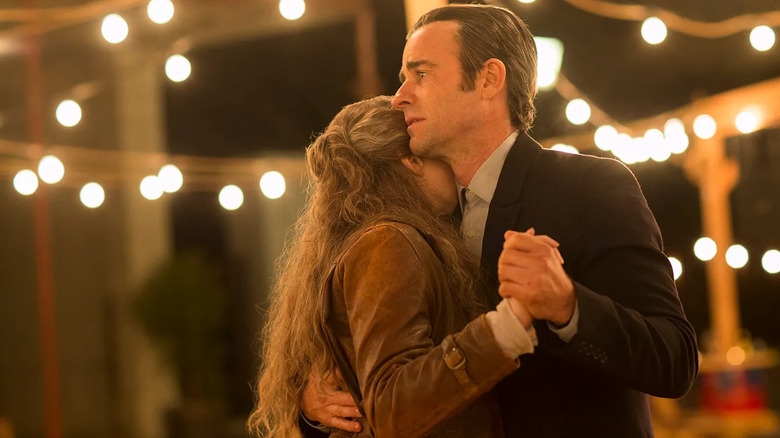
Based on Tom Perrotta's novel of the same name, "The Leftovers" was Damon Lindelof's first big solo project as a showrunner in the aftermath of "Lost," and he did not disappoint his fans. The story picks up three years after an event known only as the "Sudden Departure," in which 2% of the world's population vanished without a trace, leaving their loved ones confused, bereft, and begging for answers. As local police chief Kevin Garvey (Justin Theroux) tries to pick up the pieces in the fictional town of Mapleton, New York, we also meet Nora Durst (the great Carrie Coon), whose entire family was lost in the Sudden Departure.
The first season of "The Leftovers" sticks mainly to Perrotta's novel, Season 2 takes a detour and visits a town called Jarden in Texas where nobody was "taken" — and brings Regina King into the mix, who would eventually reunite with Lindelof for "Watchmen" and win an Emmy — and in Season 3, we watch the stories of these fascinating, troubled characters conclude beautifully. "The Leftovers" is a truly gorgeous show, and it definitely follows in the mysterious footsteps of "Lost."
Alias
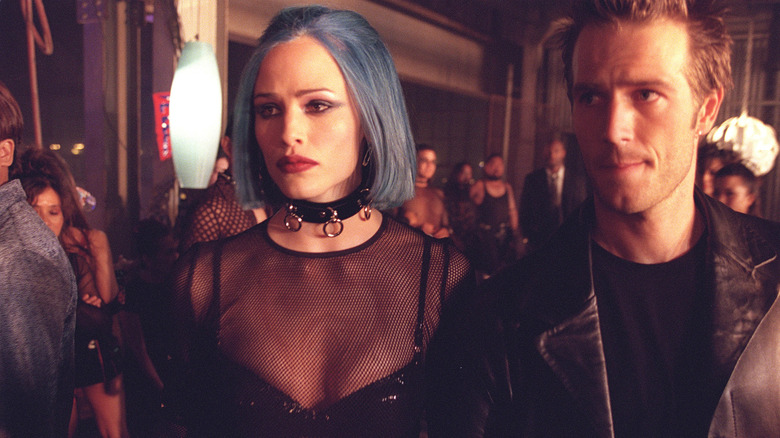
After "Felicity" and before "Lost," J.J. Abrams made a splash on ABC with "Alias," an incredibly fun and fascinating spy drama that might be the best role of Jennifer Garner's entire career. When we first meet Garner's Sydney Bristow, she's a law student who tells her friends — including Will Tippin, played by Bradley Cooper in one of his first big roles — that she works for a bank when she actually works for SD-6, a spy agency that she thinks is a secret division of the CIA.
As it turns out, SD-6 is a terrorist cell, and Sydney only learns this when she tells her fiancé the truth about her job and her boss, Arvin Sloane (Ron Rifkin), has the man killed. Sydney goes to the CIA and agrees to become a double agent, working with her handler Michael Vaughn (Michael Vartan), and it turns out there's already another double agent within SD-6: Sydney's distant father Jack Bristow (a phenomenal Victor Garber).
There is a "mystery box" element to "Alias," thanks to a multi-season arc about a possibly psychic inventor named Rambaldi, but other than that, it's just another solid show by Abrams that also happens to fall apart in its later seasons. Still, give "Alias" a shot for Garner's starring role alone.
Dark
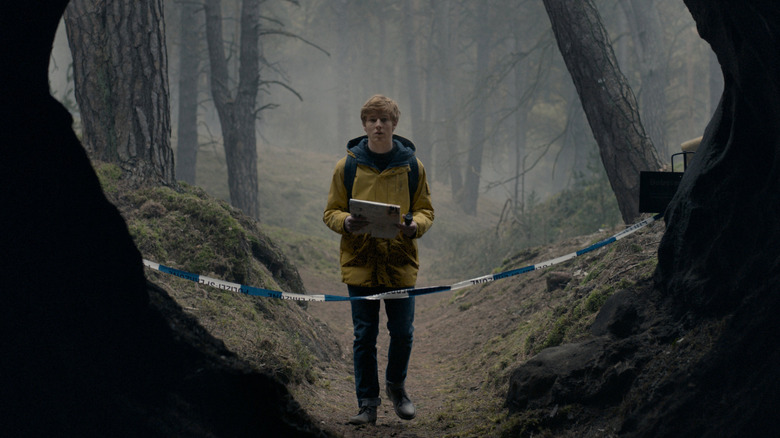
Created by Baran bo Odar and Jantje Friese, "Dark" — the first Netflix original in German — definitely feels influenced by "Lost" on several levels. In the small town of Winden, Germany, children start vanishing into thin air, and as a result, members of four of the town's families — Kahnwald, Nielsen, Doppler, and Tiedemann — are forced to grapple with long-held secrets that threaten to destroy their legacies. There's a twist, though, and it involves time travel and a wormhole tucked away in a cave underneath a local nuclear power plant.
If this sounds bizarre and complicated, it definitely is — but it's also fascinating and a ton of fun. As "Dark" moves between decades and parallel worlds and timelines — just like "Lost" did years beforehand — we keep following the Tiedemanns, Dopplers, Nielsens, and Kahnwalds as they age and de-age. There are many characters on "Dark," so it's occasionally tough to keep track, but it's worth potentially taking a few notes here and there to follow "Dark" down its winding, twisty road.
1899
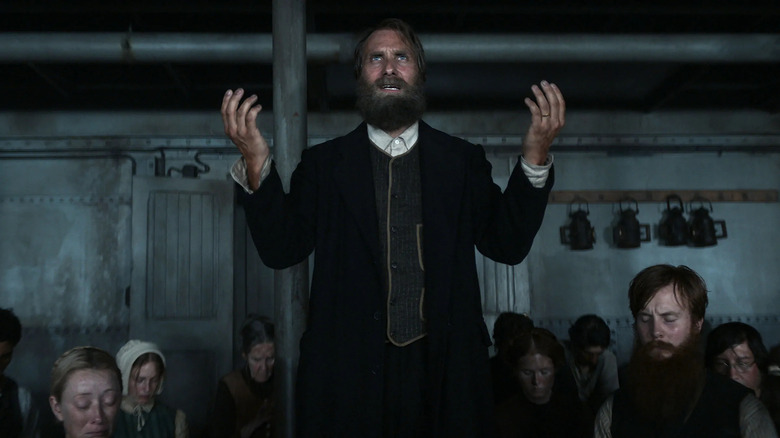
The second German-language Netflix original from Baran bo Odar and Jantje Friese, "1899" presented a brand new mystery from the duo: What happened on the Kerberos? In the titular year, immigrants from Europe board a ship sailing from Southampton in the United Kingdom to travel to New York, but there's a shadow over the journey due to the fact that the Kerberos' sister ship, the Prometheus, vanished without a trace only months before the Kerberos began its voyage. As we follow Maura Henriette Franklin (Emily Beecham), a first-class passenger and doctor, she helps a woman give birth and then starts having strange visions, leading to a larger mystery about not just the Kerberos itself, but the people on board.
Unfortunately, "1899" was canceled after just one season, leaving fans in the dark after a major cliffhanger during the finale. Still, if you're craving a quick fix after a binge-watch of "Lost," this bizarre, claustrophobic, and fascinating show will scratch that itch.
Fringe
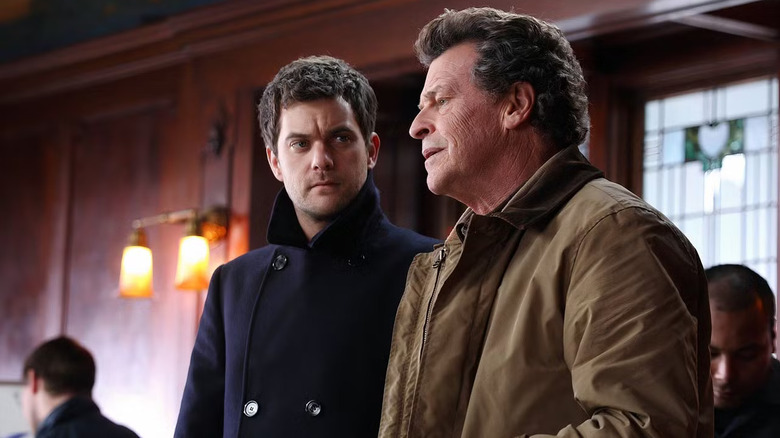
If you're trying to work your way through all of J.J. Abrams' TV shows and you've already got "Lost" and "Alias" covered, add "Fringe" to your watchlist. Led by John Noble, Joshua Jackson, Anna Torv, and the late, great Lance Reddick, "Fringe" is a great combination of supernatural shows, standard procedurals, and mystery box shows, with Noble as scientist Walter Bishop, who's brilliant but decidedly offbeat. Walter and his son Peter (Jackson) start working with government agent Olivia Dunham (Torv) in a new division of the FBI appropriately called the "Fringe Division," which investigates supernatural occurrences using fringe science.
Like "Lost," "Fringe" also relies on plotlines involving parallel timelines, but it also gets the opportunity to rely on a "case of the week" structure that "Lost" could never utilize, and when it does so in early seasons, the show is at its very best. "Fringe" is a genuinely fun series stacked with great performances from Noble, Jackson, and Torv, and it's a great pairing with "Lost" even without the Abrams connection.
From
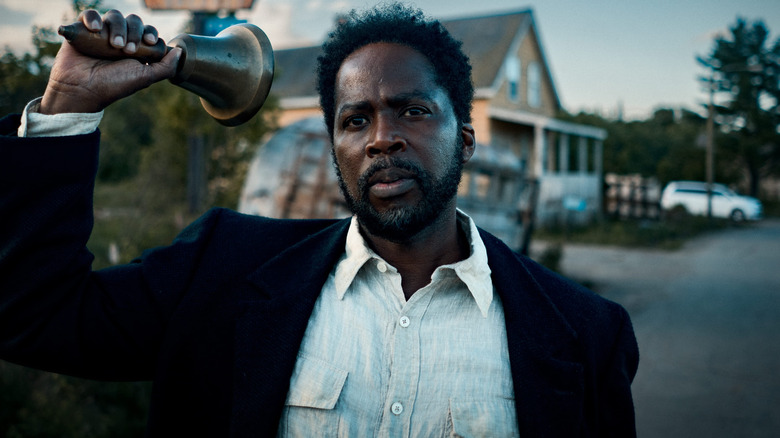
"From" and "Lost" share a star with Harold Perrineau, who plays Boyd Stevens on the former and Michael Dawson on the latter, but the two shows actually have more in common than the actor's presence. On "From," which airs on Epix-turned-MGM+, Boyd is the unelected and unofficial mayor of a mysterious location only known as the Township, which is afflicted with a strange phenomenon: Whenever someone enters the limits of the Township, they're trapped there forever. Not only that, but after the sun sets each day, horrifying creatures emerge from the darkness and attack, forcing residents of the Township to stay inside every night.
The series opens when Jim Matthews (Eion Bailey) and his family attempt to drive through the Township, only to get stuck there for good. The central mystery of "From" isn't all that similar to "Lost," but the show's spooky vibes, shadowy monsters, and collection of strangers stuck together in a deeply perilous situation definitely have big "Lost" energy.
Severance
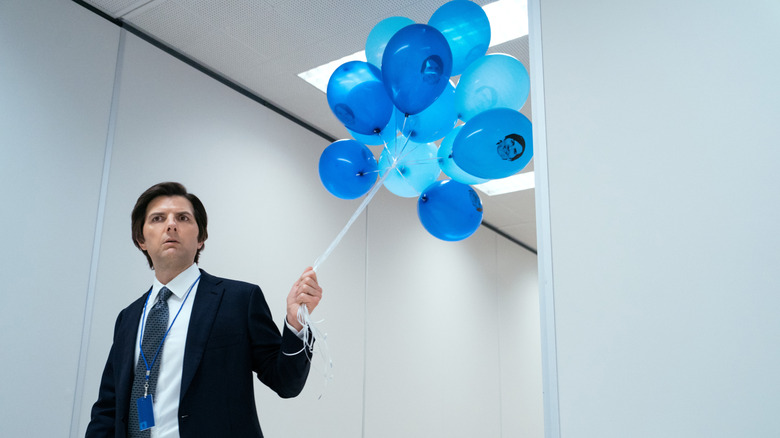
"Severance," created by Dan Erickson, is probably the show that most people think of when they think about the heir apparent to "Lost," even though, at surface level, the two shows couldn't seem more different. The show is set in a strange and seemingly futuristic world where employees of Lumon Industries can decide to "sever" themselves with a procedure on their brain: Their "Innie" goes to work at the company and their "Outie" goes home and lives a normal life, with the two personas knowing nothing about each other. Our protagonist, Mark Scout (Adam Scott), undergoes the procedure to deal with the death of his wife, becoming Mark S. when his Innie goes to work each day in Lumon's macrodata refinement division. Alongside Irving B. (John Turturro) and Dylan G. (Zach Cherry), Mark "welcomes" newly severed employee Helly R. (Britt Lower) to the severed floor, only to discover that her Innie has some serious fight in her.
Besides the overarching mysteries in "Severance" — which aren't all that different from "Lost" — the way "Severance" fans feverishly theorize about their favorite show harkens back to the days that "Lost" fans did the same thing. Do yourself a favor and check out "Severance" on Apple TV if you haven't already, and start your theory engines.
Station Eleven
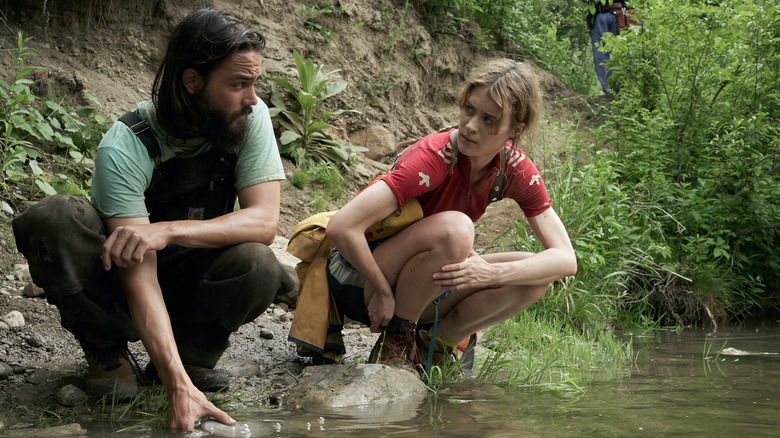
Based on the best-selling novel by Emily St. John Mandel and helmed by Patrick Somerville, the HBO Max miniseries "Station Eleven" adds a dystopian element to the basic story of "Lost," which, at its core, is about people struggling to survive and rebuild a makeshift society after a disaster. Set 20 years after a massive and deadly pandemic swept across the globe, we follow traveling Shakespearean actors that survived the pandemic as they traverse the United States and call themselves the Traveling Symphony. Throughout the series, the narrative moves backwards and forwards, showing us the grim reality of life after the pandemic as well as what happened before it — and, most disturbingly, during it.
Anchored by glorious performances from Mackenzie Davis and Himesh Patel, among others, "Station Eleven" is gripping, unsettling, and weirdly beautiful. After you watch the survivors of Oceanic Flight 815 try and get by, spend some time with the Traveling Symphony on "Station Eleven."
Silo
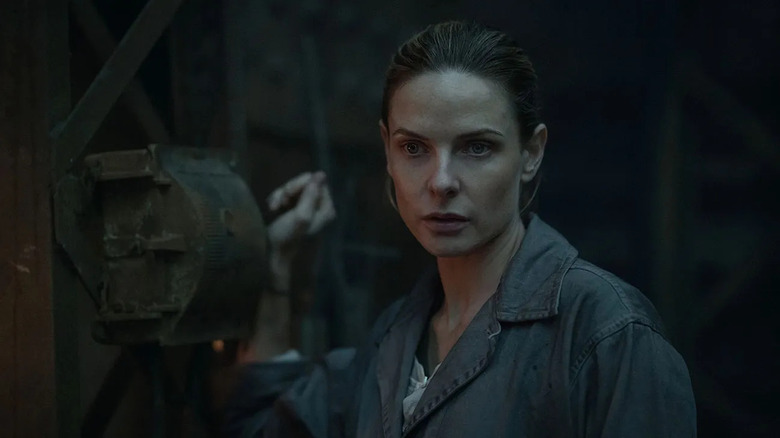
Was "Lost" somehow not claustrophobic enough for you? Try "Silo"! This Apple TV original, based on a series of books by Hugh Howey and created by Graham Yost, stars Rebecca Ferguson as Juliette Nichols, a woman who works as an engineer in a post-apocalyptic world where humans are forced to live underground in the titular silo (which, amazingly, is big enough to hold 10,000 people). While Juliette and her fellow silo-dwellers live in the deep, they're forced to abide by a series of mysterious rules meant to keep them safe, but naturally, Juliette and others start to wonder about what those rules are actually intended to do.
Imagine if the mysterious hatch from "Lost" was big enough to hold an entire society, and you've basically got "Silo" — especially because the show's big mystery centers around who created the silo, what purpose it served before the event that forced people underground, and who truly controls it. Ferguson's performance is irresistible, and she's flanked by great actors like Rashida Jones, Harriet Walter, David Oyelowo, and Tim Robbins, just to name a few. "Silo" has flown sort of under the radar, but don't let it escape your attention.
Twin Peaks
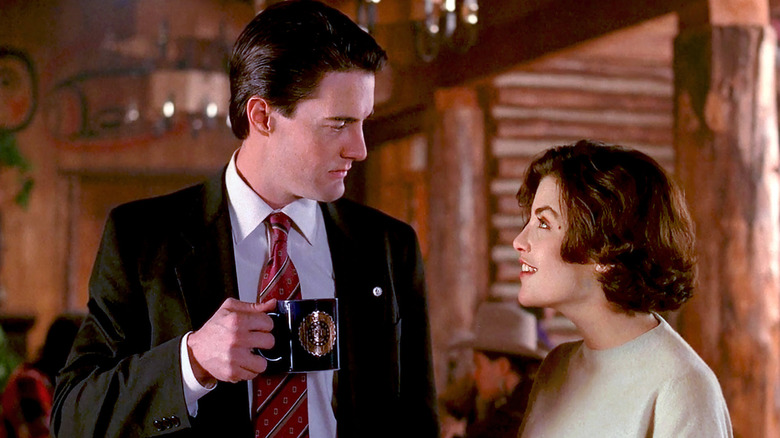
Without "Twin Peaks," we might not have audacious shows like "Lost" in the first place. On the surface, "Twin Peaks," crafted by the late genius David Lynch, is about FBI agent Dale Cooper (Kyle MacLachlan) investigating the murder of a young woman named Laura Palmer (Sheryl Lee) in the titular town, but it's really about so much more than that. In fact, Laura's death kickstarts a series of truly insane events within Twin Peaks, leaving Dale to solve even more mysteries than he bargained for.
"Twin Peaks" has lived several lives, first airing on ABC for just two seasons before returning for the 1992 prequel "Twin Peaks: Fire Walk with Me," as well as a reboot season spearheaded by Lynch in 2017 (for which MacLachlan returned). If you haven't watched "Twin Peaks" yet, it's only one of the best TV shows ever made; what are you waiting for?!
Westworld
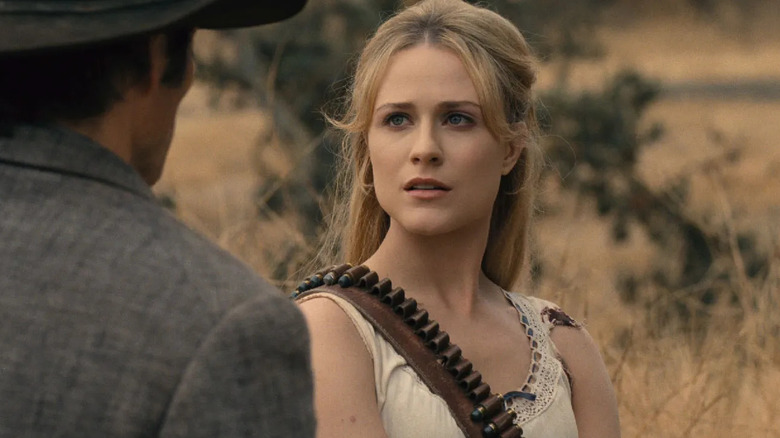
It's weirdly easy to imagine the shadowy Dharma Initiative in "Lost" constructing a theme park like the kind we see in the HBO series "Westworld." Based on the book of the same name by Michael Crichton and created by Jonathan Nolan (yes, Christopher Nolan's brother) and Lisa Joy, "Westworld" imagines a series of elaborate theme parks where guests can cosplay as cowboys or feudal Japanese lords, and gallivant around medieval settings (though the one that's most prominently featured on the show is the first one, to which the title refers).
At that park, we meet androids known as "Hosts" like Dolores Abernathy (Evan Rachel Wood), Teddy Flood (James Marsden), and Maeve Millay (Thandiwe Newton), as well as programmers and bosses like Bernard Lowe (Jeffrey Wright) and the mysterious Man in Black, portrayed by both Ed Harris and Jimmi Simpson. Thankfully, the island on "Lost" didn't turn out to be some sort of demented theme park, but if it had, it would probably be pretty similar to "Westworld." Unfortunately, the show isn't part of HBO's streaming platform anymore, but seek it out if you can.
Stranger Things
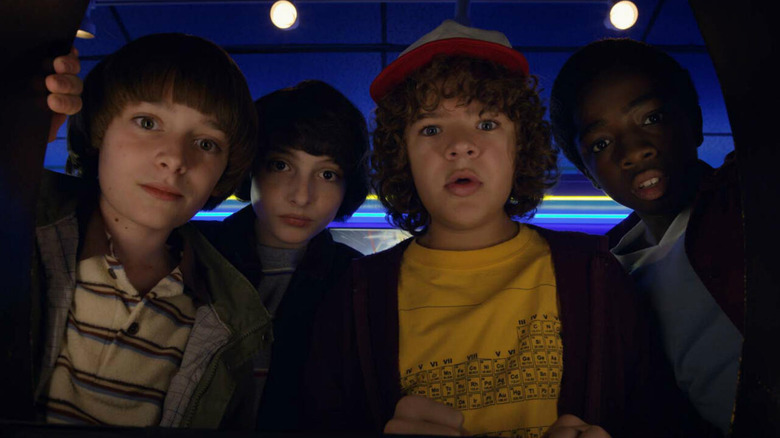
The Demogorgon situation in Netflix's hit "Stranger Things" doesn't seem like it connects to "Lost," but the show's dedication to big mysteries certainly does (and one could probably argue that the smoke monster and Demogorgon are monster cousins or something). Created by the Duffer Brothers, "Stranger Things," set in the supernaturally plagued (and thankfully fictional) town of Hawkins, Indiana, introduces viewers to a group of kids who inadvertently meet a young girl only known as Eleven (Millie Bobby Brown). She has psychokinesis... and this isn't even the weirdest thing to happen to these kids lately, due to the fact that their friend Will Byers (Noah Schnapp) just suddenly disappeared.
"Stranger Things" has, yes, a bunch of monsters, but it's also filled with secret plots and bizarre laboratories, again harkening back to the Dharma Initiative and their infamous hatch on "Lost." With a cast that includes Winona Ryder, David Harbour, Sean Astin, Joe Keery, Maya Hawke, Finn Wolfhard, and many more, "Stranger Things" will help satisfy any "Lost" fan's mystery sci-fi cravings.
Under the Dome
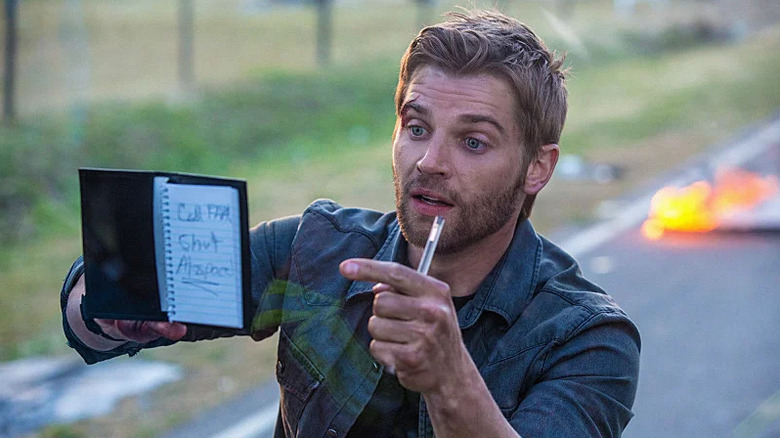
Based on Stephen King's novel of the same name and adapted for the small screen by Brian K. Vaughan, CBS' "Under the Dome" takes place in the fictional town of Chester's Mill, which is baffled and frightened — along with the rest of the world — when a massive dome springs up around the town that can't be brought down or dealt with by any means whatsoever. As both the world at large and the town try to break the dome down and figure out how and why it came into existence in the first place, the residents of Chester's Mill struggle to adapt to their new, bizarre reality.
Like "Lost," which sticks a bunch of strangers on a beach and forces them to stay trapped there and coexist, "Under the Dome" poses a question about what an entire town would do if they suddenly found themselves cut off and isolated from the rest of the globe. The show ultimately ran for three seasons and did get to conclude its twisty story, so if you want something similar to "Lost" that diverges from the deserted island trope, definitely give "Under the Dome" a shot.
As for "Lost" itself, it's available to stream on Netflix (until December 31, 2025), Disney+, and Hulu.