

One Mad Men Character's Arc Caused Behind-The-Scenes 'Fighting'
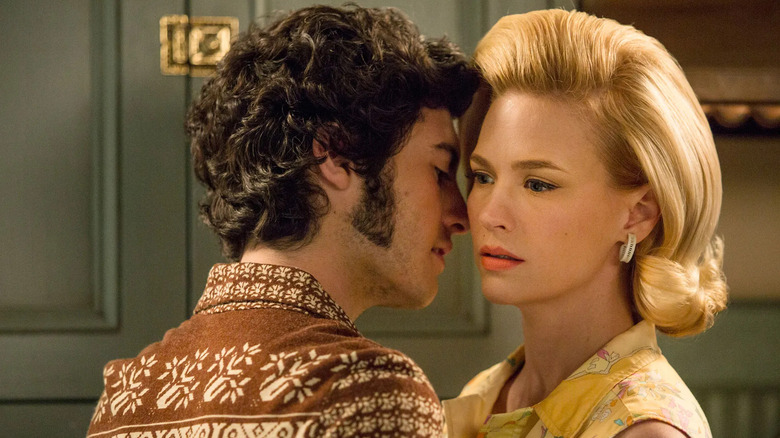
As one of AMC's first ventures into original programming, "Mad Men" was a gamble in many ways. The series had already been rejected by HBO and Showtime. Not only was it a period piece, but it featured no major stars. Its lead actor, Jon Hamm, was largely unknown at the time, as casting executives initially preferred the more popular, pre-MCU Marvel actor Thomas Jane instead. Also, as Lionsgate TV chairman Kevin Beggs recalled to The Hollywood Reporter in 2015, creator Matthew Weiner had a "very deliberate, extended" form of storytelling that was the complete opposite of the fast-paced or action-based shows that dominated television. Weiner told Beggs, "I'm going to parse the story out slowly and savor it and not overload."
He would often pause the main story for small moments that didn't necessarily drive the plot forward but revealed characters' personalities, backgrounds, and motivations with novelistic detail. The network pushed back against Weiner using this same slow-burn approach to explore Don Draper's wife, Betty. "Most of the fighting came on episode two," Weiner says, "They were really annoyed that I was paying attention to [Betty]. I wanted to branch the show out, and I felt that if Don was cheating on this woman, that was the story. They just wanted it to be a formula in the office." By juxtaposing Betty's domestic bubble with Peggy's progress and Joan's savvy, the series reveals what life looked like for women behind the white picket fence. They planted the seeds of the second-wave feminist movement that would shape the series as it moved deeper into the 1960s.
Why Betty Draper's story matters
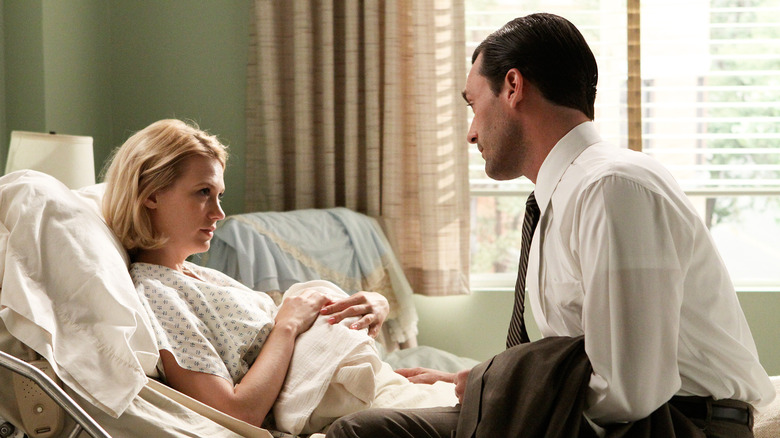
Betty's scenes are often quieter and slower, evoking the boredom and isolation many housewives faced while waiting for their husbands to return from work. Betty's storylines aren't the show going off on a tangent or grinding to a halt for no reason. She is meant to embody "The Feminine Mystique," authored by Betty Friedan in 1963 — a sociological study that examined "the problem that has no name," a sense of emptiness and unfulfillment that plagued countless housewives. Friedan argued that women were taught to believe their "highest value and their only commitment" should be home and family, carving no sense of identity for themselves outside of chores and child-rearing.
We constantly see Betty nostalgic for her past life studying at Bryn Mawr, living in Italy, and being a model. Those parts of her identity are pushed aside in favor of being a wife and mother, and it makes her unhappy. While some fans argue that later storylines about Betty's body image issues were a waste of time, we should consider her indispensable to the series because she represents the family life that Don Draper yearns for and sells to the masses.
Betty's arc reflects the huge social changes women underwent between the 1960s and 1970s, when younger generations began to have choices that Betty never did. A character like Peggy is able to prioritize her career over having children, and does not have to answer to a man for her money or independence. Betty's storylines round out "Mad Men" as not just a show about men and women in advertising, but about how an entire generation's lives were transformed by the most rapidly changing decade in modern history.