

I Love Lucy Is Responsible For One Creative Breakthrough That Changed Television
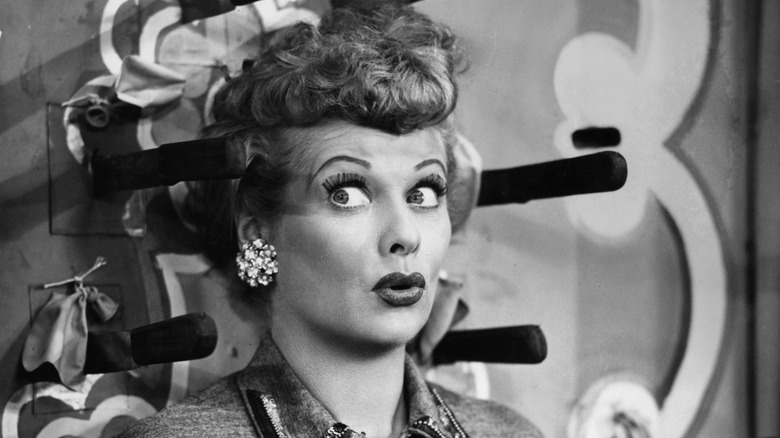
"I Love Lucy" not only established the tropes of future sitcoms — like kooky next-door neighbors causing domestic disharmony and exasperated husbands dealing with their trying wives — but also the way they were filmed.
"I Love Lucy" was the first sitcom to be filmed with three cameras in front of a live studio audience, capturing all the action from multiple angles. Using three cameras to capture the action later became the defining visual language of the sitcom, eventually known as the multicam format. This technique brought television closer to theatre, which relies so much on the chemistry of the actors and the natural, energetic flow of their performances.
The use of three cameras, taking in a wider frame, allowed the actors' slapstick antics to play out in real time, and these wider shots also meant that the audience could see actors react to one another, rather than isolating them in close-ups. As Karl Freund, the cinematographer of "I Love Lucy," put it (via PBS): "Close-ups, another routine step in standard film-making, were discarded since such glamour treatment stood out like a sore thumb."
Multicam was a technical but rewarding challenge
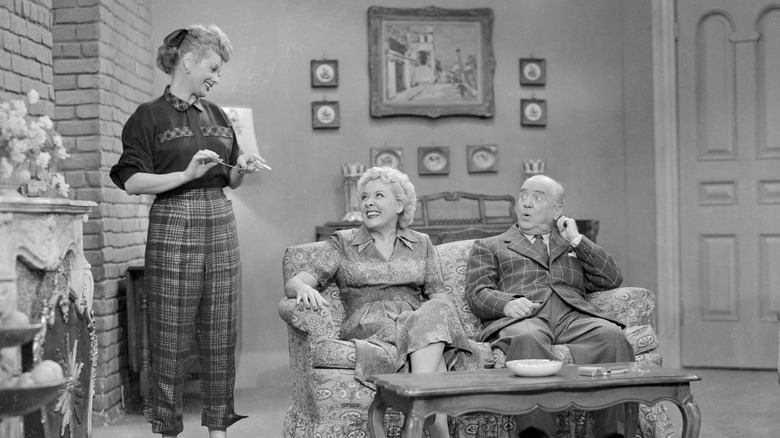
Up until "I Love Lucy" started running in 1951, sitcoms were broadcast from New York and preserved through low-quality kinescope recordings. These are described by PBS as "a method in which a film camera records the image of a television." Most kinescope recordings have since been destroyed, but from the few that remain, you can see the images were extremely fuzzy and hard to make out. "I Love Lucy," on the other hand, was shot with the crisp, cinematic clarity of 35mm film.
This style of production did have its challenges, though. For example, editor Dann Cahn would be overwhelmed by the sheer volume of footage captured from all three cameras. The footage was edited on "a Moviola with four heads — three for picture and one for sound," as Cahn once told Editors Guild Magazine (via Deadline). This giant piece of equipment — which Cahn once described as a "monster" — helped synchronize the show's innovative production process. All of this extra effort was worth it, too, because "I Love Lucy" ended up pioneering the situational comedy television genre — and it still remains one of the best sitcoms ever.
"I Love Lucy" perfected its multicam style of filming all the way up to its hasty final episode in 1957. The format remained a comedy television staple for decades afterward, structuring classics like "All in the Family," "Cheers," "Seinfeld," and "The Big Bang Theory." Lucy herself was also a trailblazing female character, and Lucille Ball's behind-the-scenes leadership, creative control, and foresight opened sitcoms up to be funnier, faster paced, and more dynamic.