

The Big Bang Theory's John Ross Bowie Says Barry Kripke Is Stuart Fails To Save The Universe's Answer To Lost In Space's Dr. Smith
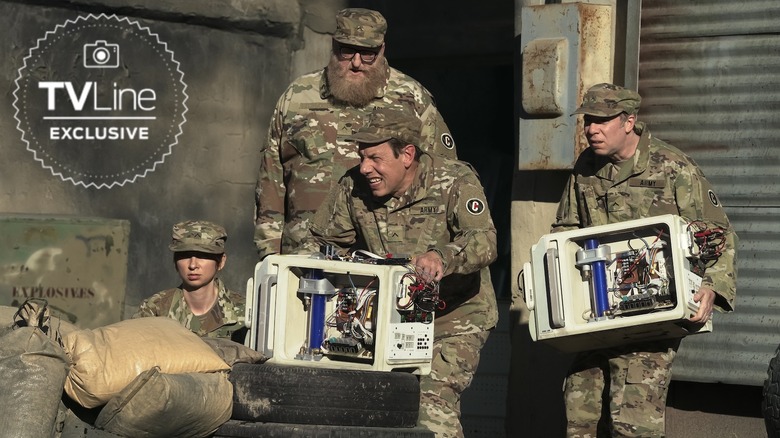
When John Ross Bowie approaches for our interview, he has just removed his blindfold. He's also dressed head to toe in Army fatigues.
The actor has just wrapped a scene that finds the central quartet from "Stuart Fails to Save the Universe" — along with another "Big Bang Theory" alum we're not yet at liberty to identify — in a potentially deadly predicament unlike anything Barry Kripke encountered during Bowie's 11 seasons as Sheldon Cooper's foil.
On this particular day, the Warner Bros. Discovery-produced HBO Max original is filming on the Universal lot. The scale of the ambitious sci-fi comedy has made it impossible to confine production to a single soundstage at Warner Bros., and just a few yards away sits the train station set from former NBC comedy "The Good Place" — a fitting backdrop for a show that delights in dropping its characters into increasingly bizarre realities.
"You can feel the joy coming off every department, you know? Wardrobe gets a brand new assignment every episode, set decoration, props...," Bowie tells TVLine. "Everyone is just so delighted at the variety the show provides. It has been really cool."
So how, exactly, do you pitch Barry Kripke on a multiverse adventure?
"I don't know what it says about me, but I caught on pretty quickly," Bowie says with a laugh. "I was just like, 'Okay, great. You're taking a bunch of tertiary characters through the multiverse. Let's do this!'"
What really interested him, however, wasn't simply the multiverse concept. It was co-creator Bill Prady's shorthand for Kripke's expanded role.
"Prady is a real showbiz history buff and so am I, and he pitched Kripke's role on the show as sort of like Dr. Smith on the old 'Lost in Space' — the in-house antagonist who is constantly around and constantly either screwing things up through incompetence or malevolence," Bowie recalls. "That really excited me because I do love the old 'Lost in Space' show, as corny as it is, so it was really fun to think, 'Hell yeah, I'm going to be Zachary Smith on this show. Cool!'"
The process of fleshing out Kripke is very much ongoing. As if on cue, Chuck Lorre wanders over and pitches Bowie an alternate line for the very scene he has just wrapped and will soon shoot again — one that reveals a more vulnerable side of Kripke without sanding off his rough edges.
"The fun thing about 10 subsequent episodes where Kripke is No. 4 on the call sheet, as opposed to being No. 8 or No. 9 on the call sheet, is that you've got to dimensionalize him in some way, or else he's just insufferable," Bowie says. "So they're fleshing him out. They're giving him a few more shades. He's still awful and inappropriate, but you sort of get a cleaner idea of why he's awful and inappropriate."
Why Barry Kripke Still Sounds Like Barry Kripke
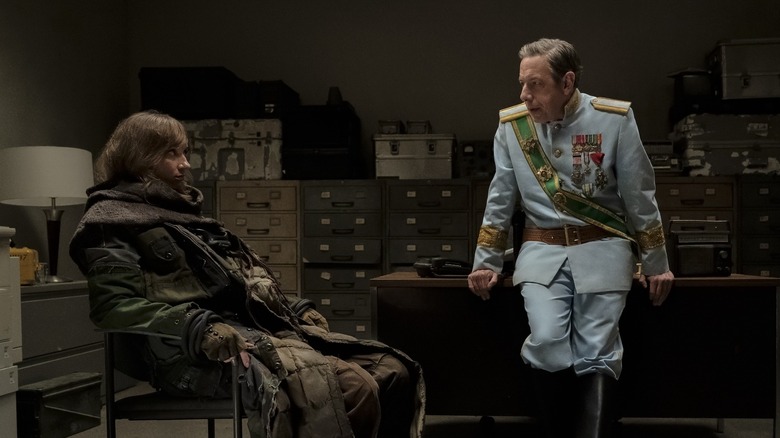
Bowie is soon called back to set. The production returns to the same scene, incorporating Lorre's alternate line, which draws hearty laughs in video village from Lorre, Prady, fellow co-creator Zak Penn, and director/executive producer Kyle Newacheck. Just as it seems they've nailed the take, Prady notices that one character, dressed as a judge advocate, is wearing an Army beret incorrectly. Cameras roll again.
Watching those repeated takes, something suddenly dawns on me. Despite all of the show's multiversal madness — the alternate realities, the explosions, the Army fatigues, the life-or-death stakes — one defining characteristic of Barry Kripke remains untouched: his speech impediment. The multiverse may reinvent "Big Bang Theory" characters in countless ways, but it never loses sight of what makes Kripke, Kripke.
"Not only does it stay the same, but we discover in an episode where everyone has telepathy that even his inner monologue has the speech impediment, which is hilarious," Bowie says. "It is a defining characteristic of the character, but I also think it's one of those things that dimensionalizes him. Because if he had a speech impediment through his childhood, then he was probably bullied a lot, and he probably put up some pretty big walls and defenses to deal with that bullying... I've always taken it as part of what makes him, him."
Spending considerably more time with Kripke this season has also given Bowie a greater appreciation for the character's place within the group.
"I think in the first episode, I have more dialogue than I had in the first four seasons of 'Big Bang,' and I'm only slightly exaggerating," he says. "The more time you spend with the guy, the more you understand what he has to offer, and there are a few moments in this first season where you realize that they do kind of need him around. He's the physicist in the group. He's able to get them into jams, but also get them out of a couple, as well. So that's been fun to play — to highlight Kripke's usefulness to the group for a change, rather than just using him as an irritant."
Asked how Kripke adapts to life as one of the show's reluctant heroes, Bowie insists the longtime antagonist hasn't changed nearly as much as viewers might expect.
"Yeah, I mean, I think he loves the attention," Bowie says. "But I think, deep down... deep, deep down, he is not actually evil. He's just very, very prickly, and very sarcastic."
"Stuart Fails to Save the Universe" premieres Thursday, July 23 at 9 p.m. on HBO Max.