

Are The Events Of Stuart Fails To Save The Universe Canon To The Big Bang Theory? The Creators' Multiverse Vision Explained
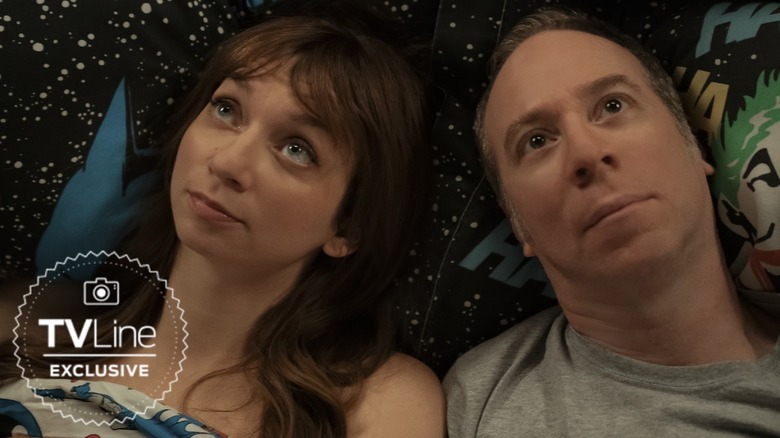
The first place audiences visit in "Stuart Fails to Save the Universe" isn't some far-flung corner of the multiverse. Instead, the HBO Max comedy opens in a familiar location — the Comic Center of Pasadena — albeit in a decidedly dystopian state.
"We start in an alternate universe, but it would be contemporaneous with a continuous timeline, so it picks up years after [the events of 'The Big Bang Theory']," co-creator Bill Prady tells TVLine. "We start in the wrong world with instructions on how to set things right. That is the mission."
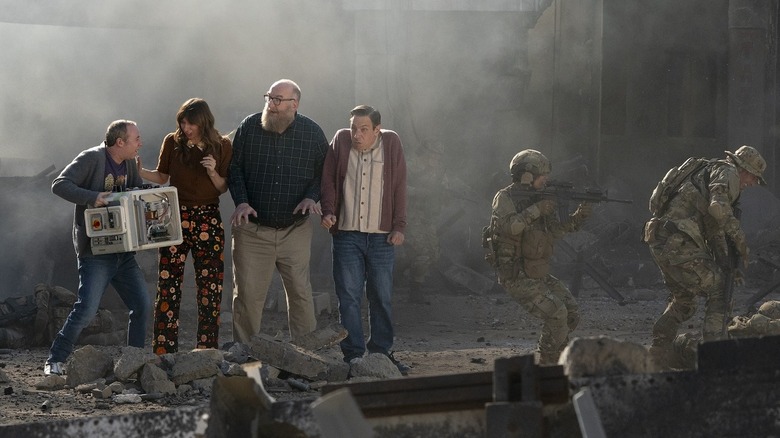
TVLine was among a select group of outlets invited to the set of "Stuart Fails to Save the Universe" last December for a closer look at the densely plotted offshoot. On the first day of our visit, production had relocated to the desert outside Santa Clarita, Calif., where cameras were rolling on Episode 8 (of 10), which finds Stuart (Kevin Sussman), Denise (Lauren Lapkus), Bert (Brian Posehn), and Barry Kripke (John Ross Bowie) suddenly transported to an active battlefield just steps from Stuart's comic book store.
"[They're] coming from another parallel universe, although this scene exists in two different episodes," Prady begins to explain. "One is from these guys' point of view, and then one's from the point of view of them later in the timeline. So this is the first version of it, and then there's a second version where a later version of them pops in and sees this version of them."
Quips co-creator Zak Penn: "We're just trying to keep it simple, you know?"
But for all its multiversal twists, the series is built on a classic storytelling principle.
"There's an Alfred Hitchcock quality to this," Prady elaborates. "Hitchcock loved putting ordinary people as the protagonists — somebody who is completely unfit for the task. Think about 'North by Northwest.' He's an ad man who winds up in this action situation. It's taking people who are absolutely the wrong people, and absolutely unprepared."
The result is unlike anything Prady and "Big Bang" co-creator Chuck Lorre have tackled before.
"This is your basic 'Doctor Who'/'Black Mirror'/'Big Bang Theory'/Hitchcock mashup," Prady deadpans. "Your basic one of those."
Stuart Fails to Save the Universe Won't Be Mistaken for The Big Bang Theory Season 13
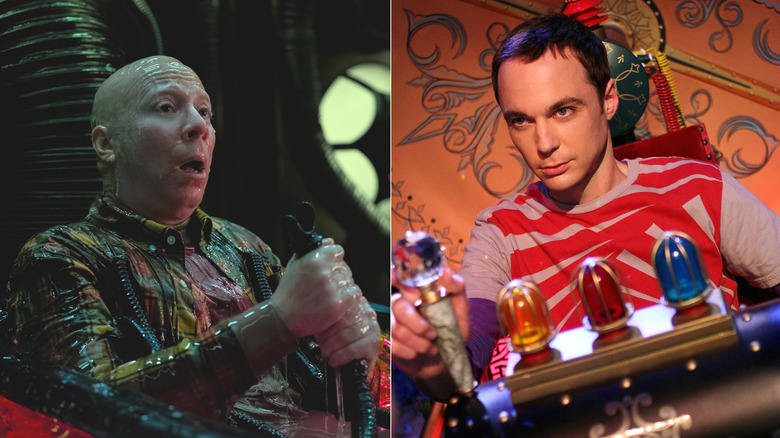
The ambitious premise, coupled with the promise of alternate-reality versions of characters audiences know and love from "The Big Bang Theory," raises an obvious question: Are the events of "Stuart Fails to Save the Universe" considered canon to the original series?
"No," Prady answers. "It's just not possible. It's not logically possible because we're meeting them in a different universe, so they have a different path" — or rather, "a point of earlier divergence.... You get updates on where they might have gone, but none of them are updates on where those characters actually are."
Prady stresses that distinction was intentional. Asked whether approaching the franchise from a multiversal angle proved more creatively satisfying than producing a hypothetical revival — or even a spin-off that retained the multi-camera format — he doesn't hesitate.
"That's where Chuck started," Prady says. "There was a great, great desire for a spin-off from the original 'Big Bang,' as opposed to 'Young Sheldon.' And I mean, I'll give that to Chuck. He just very much did not want to do 'Joey.' It's also the kind of show that the characters on 'Big Bang' would watch. That is one of the North Stars for this. It's something that Leonard and Sheldon would have liked."
The Kind of Show Leonard and Sheldon Would Watch
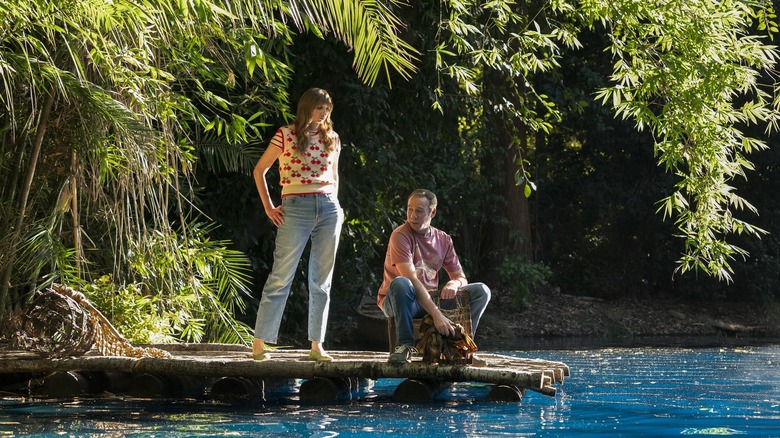
That philosophy helps explain why Lorre enlisted Penn — creator of Sheldon Cooper's beloved "Alphas," the short-lived Syfy drama whose cancellation became the subject of the memorable "Big Bang" episode "The Closure Alternative" (Season 6, Episode 21) — to help steer the franchise into unfamiliar territory.
"The first time I spoke to Chuck, he said, 'These are the characters I want to use. I'm just looking for a concept to do a sci-fi show that the characters would watch,'" Penn recalls. "That was what he pitched to me right off the bat. I mean, otherwise, there was no reason for me to be involved, you know?"
"It goes so far astray from 'The Big Bang Theory,'" Penn continues. "In terms of the tone, the characters stay the same but you're out of 'Big Bang Theory' right from the opening shot. We periodically wander right back into it, I would say. Suddenly, they're just chatting with each other for four pages. But it doesn't start that way. We give you a little bit of that in the opening scene in the comic book store, but the context is so different that no one turning it on would mistake for one second that they're watching 'The Big Bang Theory.'"
That mindset extends beyond the show's genre-bending premise.
"Part of the subtext of the whole show is that it's about shows like this," Penn continues. "It's commenting on multiverse shows. So there's a certain level of: The characters can't really follow what's going on after a while — like, it's all getting too confusing — which, hopefully, we pull back from by the end of the season. But that's a runner in the season."
The Wrong People for the Job
Asked whether the series is ultimately an ode to multiversal storytelling or a satire of it, Penn says the answer is "half and half." To that point, Prady offers another classic film reference.
"Look, this only works if the danger is real," he explains. "The characters are in genuine danger, not mock danger, so the situations all have to play real. The movie 'Airplane' works because the airplane might crash. It's legitimate danger."
Prady again cites "Doctor Who," "Star Trek," and "Quantum Leap" as key influences, while Penn reiterates the "Black Mirror" comparison, noting that many of the alternate universes the quartet visits are dystopian by design. But no matter how far "Stuart Fails to Save the Universe" drifts from its sitcom roots, the creators insist its characters never lose sight of where they came from.
"It's a comedy," Prady says. "And there are a surprising number of scenes that have the 'Big Bang' sitcom feel — where you're with the characters, and they're annoying each other...."
"That's the thing," Penn says. "The context of it is what makes it insane. They're having a conversation, but it's about developing a potion with a sorceress that can repair their time travel machine — but it sounds like a conversation from 'The Big Bang Theory.' And I think we do that a lot."
That's by design.
"The fun of it is that they continue to behave exactly as they behaved on 'Big Bang Theory,'" Prady says.
"And these are the wrong people to be in this show. That's the point," Penn reiterates. "I mean, look, you couldn't have come [to set] on a better day for an example of four people who do not belong here."
"Stuart Fails to Save the Universe" premieres Thursday, July 23 at 9 p.m. on HBO Max.