

Star Trek's Elegant In-Universe Reason For Why Most Alien Races Are Humanoid
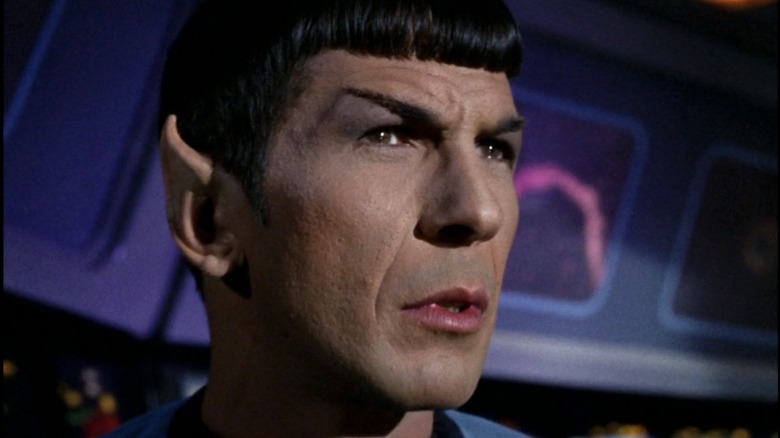
Taking place in space, "Star Trek: The Original Series" could've brought all kinds of intricate alien races into the show — but there's actually an elegant in-universe reason that most alien races in the series are humanoid in nature. Early on, the show's producer Robert Justman started to worry about concepts like having to outfit the USS Enterprise crew in bulky and expensive spacesuits so they could safely explore inhospitable planets or rigging the cast up to fly on planets with no gravity.
"From the outset, believability was as major a concern as affordability," production executive Herbert F. Solow explained in his and Justman's companion book, "Inside Star Trek: The Real Story."
Creator Gene Roddenberry first proposed an idea that would combat this in his sales pitch for the series in March 1964, two years before "Trek" would go to air and start to define the sci-fi TV genre. Roddenberry described the concept of a "Class M" planet and explained that Captain Robert April — the first Enterprise captain, holding the position before Kirk's predecessor Captain Christopher Pike — received orders instructing, "You will confine your landings and contacts to planets approximating [E]arth-Mars conditions, life, and social orders."
Using humanoid aliens kept the Star Trek writing team focused
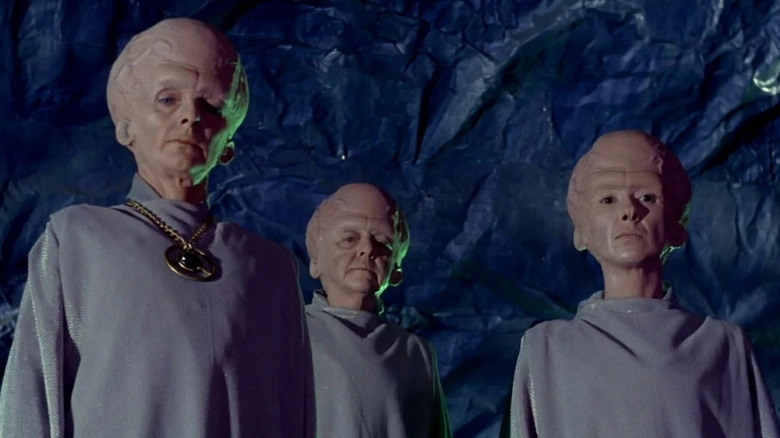
With that in mind, producer Robert Justman expanded on this idea while developing "Star Trek," both solving potential budgetary issues and providing an in-canon excuse for why the show wasn't exploring the weirder and bolder of the galaxy's alien species. Justman outlined in an April 1966 memo that Starfleet ship contact would be effectively limited to alien races that were humanoid in nature.
As quoted in his and Herbert F. Solow's book, Justman's memo read, "Our [E]arth scientists at the time of our stories have plotted out certain areas within the galaxies which they say are likely to have ... a chance of supporting life, as we know it. ... Therefore, rather than having the Enterprise and its crew happen upon civilizations which we can relate to purely as a matter of chance, we have a situation where that is their primary function."
The decision to have the USS Enterprise crew explore alien races only on planets that could sustain human life paid off from a production standpoint, but it also allowed the series to be focused in its writing and create many memorable "Star Trek" moments. Justman continued, "I think that this idea will give our format a definite direction, which will be extremely useful to us in arriving at new stories."