

Why TV Revivals Like Scrubs Are Starting Over With Season 1
When "Scrubs" returned September 30, it was for Season 2 — not Season 11.
The ABC revival reunited Zach Braff, Donald Faison, Sarah Chalke, and plenty of other familiar faces from Sacred Heart earlier this year, picking up 16 years after the original series ended. But rather than continue the original show's season numbering, ABC started fresh with Season 1.
"It was a discussion, for sure," ABC Entertainment SVP of Content Strategy and Scheduling Ari Goldman tells TVLine. Goldman, who previously worked at NBC, recalls having "similar discussions around 'Will & Grace'" when the "Must-See TV" comedy returned in 2017, nearly a dozen years after its original series finale.
Ultimately, ABC decided that starting over would make "Scrubs" more approachable to viewers discovering the show for the first time.
"I think we netted out with, we want this to be Season 1 — a new thing for people to see and jump into and not feel that they have to have the entire experience captured," Goldman explains. "Season 10 of a show, if you're, you know, a 25-year-old streaming something, 'I had to watch nine seasons to get ready for that.'"
Why TV Revivals Can't Seem to Agree on Season Numbers
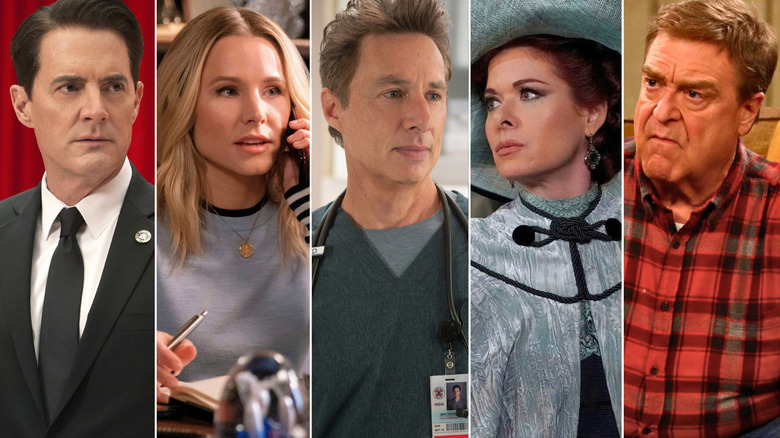
There is no industry-wide standard for how a TV revival should be numbered — and recent revivals have taken wildly different approaches.
Take "Twin Peaks," which returned in 2017, 26 years after the original ABC series ended. Showtime dubbed the revival "Twin Peaks: The Return" to distinguish it from the original series, while its DVD and Blu-ray release was branded "Twin Peaks: A Limited Event Series," rather than Season 3.
But executive producer Sabrina Sutherland said at the time that neither designation reflected how the production viewed the revival. "The title of the show is 'Twin Peaks.' It is not 'The Return,'" she told TV Obsessive, explaining that Showtime wanted "something that differentiated it from the original series in the TV guide." Sutherland herself repeatedly referred to the revival as Season 3 during a 2017 Reddit AMA.
Other revivals have been even less consistent. When ABC renewed its "Roseanne" revival in 2018, the season that never was was announced as Season 2. (The show was ultimately canceled and replaced by "The Conners.") Only later, after streaming rights were acquired by Peacock, were the revival's nine episodes, which previously streamed on Hulu as Season 1, relabeled as Season 10.
And sometimes the designation depends on where you're watching. Hulu's 2019 "Veronica Mars" revival is listed as Season 4, continuing the original series' numbering... but its DVD release branded it as Season 1 of the revival.
Even the same network hasn't always followed the same playbook. When NBC revived "Law & Order" in 2022, it simply picked up where the original run left off, with Season 21. But the network took a different approach five years earlier with its "Will & Grace" revival: The original run exists on streaming as "Will & Grace (1998)," encompassing eight seasons, while "Will & Grace (2017)" consists of Seasons 1-3 of a "new" show.
"Scrubs" has followed the "Will & Grace" model. And for networks and streamers, Goldman says, the discussion goes beyond semantics.
"We didn't want to have conflicting metadata," he explains. "The streaming platforms are a whole other beast to merchandise and personalize for people.... The people who are already watching the library, who we know are reliable and love the show, they're going to watch 'Scrubs (2026).' We know this. Will the new person watch Season 10 of 'Scrubs (2001)'? Harder to tell."
"There's no perfect answer," he acknowledges.