

Battlestar Galactica's Showrunner Loved One Scene The Sci-Fi Channel Wanted To Cut
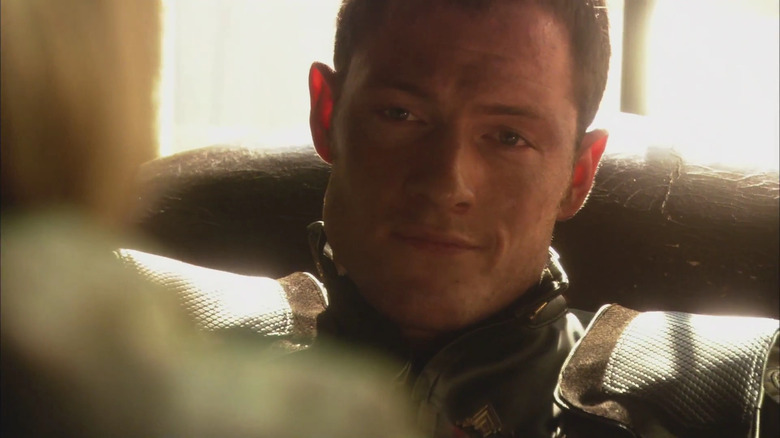
"Battlestar Galactica" is a sci-fi series that defines the genre, mixing heady, philosophical narratives with nuanced character-building. Few scenes exemplify that balance better than one in the Season 2 episode "Valley of Darkness." Starbuck (Katee Sackhoff) and Helo (Tahmoh Penikett) are on Caprica, and they stop by Starbuck's old apartment. Starbuck puts on a tape of her father playing piano — actually a Philip Glass song — and laments the fact that while everyone else is fighting to return home, she's fighting because it's all she knows.
It's a very slow scene, and it features several seconds without dialogue. Perhaps unsurprisingly, cable channel SyFy was not a fan. While appearing on Sackhoff's podcast, "Battlestar" creator Ronald D. Moore revealed that the network hated that scene "because it was slow, and they're not doing anything — shouldn't there be more action?" Their disapproval caused Moore to double down, inspiring him to make the scene even longer than intended.
Sackhoff described the scene as a great example of the "intentional" pacing of the series, which was much slower than previous projects she had worked on. Moore explained that he often had to fight to maintain this languid pace.
Battlestar Galactica highlights small, human moments
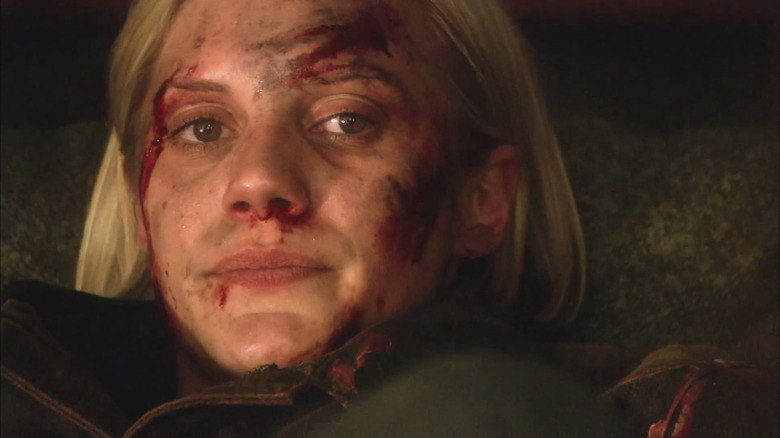
Though the original "Battlestar Galactica," created by Glen Larson, was where it all began, Ronald D. Moore's take on the series has become the defining version of the story. Moore's series grounds the tale of intergalactic war in its characters, making them feel like real people rather than larger-than-life heroes — so much so that TVLine ranked the show the best Syfy series of all time.
Speaking with Katee Sackhoff on her podcast, Moore highlighted the importance of creating space for the characters' unvarnished humanity to shine through. He referenced a scene in the 1st episode of "Battlestar Galactica," called "33," in which Laura Roslin (Mary McDonnell) and Commander Adama (Edward James Olmos) are speaking on the phone. Adama is silent for a few beats, and Roslin asks if he's still there.
Moore explained that he fought for that scene because it's the kind of natural moment that happens all the time when you're not reading from a script. "I was always looking for those little pieces that made them more people, that made them more human beings that we could relate to," he shared. Unfortunately, this was exactly the kind of thing that executives pushed back against, as they tended to look for scenes that prioritized action.