

5 Biggest Questions The Stranger Things Series Finale Never Answered

This article contains spoilers for "Stranger Things" Season 5
In a series with as many characters, storylines, and lore drops as "Stranger Things," you're bound to lose a few along the way. All told, the finale of "Stranger Things" Season 5 does a pretty good job of wrapping up the various threads, but it still leaves a few big questions unanswered.
We get happily-ever-afters of a sort for the core party, with Mike (Finn Wolfhard) becoming a writer, Lucas (Caleb McLaughlin) and Max (Sadie Sink) winding up together (no surprise there), Jonathan (Charlie Heaton) trying his hand as an aspiring filmmaker, and Joyce (Winona Ryder) and Hopper (David Harbour) getting engaged. Most of the others get similarly clean wrap-ups, while the supernatural arc ends in spectacular fashion, with the Upside Down literally being vaporized and the mysterious alternate dimension known as the Abyss losing all contact with Earth. But in its effort to give every main character some catharsis, the finale also leapfrogs over some pretty big dangling details — namely, the whole military storyline and certain aspects of the Abyss.
The other big question is the one the Duffer brothers leave unanswered intentionally — the fate of Eleven (Millie Bobby Brown). There are already plenty of theories, but for now, the truth will remain a mystery. Let's dig into some of these big lingering "Stranger Things" questions and a few possible answers.
What happens to Dr. Kay and her experiments?

"Stranger Things" has had a range of human military/government villains over the years, with Dr. Kay (Linda Hamilton) taking charge in Season 5. In the few scenes we get with her, she appears to be a brilliant, brutal, and most importantly, relentless scientist who basically wants to continue the work of Dr. Martin Brenner (Matthew Modine). That means turning the strange powers of Henry Creel (Jamie Campbell Bower) into super-people for the U.S. army, researching bioweapons based on the monsters of the abyss, and so on.
For her experiments to work, though, Kay needs Eleven, as she's the only one of Brenner's test subjects whose blood is a true match in potency for Henry's. When Eleven seemingly dies at the end of the show, Kay is left without her magical battery. But then when we jump ahead to the kids' high school graduation, there's no mention of her at all, which is kind of strange.
Yes, Eleven's absence and the death of Kali (Linnea Berthelsen) means no more super-people to steal DNA from, but Kay is still very much alive. Hopper and Nancy both kill numerous soldiers during Season 5, yet they appear to be released without issue, as is the rest of the crew. How? Why? The show prefers not to even ask those questions. In its defense, it's cramming in a lot already, but it seems like a pretty big plot point to just gloss over so quickly. Season 5 never even makes mention of the kindly Dr. Sam Owens (Paul Reiser), who helps keep the government off everyone's back in earlier seasons. A reprisal there could have helped fill in some of the gap, but instead, we have to fill it all in ourselves.
How did humans find the Abyss in the first place?
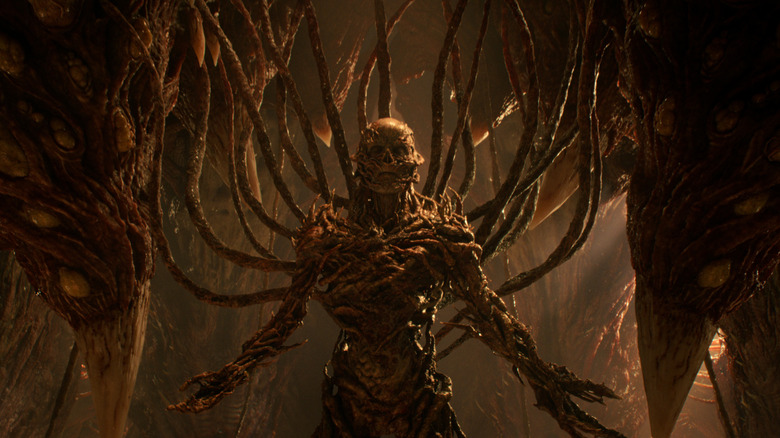
If you saw the "Stranger Things" stage play, "The First Shadow," before Season 5, you had a leg up on Henry Creel's backstory and the nature of the strange dimension Dustin (Gaten Matarazzo) dubs the Abyss. The scenes of Henry's childhood in Season 5 show him venturing into a cave as a boy to find a maddened man with a briefcase, which holds a piece of the "exotic matter" that keeps the Upside Down in place. The implication seems to be that this exotic matter carries a connection to the Mind Flayer — which drives both the man, and Henry, insane and desperate to do the monster's bidding. This isn't enough to make the "Stranger Things" finale redeem Vecna, though.
The play explains that the man found by Henry was a Soviet spy, who stole the briefcase from a lab run in part by Martin Brenner. The play also reveals that the Abyss — referred to as Dimension X by the U.S. government there — was first discovered when a World War II naval experiment to turn a ship invisible went bad, leading to the whole vessel being transported to the alien dimension.
And yet we still don't know how all this really started. Was the exotic matter used in that World War II test? Or did it come back as a result of it? If the latter, how was the navy able to open up a portal without it? And if the former, where did they first find the exotic matter to begin with? If it's just an aspect of quantum physics, then why does it carry a direct line to the Mind Flayer? None of these questions are answered in either the show or the play, but of course, a little mystery never hurt anyone.
Where do Eleven and Kali's powers really come from?

Leading up to Season 5, "Stranger Things" presented a few different overlapping explanations for Eleven's superpowers, as well as those of Kali and the other children from Brenner's program. For the first three seasons, the only explanation we had was that the MKUltra experiments conducted on pregnant women, and whatever other scientific augmentations were conducted post-birth, led to El's psychic powers. Season 4 complicated that by introducing Henry Creel and revealing that his powers were the original source for Brenner's experiments. Still, there was enough mystery that many fans assumed El's powers were a combination of the two.
Season 5 shows pretty clearly that all of the supernatural powers held by humans in "Stranger Things" come from Henry, aka Vecna. And in the finale, we see that it really all just comes from the Mind Flayer. Henry's flashback to his first encounter with the exotic matter also shows his first use of psychic power, which is clearly meant to evoke Will's psychic display at the end of Season 5, Episode 4. Will is only able to channel the powers of the hive mind, aka the Mind Flayer, and it seems that that's how Henry's powers work too.
That leaves one big question: How are Eleven and Kali able to use their own powers with no connection to the hive mind? Yes, they received blood transfusions in utero (presumably) of Henry's blood, but if even his powers came from the hive mind, and weren't truly internal, then where do their powers actually come from? For that matter, why is Eleven the only test subject who has a clean match of Henry's blood? If Dr. Kay were to capture her, would her blood even be able to produce more psychic children? Or is that all just another theory?
What does the Mind Flayer actually want, and what is the Abyss?
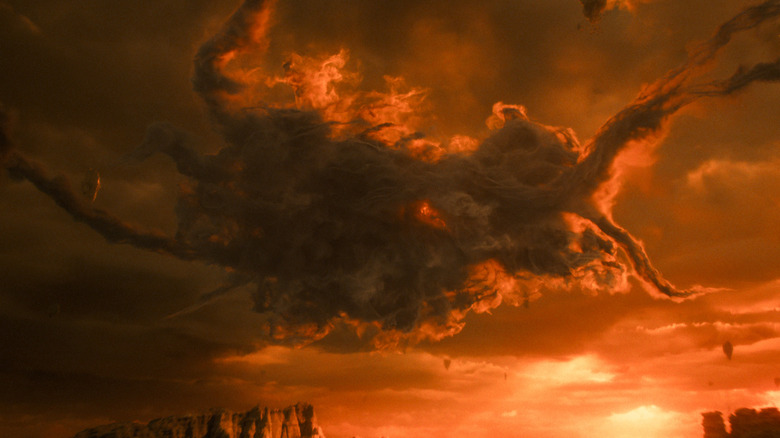
We all understand the concept of a barren alien dimension, full of lightning storms, monsters, and wasteland. It's the kind of hyper-legible sci-fi genre stuff that "Stranger Things" thrives on, so it might seem silly to give the Abyss any kind of real scrutiny. While it's best that Season 5 ends without overexplaining every single supernatural detail, there are some bigger questions that are interesting to think about.
The first involves the Mind Flayer specifically, referred to increasingly as the hive mind in Season 5. We understand this creature to be a deeply intelligent, malevolent being, but ... why? Animal instinct isn't a very compelling explanation for a monster with such advanced intelligence. This leads to the other big question — the nature of the Abyss itself. We know now that the demogorgons and other creatures from the hive mind have always been hunting humans, but we also see them eat people. Do they need to eat? Is there anything alive to consume in the Abyss beyond other creatures of the hive mind? If not, how do such massive creatures — which bleed and die — sustain themselves?
Then, of course, there's perhaps the most perturbing question: How are our human heroes able to breathe naturally in this alien dimension, when simply setting foot there ripped Henry Creel apart and transformed him into an "I am Groot" monstrosity? The show's answer to these various questions is to keep the Abyss and its denizens in a more thematic space. They represent fear and conquest. They wish to conquer our world because they are evil, and that's what evil things do.
Is Eleven really dead?

Now for the biggest question of them all: Did Eleven actually die in the collapse of the Upside Down, held in place by Dr. Kay's Kryptonite devices, or did she escape, as Mike theorizes, with help from a dying Kali? First, the arguments for death: Kali seems pretty well done-in by the time Hopper and Eleven leave her, and projecting an illusion all the way into the material world — especially while the Upside Down is exploding around her — seems like a big ask given her state. Also, even if Eleven were to sneak through unseen, the Kryptonite sonic devices are still active. Elsewhere in the season, those make it basically impossible for her to move.
On the other hand, the way she just vanishes into thin air is pretty suspect. She's clearly able to use her powers to talk to Mike though his mind, which means that while she's standing in the Upside Down, the Kryptonite hasn't affected her. She also seems pretty determined to live at different points in the finale, and you'd think she'd consider an escape plan.
The verdict? Still unclear. "For us and our writers, we didn't want to take her powers away," Ross Duffer explained in an interview with Netflix Tudum. "She represents magic in a lot of ways and the magic of childhood. For our characters to move on and for the story of Hawkins and the Upside Down to come to a close, Eleven had to go away." The Duffer brothers are mum on her actual, canonical fate, emphasizing that even if she is alive, she won't be able to contact Mike or the others again.