

Scrubs Team Talks Season 9 Erasure, J.D. And Elliot's New Normal, And Where Turk, Carla, And Dr. Cox Stand In The Revival
Whoever said you can't go home again was clearly wrong.
Sixteen years after "Scrubs" signed off, the ABC revival returns viewers to Sacred Heart — presented as the very same hospital we last saw at the end of Season 8. The med school-focused Season 9, which famously began with the original hospital torn down, is effectively wiped from canon, with the revival picking up as if Sacred Heart had never been demolished.
"This is definitely written as if the eighth season was the finale of 'Scrubs' as it was kind of supposed to be," creator Bill Lawrence tells TVLine.
"Season 9 is like a what if, or like an Elseworlds situation," adds Donald Faison, referencing DC Comics' alternate-universe imprint.
But that doesn't mean everything is exactly as we left it.
J.D., who has been working as a concierge doctor so he can spend more time with his kids — plural, suggesting that in addition to Sam (whom he shares with Elizabeth Banks' Kim), he and Elliot now have at least one child together — finds himself pulled back into Sacred Heart when one of his patients is admitted, a return that quickly becomes something more permanent. Inside those familiar halls, he's reunited with Turk and Carla, who are still going strong 25 years later and now share four daughters; Elliot, with whom he's now divorced; and longtime mentor Dr. Cox, who steps down at the end of Episode 1 and taps J.D. to succeed him as chief of medicine.
So why start here? In speaking with TVLine, Lawrence and the legacy cast explain the thinking behind J.D. and Elliot's new normal, Cox's decision to step aside, and how those shifts ripple through Sacred Heart.
Why J.D. and Elliot Aren't Together
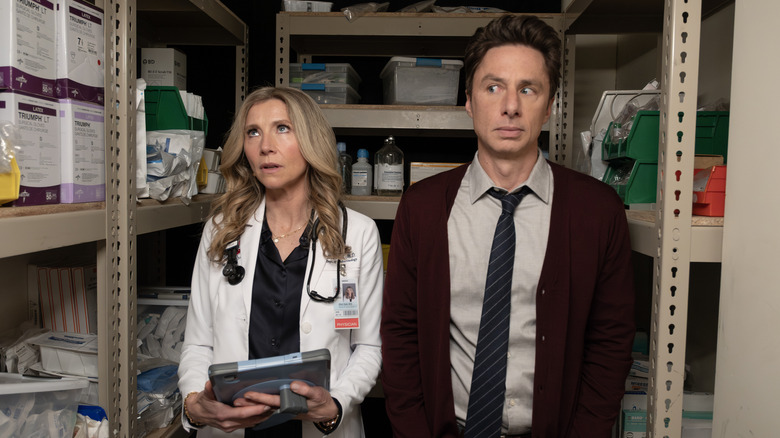
The revival wastes no time delivering its biggest shocker: J.D. and Elliot are divorced. For Bill Lawrence, the decision felt like the honest extension of where the characters left off, not the fantasy J.D. imagined in the Season 8 finale.
"You can hope all your dreams come true just this once," he says. Alas, "nothing ever turns out 100% happy. It's always more complicated than that."
Looking back at the couple's history, Lawrence adds, "I would not say if you watched the first 9,000 episodes of 'Scrubs' that you would go, 'That's a couple that's definitely rock solid.'"
Zach Braff, meanwhile, sees the split as reflective of age and experience.
"As you get to be 50, some marriages work out in the example of Carla and Turk, and some marriages don't," he says. "What J.D. sees at the end of Season 8 in that projection on the sheet is what he hopes... not necessarily what his life will be."
For Sarah Chalke, the divorce opened up story instead of closing it off.
"I thought it was a great way in when I read it," she says. "This way you get to figure out, like, how are they going to co-parent and then eventually work together again? And then when are they going to start dating? And how does that feel?"
Instead of simply bringing them back still happily together, she adds, the writers created "so much more opportunity for comedy and drama."
Why Turk and Elliot's Friendship Matters More Than Ever
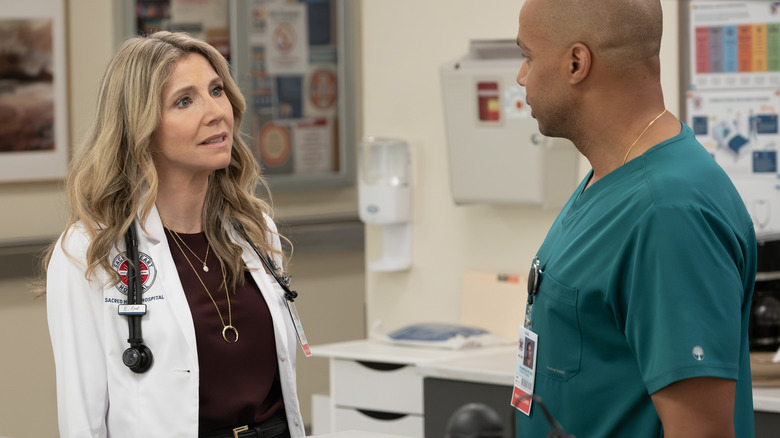
The divorce doesn't just affect J.D. and Elliot. It ripples through the friend group.
Episode 2 addresses that shift in a quiet heart-to-heart between Turk and Elliot, as she admits she misses their closeness after the split. For Donald Faison, that moment was essential.
"It would suck for the audience to see Turk riding real hard for J.D. and not giving Elliot any love," he says, noting that after the breakup, "there was still a divide," with Elliot and Carla on one side, and Turk and J.D. on the other.
"Elliot being the brave one bridged the gap," he says. "Turk needed to hear that."
Sarah Chalke, meanwhile, points out that the scene carries an added layer of nostalgia: "The very first scene Donald and I shot [in the original pilot] was right there at the pinball machine," which is seen behind them in the doctors' lounge — a subtle callback to where their dynamic began on their first day at Sacred Heart.
Why Turk Evolved Into 'Dr. Bummer'
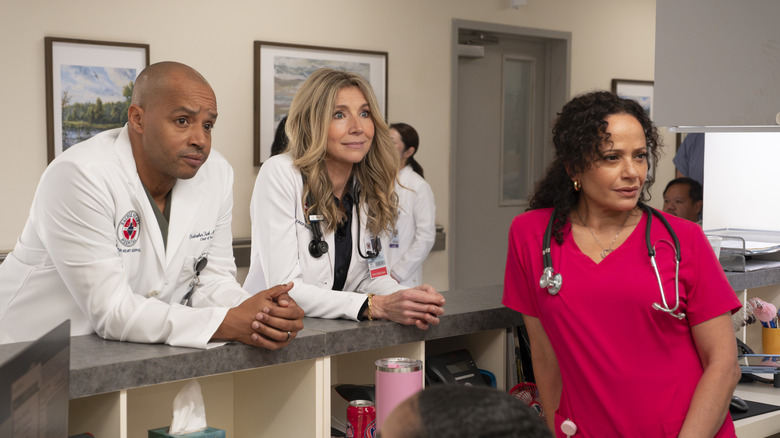
When we last spoke to Zach Braff and Bill Lawrence, J.D. was poised to be the one "beaten down by the system." Instead, the premiere pivots in another direction.
It's Turk who appears burned out — to the point that the interns have nicknamed him "Dr. Bummer." He's grappling with depression and questioning whether there's any joy left to be found at Sacred Heart. For Lawrence, that shift had personal roots.
"The story [of 'Scrubs'] was originally based on my best friend from college named John Doris," he explains. "He's still a cardiologist and heart surgeon out here, and it's going to age us both because I just said we went to college together, but he is on a lightning path towards retirement. Not to retire from working — because everybody that retires from working kind of ages 20 years in the first six weeks — but he's just been beaten up by doing this for so long."
Watching his friend navigate "the bureaucracy of medicine... the inability to help people... being part of an industry that, even though you got into it because you want to be of service, almost everybody has nothing but ill to say about it — understandably," informed the direction of the revival.
"We thought the bigger surprise was that the guy who seemed kind of Teflon was the one who had almost reached the end of his rope," Lawrence says.
And while one character ultimately "is shuffling off... out of this career," he adds that for Turk, "the thing that he was missing was the community and friendship that enabled him to get through it."
"Not to be too corny," Lawrence continues, "it literally drafts off the theme song... of not being able to get through it on your own." And with J.D. stepping into Dr. Cox's role, Turk once again has his best friend by his side.
Why Dr. Cox Steps Aside
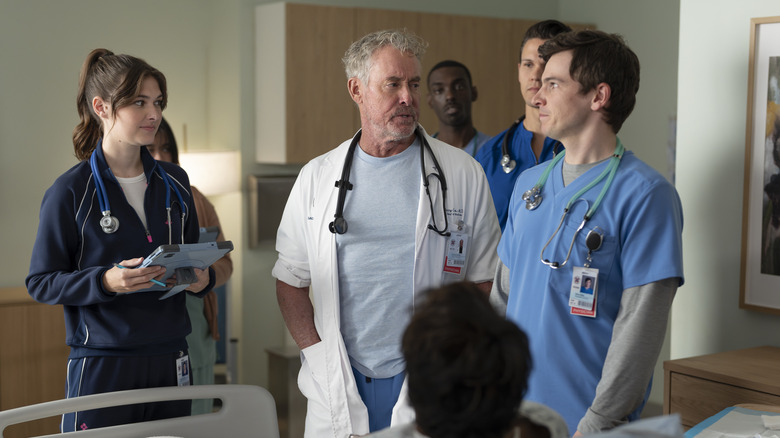
While Turk's arc explores burnout, Dr. Cox's takes it one step further: At the end of Episode 1, he steps down as chief of medicine and taps J.D. to take over.
For John C. McGinley, the decision felt grounded in a harsh reality.
"I think it was really interesting for Bill Lawrence to explore fatigue and exhaustion and burnout, which is pervasive in my demographic," he says. "I'm 66 and I see people and they're toast, man."
For a character whose identity has long been tied to Sacred Heart, choosing to walk away required, in McGinley's words, "a lot of spine." And the most emotional pivot comes just before Cox scrubs out for good, when he tells J.D. he's the right person to lead.
When asked about playing that vulnerability without the usual sarcastic armor, McGinley shrugs off the idea that it required much adjustment.
"It felt like Billy was writing to John McGinley's strengths," he says. "So there's very little acting and more just behavior and telling the truth."
For Zach Braff, the scene lands on multiple levels. When we note that this may be the closest J.D. has come to getting Dr. Cox's outright approval, he admits it still gives him goosebumps.
"The hair rose on my arm when you said it," he says. "Johnny and I have a similar relationship... he was someone I looked up to, and he was a mentor to me."
Now directing the pilot himself — and serving as an executive producer alongside Faison and Chalke — Braff couldn't ignore the parallels between what was unfolding on screen and off, with McGinley also stepping aside to let him lead the way.
"It felt very meta," he admits.
Cox's retirement doesn't mark the end of McGinley's revival run. He's set to appear in two additional episodes later this season, including one alongside his equally acerbic half, Jordan (Christa Miller). Asked whether those appearances explore Cox's adjustment to life outside the hospital, McGinley will only say that Cox has "much bigger problems" on the horizon.
How J.D. Learns to Lead
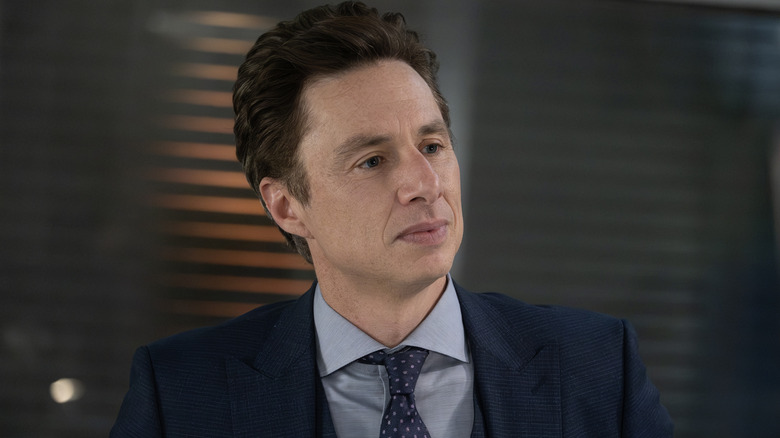
Taking over for Dr. Cox is one thing. Leading without his guidance is another entirely.
In Episode 2, J.D. looks up at a portrait of Cox that hangs beside Kelso's, as if searching for answers. But when custodial staff removes it to make room for his own, the message is clear: There's no one left to consult. The answers have to come from him.
For Bill Lawrence, that beat stemmed directly from conversations with his leading man about how much J.D. could realistically stay the same.
"It was a huge Zach Braff thing," he says. "Zach was like, 'I'm a 50-year-old man. I don't think I can wander around being the same goofy youngster.'"
After nearly a decade of playing J.D., Lawrence jokes that the character's growth once amounted to little more than "at the end I had a beard." This time, the goal was different.
"We owe it to people that got invested in these characters to go, 'Oh, he did grow up,'" Lawrence says. "He did reach a level of maturity that he can be for others what the older characters on 'Scrubs' were once for him."
But that evolution doesn't mean stripping away what made J.D., well, J.D.
"The two gifts we have are his internal monologue and fantasy life," Lawrence explains. "It might be tweaked, but it's never going to completely go away."
J.D. won't be navigating the transition alone. Braff shares the screen in every episode with longtime co-stars Donald Faison and Sarah Chalke, while Judy Reyes returns as Carla for three additional installments and John C. McGinley for two more. And yes, Neil Flynn will reprise The Janitor in one episode during this initial run.
Now we want to hear from you. Grade the "Scrubs" revival premiere via the poll below, then leave your full review in the comments.