

The Pitt's Sepideh Moafi Says Al-Hashimi Tried And Failed To Reach The 'Best Version' Of Robby — And Reveals What We Didn't See In Her Final Scene
"The Pitt" Season 2 saved one of its most revealing moments for Dr. Baran Al-Hashimi until late in its run.
From her initial freeze at the end of the premiere, to a quiet call to her neurologist midway through the season, to another freeze in Episode 13, the signs were there all along — even if Baran was determined to keep her temporal lobe seizures hidden. When she turned to Dr. Robby for a second opinion in the finale, it marked a rare moment of vulnerability from a doctor hoping to connect with the more human side of her colleague.
For Sepideh Moafi, that push and pull between what Baran shows and what she conceals was central to every scene.
"I'm always fascinated by what is public and what is private," Moafi tells TVLine. "What do you share with your colleagues? How do you present yourself at work? I think there is a very clear divide with Baran... She's become very good at hiding, but she's not irresponsible. She really does prioritize her work, and would never want anything to come in the way of that."
In the video Q&A above — a transcript is provided below — Moafi breaks down Al-Hashimi's first shift at PTMC, from her complicated dynamic with Dr. Robby to that devastating final scene in the parking lot... and a key moment that didn't make it to air.
When Baran's Condition Was Revealed to Moafi
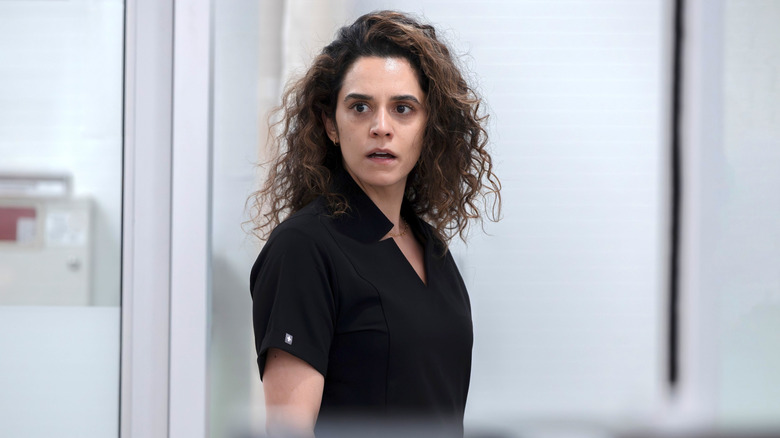
TVLINE | When we spoke at the junket, the elephant in the room was that something was clearly off with Baran, but you had to be really careful about how you talked around it. At what point were you actually let in on what was going on with her?
So it was actually during the audition process. At the final step, there was a chemistry read with Noah and an in-person test. They brought me from New York to L.A., and at every step of the process, they added a scene. I had the initial audition, which was a self-tape, then a callback over Zoom, and they added another scene. And then in the final step, they added another scene, which was basically a very casual, expositional scene about her condition — just her talking to Dr. Robby very casually.
Obviously, it didn't play out like that, but I did see this idea — that this might be something they're working with. When I was cast and I read the first episode and I saw the freeze, I thought, "OK, this is definitely what they're working with." Then I sent an email to [series creator R.] Scott [Gemmill] and confirmed with him that it was indeed what was happening. From then on, I knew. I didn't know exactly how the climax would show up, but I knew there would be a reveal at some point, and I kind of had to work my way backwards from there.
It was already so clear to me who this woman was and what she was working against without the condition. But I think that this condition, her temporal lobe seizures, definitely amplify everything — her experience, and the drama.
Baran's Public vs. Private Self
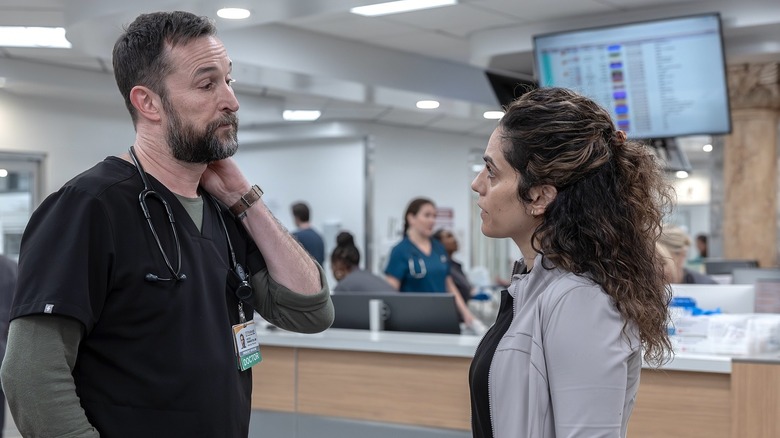
TVLINE | Knowing what she's carrying doesn't mean it's top of mind in every scene — but it is always there. How much were you thinking about that split between what's going on inside her and how she's presenting herself on the outside, especially depending on who she's with?
I'm always fascinated by us as human beings, and therefore as characters — what is public, what is private. What do you share with your best friend? What do you share with your mom? What do you share with your colleagues? How do you present yourself at work?
I think there is a very clear divide with Baran. We haven't seen her in her personal life, necessarily. We've seen her briefly mention her son and the color that that brings out in her. We saw her in that scene when she calls her neurologist — that's as private as we've gotten with her. And then in the last episode, we see different colors with Dr. Robby that feel earned.
But I think with anybody, we all hold trauma in our bodies, in our minds. Whether you were bullied as a child or displaced from your homeland or whatever it is, we carry this in our life. It shapes the way that we see the world. It shapes the way we relate to the world and people.
And so I think with Baran, this manifests in a medical condition that she had very early on, when she was five. And it's a foundational part of who she is and how she exists in the world, and the resistance that the world has shown her, and the obstacles and the hurdles that she's had to overcome as a result. She's become very good at hiding, but she's not irresponsible. So she really does prioritize her work, and serving and caring for patients, and would never want anything to come in the way of that.
It's something that she has learned how to manage her entire life. She has a very clear, very ambitious medical track, and has worked in a variety of fields — from research and clinical informatics, to working with Doctors Without Borders, to working at the VA — and now, Pittsburgh Trauma Medical Center. So she has learned how to manage it, and how to hide it from the colleagues that, if they knew, they might try to jeopardize her position. But she has always been forthcoming and honest about it with the people that matter, like her medical team and her neurologist, who have always been advising her. So it's a delicate balance that she's had to live with her whole life.
The fact that she has overcome these obstacles is so impressive — that she is the woman that she is, in the position that she has, despite all of this. Or really because of all of this. Because I would argue that it has made her an even more generous, more caring, more brilliant doctor as somebody who has lived on both sides, as the doctor and the patient, and as someone who lives in such close proximity to her mortality. It changes everything.
How Baran's Condition Fuels Her Need for Structure
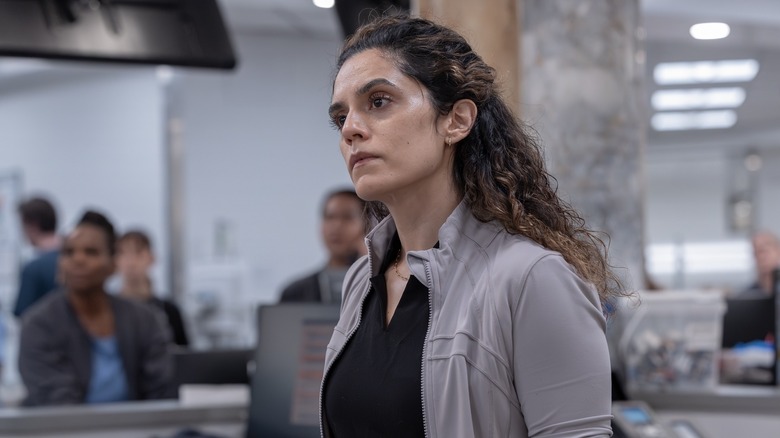
TVLINE | Baran is systems-driven, methodical, very precise — someone who's almost wired for order. Watching her made me think about that instinct to impose structure. I dealt with dissociative seizures when I was younger, and that really resonated with me. Do you see her need for control as tied to living with something in her body she can't control?
Absolutely. They are inextricably linked. There's no way that you can separate this desire for control and structure and order from her approach, and also her experience.
Working in places where entire areas, entire cities or countries are seemingly one continuous emergency room, and seeing the scarcity of resources and help, of course informs how she approaches her work — wanting to organize and use all of her knowledge and all of her experience and every tool she's got to improve the system. It's not like she doesn't know it's a mess, but she's trying to do everything that she can in order to help improve it even a little bit. But yes, of course, that is directly linked. Her temperament is tied to this condition.
Baran Reaches Out (And Is Let Down)
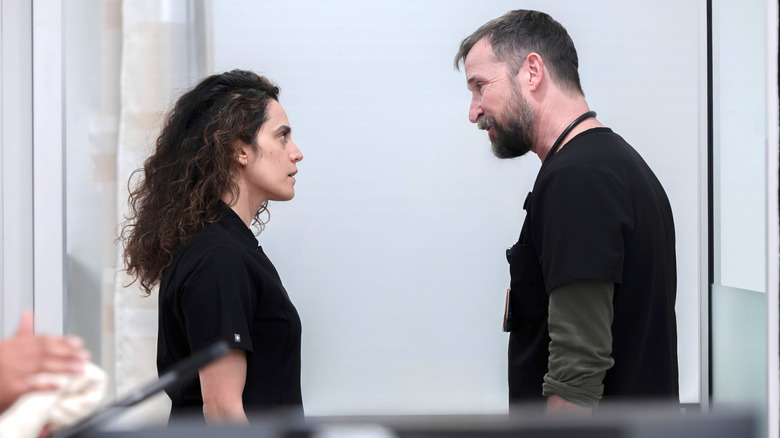
TVLINE | Robby doesn't call Baran by her first name, despite her request in Episode 1, until he's brought in for a second opinion in Episode 14, and realizes she's the patient. What do you think it means to her to hear him say her first name aloud in that moment?
I think there are a few reasons why she goes to him in that moment. One of them is after that second seizure — at that point, it's dire, it's pretty urgent. She's desperately trying to reach her team, her neurologist, and she can't. So that's one of the reasons why she goes to Dr. Robby.
I think another reason is that no matter what she does — and no matter how hard she tries, and how many angles she approaches their dynamics — she seems to fail and not be able to connect with him, and get his respect and trust. Time and time again, she has proven herself to be really good at what she does, and still that doesn't seem to resonate with him.
I think in this moment, she's appealing. She sees his wounds. And so she's bringing forth her wound and appealing to his wound to see if they can connect and relate as human beings who carry an enormous amount of trauma and pain.
She can't connect with the doctor, so she's trying to connect with the patient.
TVLINE | By the end of the day, I think it's fair to say she knows Robby well enough to anticipate that he's going to take issue with her concealing her ailment from the administration. Do you think she was subconsciously counting on him to force the issue?
No. I think she went to him as a human being. And when he says "Baran," she thinks she's getting the human in him.
But she has been met with, yet again, these impossible obstacles and hurdles that she's had to deal with throughout her life. In proving that she's capable, that she's accountable, that she's responsible, she has shown how utterly competent she is, and yet he still dismisses her.
It's not like she's going against any rules. He can't take away her medical license, but he could argue that she's a direct threat, and that's at his discretion. So for him choosing that path feels pointed, it feels cruel. And she just hoped for the better version of him, because she thought that she was dealing with a tough exterior, but she could feel the pain and the warmth and the love. I don't think she expected for him to threaten her in the way that he does.
Baran's Final Scene (And the Moment That Didn't Make It In)
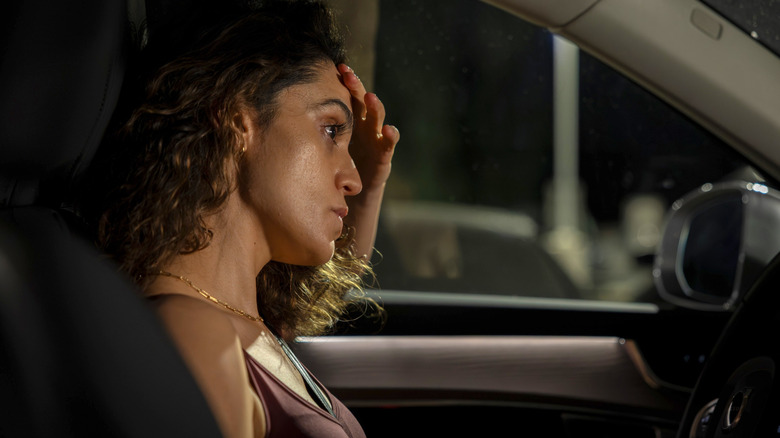
TVLINE | This isn't a show that typically follows its doctors out of the ED, but we end the season with Baran in her car, crying. What did you make of that beat, and what do you think it means moving forward?
The way it was originally written was she gets in her car, she's about to turn it on, she doesn't, and she calls her ex-husband and asks him to watch their kid overnight. What ended up happening was [executive producer] John [Wells] added this piece where she gets in the car, contemplates driving, then drives and stops the car, calls her ex, can't really hold it together, and then hangs up.
I think it's still effective in saying that in an act of defiance, she goes to her car and says, "f–k you, f–k it all. I know what I'm capable of, I can drive," which is out of character for her. She's somebody who is responsible and accountable, and has been managing this her whole life. So for her to do that means she's living in her eight-year-old self that's raging against the world and says, "It's not fair, I can do this." And then she has this vision of picking her son up and something happening, and that's what stops the car. And that's what makes her completely unravel — the idea that she's been doing everything, she's worked so hard in her life to have the family and the success in her work, and be in this position where she can potentially affect change, and to have that all taken away is completely devastating.
I think it's a beautiful moment and a beautiful exploration. In my life, I live by this idea of when something bad happens, you let it spoil your dinner, but not your breakfast. I think this is something really existential for her, so it spoils her week. And then she comes back like a phoenix, even stronger.
TVLINE | Noah and Scott both told me that Baran will be back on shift next season, and that Robby will return after some time away and start to confront his demons. How do you anticipate their dynamic shifting now that they've laid their cards on the table?
I don't know how deep we'll go into it. I just know that for her, he has punctured a deep wound in her with trust and revealing part of herself. Part of the reason why she revealed herself to him was to get closer to him, and for him to betray her in that way — you don't bounce back from that quickly.
But she's a pro, and it's not about her feelings. Even though he's making it about his feelings, she's a total professional and prioritizes the needs of the hospital first. And so I imagine that she would go back to work and do everything she can to be even better than she was before while managing her condition responsibly.