

The Pitt: The Significance Of Dr. Robby's Tattoos, Explained
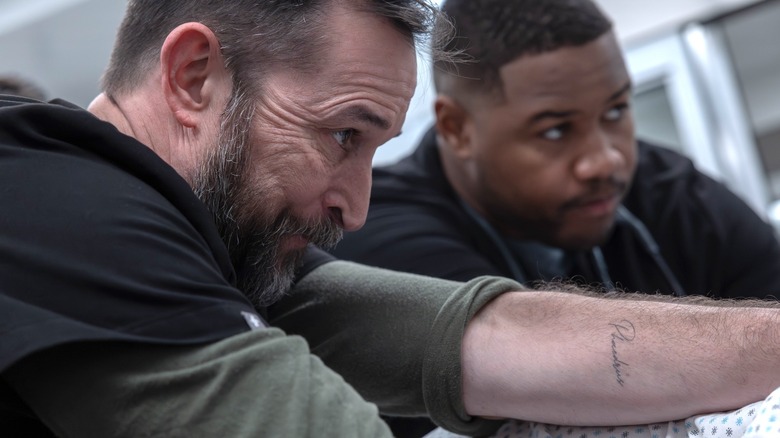
"Little character secret: My character's got two tattoos that you probably will never see."
It was during a January 2025 appearance on "WTF With Marc Maron" that "The Pitt" star Noah Wyle first disclosed a lesser-known detail about his tortured alter ego, Pittsburgh Trauma Medical Center emergency department chief Dr. Michael "Robby" Robinavitch.
"One of them is 'memento mori,' and the other one is 'amor fati,'" he shared. "Remember that you're gonna die, and love your fate."
At the time, it felt like an intriguing bit of character color. But as "The Pitt" has evolved, those tattoos have come to feel more like a roadmap to understanding Dr. Robby.
In a recent interview with Vulture, Wyle revealed that when Robby crosses his arms, he's covering those words with his hands — and by Season 2, he'd added a third tattoo on his left forearm: "Phaedrus."
The meaning behind 'Phaedrus'
The name "Phaedrus" is a direct reference to "Zen and the Art of Motorcycle Maintenance: An Inquiry Into Values" — and it wasn't a random pull. During a June 2025 appearance on "The Checkup With Dr. Mike" podcast, Noah Wyle revealed that he had revisited Robert M. Pirsig's seminal 1974 novel "for somewhat creative reasons having to do with Season 2 and Robby."
In fact, he'd been seeding that connection from the start. In Season 1, Wyle asked the prop department to place a copy of the book in Robby's backpack... but with a very specific note.
"I love the detail work — and last year, when Robby is walking to work with that backpack, I asked the prop department to fill that backpack with a lot of very specific items, one of which was a copy of 'Zen and the Art of Motorcycle Maintenance.' But I only wanted it dog-eared on Page 17 because he'd just begun reading it," he told TVLine in January. "Now, 10 months later, not only has he read it, but it has become a major influence, and he's gone so far as to purchase the same bike and fix it up and plan this utopian voyage — of self-discovery, distance and solitude — that's a little bit analogous to the journey that the character is taking in the book.
"It's a journey that has no fixed destination, but the journey itself is the point of the journey," Wyle added. "You're hoping to get the answers to the questions that are chasing you en route, and that feels very thematic to Robby."
Despite its title, "Zen and the Art of Motorcycle Maintenance" isn't really about mechanics. It follows a father and son on a cross-country ride that evolves into a deeply personal and philosophical odyssey — one that ultimately forces its narrator into a reckoning with Phaedrus.
Wyle made that connection explicit to Vulture, describing the protagonist as someone "pursued by a ghost he calls Phaedrus and believes to be an evil spirit," only to realize "he's been running from the ghost of his better self."
That's where the tattoo clicks into place: If "memento mori" and "amor fati" reflect the principles Robby aspires to live by, "Phaedrus" represents the version of himself he hasn't been able to reconcile — or, more specifically, the part he's been running from.
What does this mean for Robby's journey going forward?
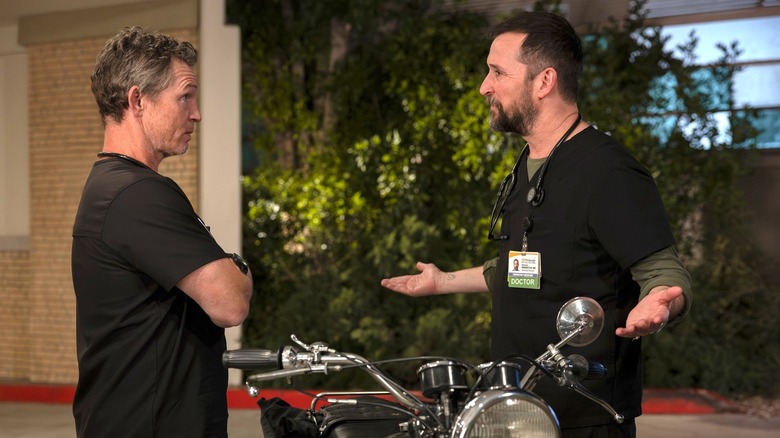
As TVLine previously reported, Season 3 will pick up four months after the events of the Season 2 finale, bringing the timeline to November — a shorter jump that will allow the show to introduce new, colder-weather scenarios.
But the primary focus of Season 3 will be Robby himself.
After hitting a breaking point in Season 1 and spending much of Season 2 in avoidance, the next chapter will center on him "doing the work," as series creator R. Scott Gemmill put it — actively confronting his trauma and attempting to heal.
That process won't be immediate. Robby will have returned from his "spirit quest," but not to the hospital right away, having been away from work longer than initially anticipated.
"Season 1, the doctor is the patient. Season 2, doctors don't make good patients. Season 3, doctors benefit from being patients," Noah Wyle told TVLine, speaking to the theme of the next 15 episodes.
In other words, the ideas embedded in Robby's tattoos — mortality, acceptance, and self-reckoning — are about to be put into practice. That means rethinking his instincts, his relationships, and the coping mechanisms that led him to suicidal ideation.
As Wyle described it, Robby's path forward will be marked by "a thoughtfulness, a caution, a trepidation," but also "a sense of possibility and hope."