

The Pitt's Noah Wyle: After Uncovering Robby's Trauma, Season 3 Will Show How 'Doctors Benefit From Being Patients'
Dr. Michael "Robby" Robinavitch could no longer outrun what had been building inside him by the end of "The Pitt" Season 2.
The reveal in Episode 13 that he was abandoned by his mother reframed why Robby has struggled to let people in — and why so many of his relationships have been short-lived. After confirming his suicidal ideations to Duke in Episode 14, he made a more personal disclosure to Dr. Samira Mohan in Episode 15, quietly taking stock of the life he once imagined for himself: a wife, children, even something as simple as a piece of land with a pond to skate on in the winter. Instead, he was forced to confront the life he's actually living.
When Samira told him it was "never too late," Robby pressed her on whether that belief applied only to him, or to her as well. And when she asked whether the future he described was real or simply something he said to make a point, he responded with only a shrug, an ambiguous answer that nevertheless suggested some truth.
Then came his admission to Dr. Jack Abbott: "The most important things I've ever done in my life have been in this hospital. Nothing will ever matter more than what I've done in this hospital, but it's killing me." From there, he gave voice to something even more unsettling: that the cumulative weight of every loss he's witnessed may be eroding him in ways he can no longer endure. But rather than find a way to cope, he seemed prepared to run from it permanently, because he could see no other way out.
Duke had asked Robby whether that was the final lesson he wanted to impart to these kids. Even after Langdon confronted him in the finale, it remained unclear whether he intended to seek help. Then came his final scene with Baby Jane Doe, in which he turned on a lullaby, swaddled her, and spoke to her as much as to himself, acknowledging his own abandonment while offering the reassurance he's never quite been able to give himself.
Until now.
In a post-mortem interview with TVLine, Noah Wyle unpacks that turning point, reflects on Robby's long-simmering abandonment issues, and previews how Season 3 will force him to reckon with the idea that doctors don't just treat trauma, they carry it, and whether he's going to let it keep consuming him.
'One more face to carry, one more case to carry...'
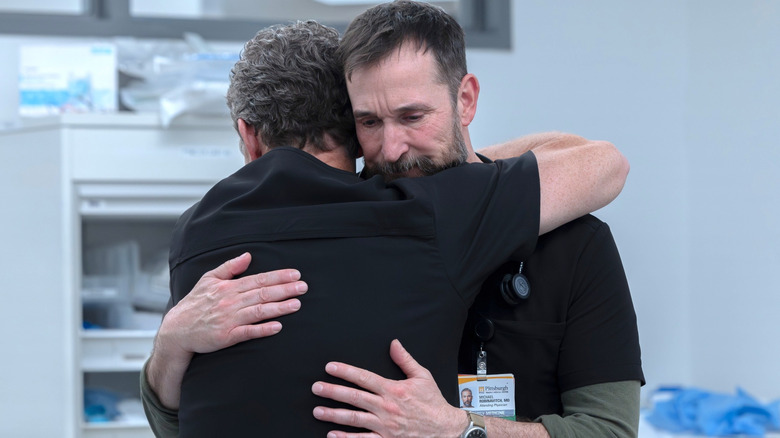
TVLINE | We knew Robby grew up with his grandparents, but we didn't learn until Episode 13 that he was abandoned by his mother, which reframes why he struggles to let people in. Was that always part of his backstory, or something you found along the way?
Once we initiated the idea that he was raised by his grandparents, we kind of needed to answer what happened to his parents. We latched onto that pretty early, but didn't really understand what the significance of it could or would be when we put it as a detail. And then as Season 2 unfolded, whether it was the character of Yana Kovalenko [in Episode 3] that reminded him of his grandmother, or the mother who walks into traffic after [she leaves] her toddler in the car [in Episode 11] who might be suicidal being another trigger, suddenly, it had possibilities of resonance.
We actually wrote more toward it than we showed, and judiciously pulled back so that we still could leave some bullets in the chamber down the line.
TVLINE | When the team saves the mother with preeclampsia, you see Robby get visibly overwhelmed. Knowing what we now know about his own mother, how much of that moment is tied to him ensuring this child doesn't grow up the way he did?
I'll be perfectly honest, I think my preparation for that moment had more to do with what Abbot says [afterward] — "If you hadn't been here, she would have died" — and the intense pressure of there being one more face to carry, and one more case to carry that I don't have to carry because it went well, but that could have gone poorly and I would have had to carry that, too.
I think it was the fear of another name and another notch on the unfortunate belt that he was most worried about. That's the way I took it anyway.
TVLINE | Piggybacking on that, when Robby tells Abbot, "I'm not convinced that a part of you doesn't die every time you see a fellow human pass...," you can practically see the life drain out of him. How important was it to make clear that it's not just one trauma, but the cumulative toll of everything he's been carrying?
That's the amazing thing about these professional physicians — they can weather a case, they can weather a couple of cases, they can handle a couple of years, they can handle a couple of decades. It's the aggregate toll of a career. If you don't have a way of synthesizing this into your life and having balance with it, it becomes sort of a ticking time bomb that's going to take its measure at some point — usually when it's least convenient to do so. I think that's what we're going to enjoy getting into with the narrative going forward, is just how clear that becomes to him.
'Season 1, the doctor is the patient. Season 2, doctors don't make good patients. Season 3, doctors benefit from being patients.'
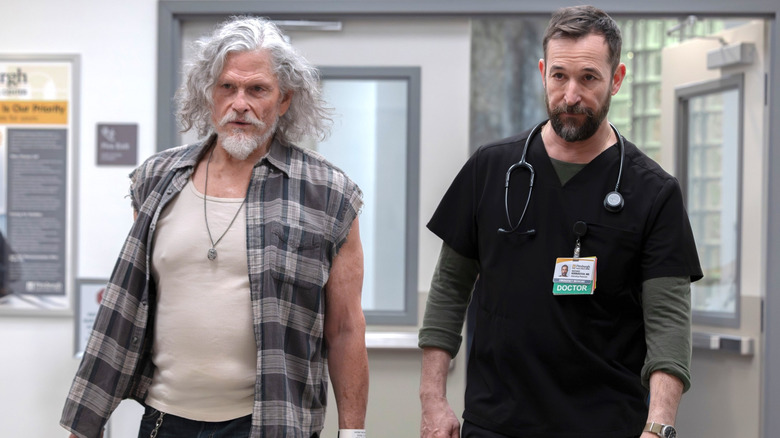
TVLINE | By the finale, Robby has been confronted by Dana, Duke, Abbot, Langdon...
[Laughs] One after the other, man...
TVLINE | Does that change what this "spirit quest" actually is for him, compared to what he thought it would be at the onset of this season?
Yes. In the same way that he has been actively trying to deny that these people have affection for him, and have a vested interest in his survival, he can't deny that any longer. He is loved. He is loved. He does have a community that wants him to be better, to feel well. They may not know how to help him, but there is a de facto family there for him. It redefines possibility. I still think he's got a road to travel, and he's got a road to come back from. What happens on that road out and that road back will be fun to play with next year.
You never want to evolve your characters too quickly. This has been a very slow and methodical mental health journey — bringing somebody into a state of awareness from real desperation. Hopefully, we'll get him to a place of real enlightenment.
Season 1, the doctor is the patient. Season 2, doctors don't make good patients. Season 3, doctors benefit from being patients.
TVLINE | Series creator R. Scott Gemmill told me that Robby is finally going to start working on himself. For someone who has spent the better part of his life pushing everything down and focusing on others, what does that actually look like?
That's the stuff we're talking about in the [writers'] room now, which is the stuff I enjoy the most. I think when you come back from a situation that was toxic, you have to question all of your methodologies and assumptions that led you to that place.
It's almost like starting from scratch. You can't be an expert anymore if your expertise led you to suicidal ideation. You have to come in with a fresh set of eyes and a humble nature — and moment by moment, gut check your instinct against whether or not your instincts are good for you. I think there's a thoughtfulness, a caution, a trepidation that's also married to a sense of possibility and hope. There's almost a kind of giddy excitement that this could be real. There might be a light at the end of the tunnel that isn't the train.
'It's not them, it's him. He is them.'
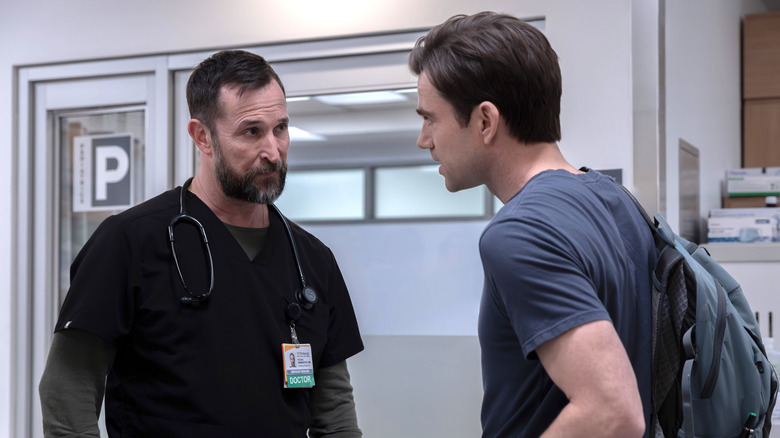
TVLINE | Last we spoke, we were discussing how so much of Robby's avoidance of Langdon in the first half of Season 2 was because he knows Langdon is doing the work that he's not. Do you think the thing Robby feared most was that Langdon, of all people, would be the one to tell him he needs help?
I think that was the fear all along — that he would be at the mirror he'd hold up and say, you know... when we wrote that line — "I went to rehab and all I saw was you, guys just like you" — I knew that would be poignant because that's the truth that Robby has feared all along: It's not them, it's him. He is them.
TVLINE | Dana confronts him in the ambulance bay, Duke tells him he's not riding, he's running... then there's Langdon... and finally Baby Jane Doe. Was there a specific moment where it clicked for Robby: "I need to do the work"?
Some of this I'm reverse-engineering as I've watched it. Because sometimes you shoot these things, and you don't really see the connective tissue. But there's a scene with Robby outside with Mohan where he says to her, "Do you really think you could be happier? Is that something you can only prescribe for someone else or do you think could apply to you, too?" And she says, "Oh, I see what you did there." And I think in the moment with that baby, when he's saying "you've got so many wonderful things to see, and so many people to love you still," does that apply only to you? Or am I allowing of that possibility for myself as well? And the hypocrisy of saying that one is true and one isn't, I think, was a catalytic moment. I think as he's saying those words out loud, it's wish fulfillment, and he's acknowledging that it's wish fulfillment for himself, not just for the kid.
'Robby is going to be coming back in a very different place emotionally'
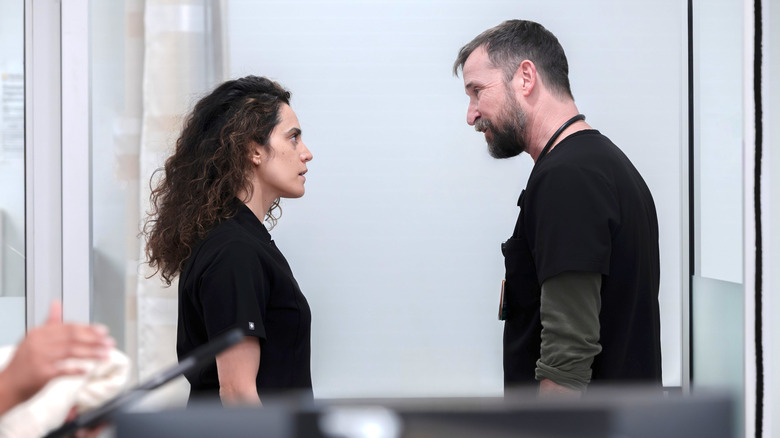
TVLINE | Let's circle back to the penultimate episode briefly, which you wrote, because there's a line at the end that caught my ear, which I previously discussed with Scott. Back in Episode 1, when Al-Hashimi introduces herself, she asks you to call her by her first name — but you don't call her Baran until she reveals her diagnosis to you. Why do you think Robby makes that change in the moment?
For him, she's human for the first time. She's not the competition. She's not a threat. She's not his replacement. She's not the future. She's not representative of AI. She's a very vulnerable, scared human being.
TVLINE | Scott told me she'll be back on shift in Season 3. Now that Robby and Al-Hashimi have connected on a more human level, what do you look forward to in regards to how that dynamic evolves?
I think there is going to be a lot of redefining relationships to play because Robby is going to be coming back in a very different place emotionally. And I think he's going to have a sense of maturity and contrition about the less professional behavior he has exhibited, and looking to make some amends there. I mean, that's a great question — one that will be fun to answer.
TVLINE | So much of this season was about Langdon making amends. Will part of Season 3 be about Robby making amends for how he treated those he cared about most in Season 2?
Yes, but it's different. I think it's part of the 12-step program to get humbled and honest with yourself — to make those amends when you're in recovery. Robby's amends have more to do with a personal amends, a personal forgiveness, and then an acknowledgement that the manifestation of his unhappiness was sometimes really thoughtless. But it wasn't manipulative. It wasn't taking advantage of relationships to get a different ulterior motive out of them. It was very self-reflective as opposed to opportunistic.
TVLINE | Do you think that, coming out the other side of his sabbatical and starting to do the work, that Robby will have an easier time not making everyone else's problems his own?
Well, you know, Scott said he's doing the work. I don't know that he's doing the work. [Laughs] I don't know anything. These are baby steps. I wouldn't pin us down on anything here because we're going to have to retract. We have some really great ideas. We've got some really wonderful arcs. We understand who the characters are in a lot of ways. But, you know, people are funny. You never know how they're going to react.