

Ted Lasso Season 4 Review: A Worthy Revival That Still Has Something To Prove
There's reason to be cautiously optimistic about the future of "Ted Lasso" after screening the first five episodes of Season 4 — but don't call it a comeback just yet.
Ted famously quoted Walt Whitman during one of Season 1's defining moments, when he challenged Rebecca's ex-husband Rupert to a game of darts and offered a simple piece of advice: "Be curious, not judgmental." That's the mindset I tried to bring into these five episodes, arriving not with the disappointment of Season 3 but with an openness to the idea that this three-year hiatus could serve as a reset — a chance to steer the show back toward what made it so special in the first place. After all, for all of Season 3's shortcomings, Jason Sudeikis & Co. still landed the plane beautifully, giving virtually every major character a satisfying sendoff.
The challenge facing Season 4, then, isn't simply telling another story — it's justifying why this one needs to exist at all.
The story picks up three years later, with Ted having traded coaching for a job as assistant manager at his local grocery store, affording him more time and energy to devote to co-parenting middle school-bound Henry (now played by Grant Feely) with his ex-wife Michelle (Andrea Anders). It quickly becomes clear, however, that Ted has buried his passion, while neither he nor Michelle find much fulfillment in their current careers. A change, it seems, might do their family some good.
Conveniently, this coincides with the arrival of AFC Richmond owner Rebecca Welton (Hannah Waddingham), accompanied by CMO Keeley Jones (Juno Temple, channeling her inner Dorothy from "The Wizard of Oz" as she emerges from an Escalade) and director of football operations Leslie Higgins (Jeremy Swift). While the trio is in Kansas City to attend a KC Current match as research for AFC Richmond's own women's team, Rebecca also has a more personal mission: convincing Ted to return to England and coach it.
With a runtime of roughly 45 minutes, there are stretches where the premiere feels like unnecessary table-setting. It's not as though there's any real suspense about Ted's decision to return to England — or that Michelle and Henry will ultimately join him this time around. What gives the episode its emotional weight, however, is the decision to make the memory of Ted's late father such a defining part of that choice, reframing his return to Richmond as a way to show Henry what he's passionate about — just as Ted once had the opportunity to watch his own father thrive at work before he ultimately took his own life.
A New Era at Nelson Road
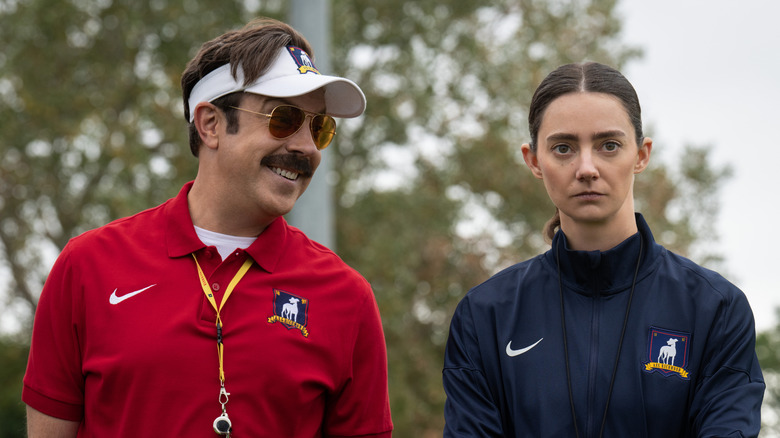
Episode 2 is considerably stronger, recapturing the feel-good vibes that defined Season 1. Following Ted's return to Richmond, the installment chronicles his first week back at Nelson Road, where viewers are reunited with men's team manager Roy Kent (Brett Goldstein, who slips back into the gruff role as though he never left) and Coach Beard (Brendan Hunt, who makes a meal of the screen time he's given as Beard grapples with Ted's return and, later, the repercussions of marrying Jane Payne), both making their Season 4 debuts after missing the premiere.
We do get updates on where some of the former men's team players wound up — if they even left at all. Interestingly, one original character who became increasingly divisive over the show's initial three-season run isn't mentioned once in Episodes 1-4, and is only indirectly referenced in Episode 5 — but ultimately, this is no longer their story. That becomes evident the moment the show introduces new women's assistant coach Alice Chilton (played by Hannah Waddingham's former "Sex Education" co-star Tanya Reynolds), who injects a wholly unique energy into the ensemble and instantly becomes someone you want to know more about. And while Ted's latest mission to win over a skeptical colleague follows a well-worn formula, Reynolds brings enough stoic charm and vulnerability to the role to make it feel fresh. Reynolds also plays spectacularly off Waddingham, particularly as Alice sends Rebecca spiraling into a crisis of conscience over whether she made the right call putting a man in charge of the fledgling women's team, forcing her to confront what that decision says about her relationship with feminism.
Much like Season 1 did with the original Greyhounds, Season 4 wisely resists trying to flesh out its entire roster at once. Instead, three members of the Lady Greyhounds emerge as immediate standouts. Boots, played by Jude Mack ("I Hate Suzie"), is first among them: a goalkeeper who refuses to wear gloves because she wants to feel everything. Though she initially comes across as an oddball, Episode 4 — which sees the team compete in a pub trivia night at the Crown & Anchor — hints at a rich backstory that the show will hopefully mine in subsequent episodes. Center back Lizzie, played by Faye Marsay ("Andor"), is immediately established as the team's voice of reason, bringing with her a maternal instinct that extends well beyond the adorable son who accompanies her to open tryouts. Then there's Gemma, played by Abbie Hern ("My Lady Jane"), a striker whose history with assistant coach Alice quickly produces plenty of friction, even if the show has yet to fully explore where that relationship is headed.
Keeley, who is somehow still running her public relations firm with Barbara off screen while also serving as CMO of the women's team, emerges as perhaps the Lady Greyhounds' biggest cheerleader. Temple, in turn, is given significantly stronger material than she had in Season 3, as the show prioritizes Keeley's career over her romantic life. Even so, with Phil Dunster's Jamie Tartt out of the picture, the show once again leans into the chemistry between Temple and Goldstein. Unfortunately, one of Season 4's few weak spots is its apparent determination to play the long game with Keeley and Roy, forcing Roy, in particular, to behave more immaturely than feels true to the character. Goldstein remains one of the show's greatest assets, but Roy's Episode 4 storyline veers a little too far into sitcom territory, undercutting some of the emotional maturity the character spent three seasons earning.
Keeley's most important love story, however, remains her friendship with Rebecca, and there are growing pains in their partnership as Keeley's impulsiveness rubs up against Rebecca's hard-earned instincts. Rebecca, meanwhile, keeps Keeley in the dark about certain business matters perhaps longer than she should, but the writers wisely resist manufacturing conflict for conflict's sake, instead bringing in the great Tracey Ullman as something of a chaos agent in Episode 4. Waddingham, meanwhile, delivers her finest work in Episode 5, as Rebecca's long-distance relationship with Matthijs, the Dutch pilot she met in Amsterdam, is challenged in an unexpected way. It's a reminder of just how deftly Waddingham balances the show's emotional sincerity with its broadest comedy.
Can the Revival Stick the Landing?

At the end of Season 3, Ted convinced Trent Crimm to change the title of his book from "The Lasso Way" to "The Richmond Way: The Unbelievable Season of a Premier League Underdog," underscoring the idea that neither Trent's book nor "Ted Lasso" itself was ever really about its title character. It was, in large part, a show about rejecting toxic masculinity and giving men permission to feel their feelings. Season 4, meanwhile, shifts its attention to the women. It's a story about gender inequality in sports — and in women's football, specifically — as Rebecca and Keeley struggle to convince the Greyhounds' most ardent supporters that AFC Richmond's fledgling women's club is worthy of the same attention afforded to Coach Kent's team.
For as much as "Ted Lasso" was about Ted's emotional journey, it was ultimately about a fish out of water entering an unfamiliar world and leaving the people around him better than he found them. That mission continues with the Lady Greyhounds. But just as importantly, Season 4 recognizes that there are times when Ted, as a man, needs to step aside and let Alice take the lead. Or let the women in his life — including the up-and-comers he now finds himself coaching — help steer him out of a rut.
Whether the show can continue to strike that balance — making Ted feel essential, and his story worth continuing, without letting it become the sole engine driving Season 4 — will ultimately determine whether it proves worthy of its own existence. So for now, I'll remain curious, not judgmental, and see how it all plays out.
THE TVLINE BOTTOM LINE: As it stands, "Ted Lasso" Season 4 is already a marked improvement over Season 3. And if it continues to recapture even some of the magic of the show's first two seasons? Well, that'd just be barbecue sauce.