

What Was The Significance Of Picard's Borg Name In Star Trek: The Next Generation?

As a rule, members of the Borg hive mind don't have names, but when Jean-Luc Picard (Patrick Stewart) becomes assimilated in the Season 3 finale of "Star Trek: The Next Generation," his cyborg persona gets one: Locutus of Borg. The moniker wasn't chosen arbitrarily, either — this Latin word is highly appropriate, considering the role Locutus plays in the Collective.
"Locutus" is a participle of the Latin word "loquor," which means "to speak." It specifically translates to "having spoken," which is fitting, as the Borg attempt to use Picard as an envoy to the human race as part of their planned assimilation of Earth. The Borg abduct Picard in "The Best of Both Worlds, Part 1," which ends with a shocking cliffhanger when he shows up with cybernetic prosthetics on his face. The plan is to use Locutus as the Borg spokesperson when the Borg consumes Earth; luckily for humanity, the crew of the Enterprise is able to rescue Picard and return him to normal in "Part 2." The lingering after effects of his time in the Collective would later be explored in "Star Trek: Picard."
Behind the scenes, the name "Locutus" was deliberately chosen. Speaking to "Star Trek: The Magazine" (via Memory Alpha), "TNG" writer Michael Piller later said that it was "a name which I got out of the dictionary about language."
Latin comes up a lot in Star Trek
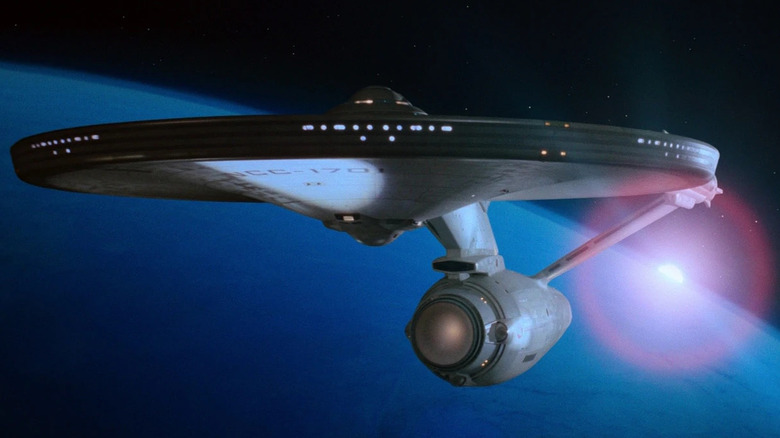
For a language that's considered dead in the 21st Century, Latin sure does come up a lot in the 24th century. Several characters use Latin phrases throughout the Star Trek franchise, including Jean-Luc Picard. In-universe, it may even be that Picard's love of Latin is why the Borg decided to name his assimilated form "Locutus."
Elsewhere, in the Season 5 episode "The Game," Wesley Crusher (Wil Wheaton) returns to the Enterprise after studying at Starfleet Academy. When Picard, who is seemingly fluent in Latin, quizzes him, he notes that Wesley's use of the language has "improved." Starfleet also uses Latin in much the same way that today's governments and organizations do. Its motto is "Ad Astra per Aspera," which can be translated as "To the Stars Through Hardship." The same phrase appears on the real-life memorial for the three astronauts who died during the Apollo 1 accident.
"Ad Astra per Aspera" is also the title of an episode of "Star Trek: Strange New Worlds." This is one of many episodes of "Star Trek" spin-offs to have a Latin title, including the "Deep Space Nine" episode "Dramatis Personae," the "Voyager" episode "Ex Post Facto," the "Enterprise" episode "Terra Nova," and the "Picard" episode "Et in Arcadia Ego."