

This Classic '60s Sitcom Was A Syndicated Hit Before CBS Bought It

Thanks to an unexpectedly loyal fanbase, one zany sitcom about a talking horse ended up changing television history. From 1961 to 1966, the beloved sitcom "Mister Ed" broadcast the adventures of its titular horse and his quirky keeper Wilbur Post (Alan Young) to CBS viewers across America. But "Mister Ed" took an unconventional path to traditional airwaves.
"[Executive producer George Burns] went to all three networks, and [the pilot] didn't sell," Young told the Television Academy Foundation in an interview about the sitcom's legacy, reflecting on the struggles of its early days. Following the failure of the original pilot, the team behind "Mister Ed" recast the series and eventually managed to sell its first season into syndication, meaning that it would only air on about 100 local television stations throughout the country.
"Most shows go into first runs and then go into syndication ... we backed into television with that show," Young remarked.
Despite being dropped by its sponsor, the Studebaker Automobile Company, after its first year on the air — a withdrawal possibly related to financial difficulties faced by Studebaker throughout the '50s and early '60s, although unconfirmed by Young — local ratings for "Mister Ed" still proved "so good that [the series] was sold to the network," Young asserted. "CBS bought it." At the time, "Mister Ed" was one of the only television shows in history to have begun in syndication before being picked up by a major network.
Mister Ed influenced television's Silver Age
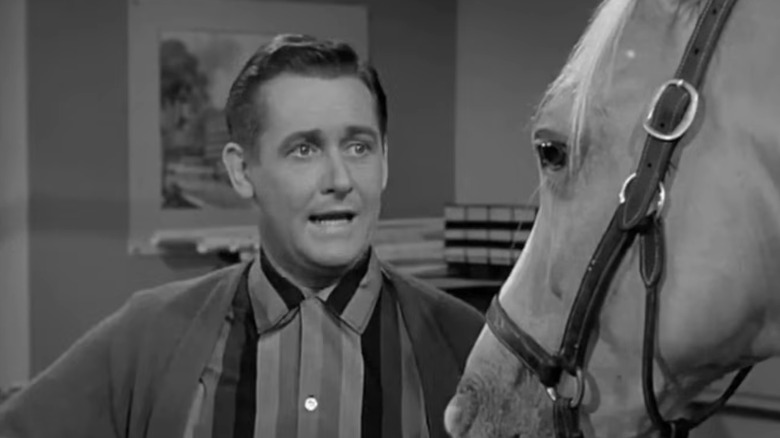
Young further revealed that around the time "Mister Ed" was bought by CBS, two of the television network's most prominent shows — "Lassie" and "The Ed Sullivan Show" — were both "slipping in the ratings." James Aubrey, the then-president of CBS, ultimately offered "Mister Ed" the time spot just ahead of both shows.
Once Season 2 of "Mister Ed" started airing, "Lassie's rating went up, Ed Sullivan's rating went up. They stayed on the air for a long time after," Young reminisced. "So we credit dear old Ed with that."
Following its early success on the network, "Mister Ed" was renewed by CBS for four more seasons, sparking a subsequent surge in fantasy sitcoms that would persist throughout the 1960s. While its whimsical premise left a lasting impact on television, fans of the series often cite the central relationship between Wilbur Post and Mister Ed as a reason for the runaway success.
"It's the one guy making a fool of the other guy," Young told the Los Angeles Times in a 1990 interview, reflecting on the classic nature of the dynamic between the "naive and bumbling" Wilbur Post and the "wily" Ed.
"I think it's the same chemistry that made Laurel and Hardy and Jackie Gleason and Art Carney."