

5 Best Star Wars Worlds Introduced In The TV Shows, Ranked
In the "Star Wars" saga, the galaxy far, far away invites all kinds of adventures. George Lucas endeavored to introduce amazing worlds with new biomes and environments in every film. As the franchise has expanded beyond the big screen and onto television, the worlds of "Star Wars" have become more varied, more surprising and more complex.
With the opportunity to spend multiple episodes — or sometimes almost entire seasons — of TV shows on new worlds, the creators behind "Star Wars" have had the opportunity to dive deep into the cultures and environments of the planets they have introduced. Sometimes having one planet serve as the center of just a single episode or story arc has forced writers and creative teams to make each world as compelling as possible.
Ever since "Star Wars: The Clone Wars" started telling new stories set in the galaxy of the movies, audiences have been able to experience all manner of new worlds via the small screen. The series opened by introducing Christophsis, where forests of giant crystal spires lined the horizon beyond towering skyscrapers jutting out of vast uneven terrain made up of naturally occurring hexagonal plates. Immediately, it was clear that animation allowed "Star Wars" to create new environments far beyond anything the movies had been able to accomplish and that, through television, the franchise could explore all kinds of worlds.
5. Umbara
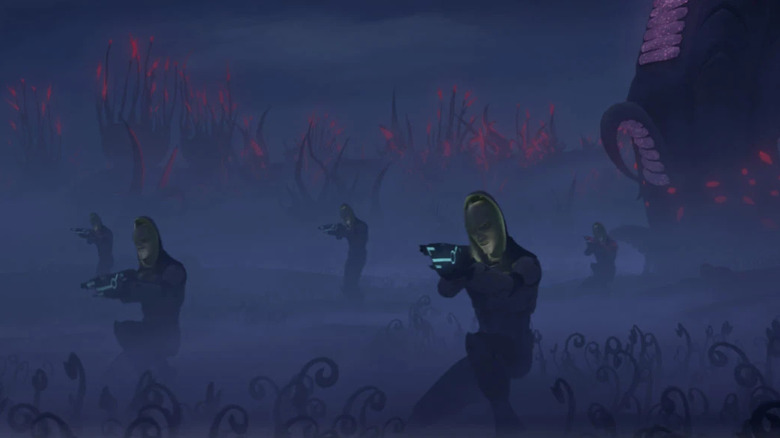
A world of perpetual darkness — a darkness mirrored by the gruelling battles fought there and by the traitorous soul of corrupt Jedi General Pong Krell — Umbara served as the stage for one of the most unforgettable arcs on "Star Wars: The Clone Wars." The storyline that began in "Darkness on Umbara" and ran for four episodes, culminating in "Carnage of Krell," was one of the darkest and most mature in the series, seeing the Clone Troopers of Anakin Skywalker's 501st Legion placed under the command of the ruthless General Krell. While a lot of the darkness stemmed from Krell's brutality, the dread and hopelessness was only amplified by the shadowy landscape of Umbara.
Umbara's surface received no natural sunlight, throwing the planet into eternal night. It was home to various hostile flora and fauna. The Vixus was a tentacled species native to Umbara, several of which were seen grabbing and eating unsuspecting Clone Troopers on "The Clone Wars." Banshees were a similarly hostile flying predator from the planet. The Umbarans themselves had developed some of the most advanced technology in the galaxy, including stealth droids, highly powerful and maneuverable starfighters and a gas that improved soldiers' reaction times. Members of the Separatist Alliance, the Umbarans were a truly terrifying threat to Republic forces.
4. Ferrix
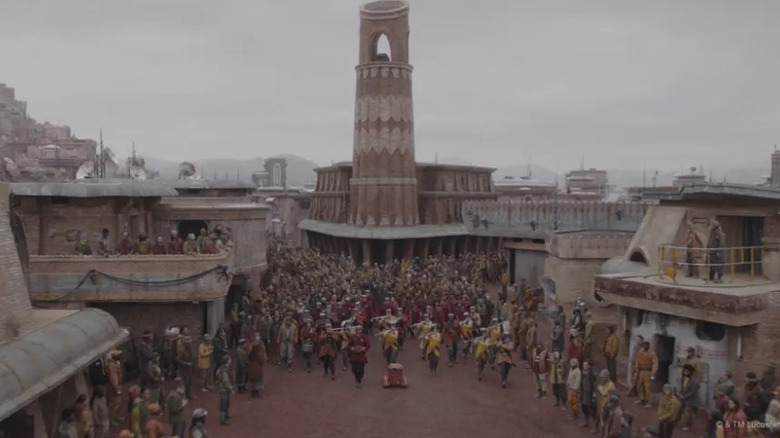
The adopted home world of Cassian Andor, Ferrix was first seen in Season 1 of the "Rogue One" spin-off series, "Andor." Ferrix feels at once deeply familiar and entirely new to the galaxy far, far away. The earthy tones, sweeping modernist shapes, and weathered the buildings are all decidedly "Star Wars." But the brickwork of every building, hand-painted signs, and clock tower in the town square imbue Ferrix with a more contemporary, down-to-earth identity than other worlds. For a story about a rebel who rises up from the galaxy's lower class to confront the Empire, Ferrix is the perfect foundation.
The planet feels so alive because we are shown so much of its own distinct culture. Maarva Andor, Cassian's adoptive mother, was once a member of the Daughters of Ferrix — a social club with a strong presence and long history in the community Cassian Andor grew up in. When Maarva died, she received a traditional Ferrix funeral, organized by the Daughters of Ferrix. Maarva was cremated and her ashes turned into a funerary stone, which was carried through the streets at the head of a funerary procession. The Honor Guard band played and Maarva delivered her own eulogy via hologram.
3. The World Between Worlds
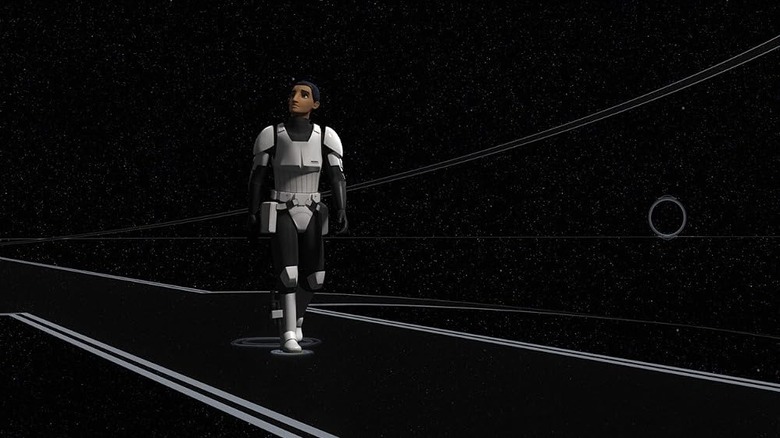
If Ferrix is the most grounded and earthlike location "Star Wars" has ever produced, the World Between Worlds is its polar opposite. Not exactly a planet, but a world nonetheless, this strange realm appears to be a physical manifestation of the Force itself — embodying the connectivity between all moments in time and space and between all living beings.
The World Between Worlds was first seen in "Star Wars Rebels." Though teased and glimpsed through the Jedi temple on Lothal on at least two previous occasions, its proper debut occurred in the Season 4 episode, "A World Between Worlds." Ezra Bridger found himself transported into this ethereal domain through a hidden gateway in a mural on the side of the Lothal temple. A dark void filled with featureless floating pathways, it offered Ezra a means by which to access other moments in time. Through the World Between Worlds, he was able to save Ahsoka Tano during her encounter with Darth Vader.
The World Between Worlds appeared again in the live-action series, "Ahsoka." Here, further evidence was provided that the World Between Worlds is essentially the Force given physical form. Upon entering the World Between Worlds this time, Ahsoka was confronted by her long-dead former master, Anakin Skywalker, and was able to revisit key memories from her time fighting in the Clone Wars.
2. Mortis
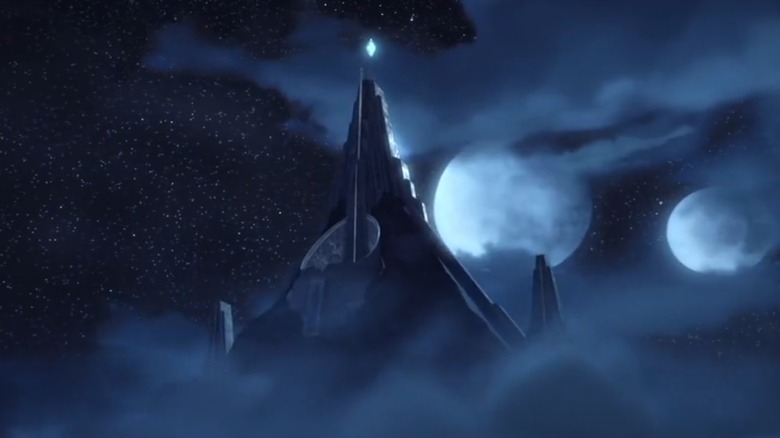
Similar to the World Between Worlds, though with at least a little more sense of physical reality, Mortis was where the Force was amplified beyond anything seen anywhere else in the galaxy. Anakin Skywalker, Obi-Wan Kenobi, and Ahsoka Tano visited this otherworldly realm in "Star Wars: The Clone Wars."
The strange world of Mortis appeared to exist within a stone monolith at the galaxy's edge, consisting of shifting dreamlike landscapes. Trees glowed pale blue, mountains floated in the sky, seasons changed with the time of day, its caves of luminous gemstones appeared to invite visitations from those who had died or who were yet to be, and the world was crowned by the shining light atop a towering monastery.
Mortis was home to three all-powerful Force wielders — The Father, representing balance in the Force; the Daughter, representing light; and the Son, representing the dark side. These ancient beings had left the material galaxy behind in order to protect others from the extreme power they wielded. All three were killed during their encounter with the Jedi. The Son inadvertently killed the Daughter, who gave the last of her life to save Ahsoka. The Father gave his life to strip the Son of his power, allowing Anakin to kill the Son.
The dead Qui-Gon Jinn was seen on Mortis twice, manifesting as a spirit and revealing the world was "unlike any other, a conduit through which the entire Force of the universe flows."
1. Lothal
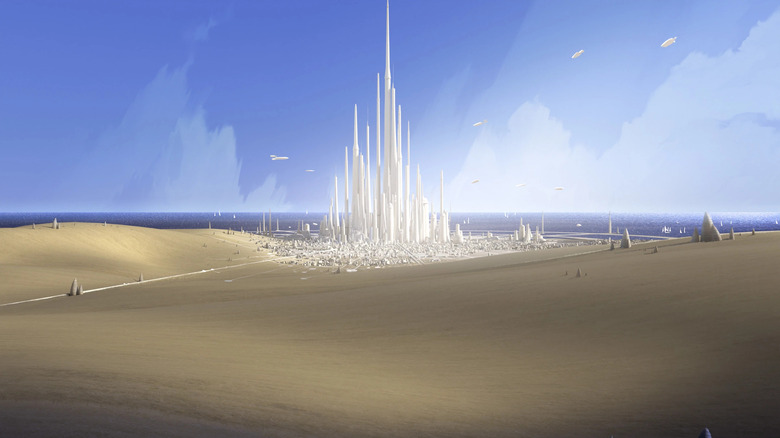
Ezra Bridger's home planet introduced on "Star Wars Rebels," Lothal is one of the most beautiful and most multifaceted worlds in the canon. Inspired by legendary concept artist Ralph McQuarrie's original drawings of Alderaan, Lothal consists of a city of shining white spires, rising up over rolling grassy plains dotted with rocky outcroppings. The Capital City on Lothal was home to markets, street traders, and a diverse working class of species from across the galaxy — including humans, Rodians, Ithorians, Gotals, and Ugnaughts. The planet was once run by Governor Ryder Azadi, who resumed his office once the Empire's occupation of the planet was overthrown by rebels.
The planet also had its own uniquely profound connection to the Force. The Jedi temple on Lothal, carved into one of the planet's natural stone spires, bore a special connection to the World Between Worlds and offered profound visions to Ezra Bridger, Kanan Jarrus, and Ahsoka Tano. The planet was also home to the Loth-wolves. Long thought extinct, these creatures revealed themselves to Ezra. Not only did they apparently possess the ability to traverse great distances via hyperspace travel, they embodied the will of the Living Force. Loth-cats were among the planet's more common fauna, a white Loth-cat acting as a mysterious guide to Ezra on several occasions when he returned to his beloved homeworld.