

20 Years Ago Today: A Serial Killer Series Launched One Of TV's Darkest Antiheroes

Breaking news: Killing people is bad. But 20 years ago today, an ambitious crime drama series questioned what would happen if a serial killer turned his bloodlust into an avenging force — ridding the streets of other killers and criminals to make the world a safer place. "Dexter" premiered on October 1, 2006, and became a pop culture sensation, propelling Michael C. Hall to fame and delivering the best Showtime show of all time.
Before we dive into the brilliance of "Dexter," it's worth noting that the show is based on Jeff Lindsay's 2004 novel, "Darkly Dreaming Dexter," and its sequels. The series does deviate from the books at a certain point, but we wouldn't have the serial killer series without them. The show follows Dexter Morgan (Michael C. Hall), a blood-spatter crime scene analyst at Miami Metro Police Department by day and a vigilante killer by night. He was adopted as a toddler by police officer Harry Morgan (James Remar), who found him at a gory crime scene with his mother's dead body.
Instead of allowing him to become a monstrous killer as a result of the trauma, Harry teaches Dexter a strict code to channel his bloody urges — which is why he follows a pattern of getting evidence of his victims' crimes before carving them up on his table. Dexter is categorically an antihero, because even if he does target evildoers, he's still regularly committing brutal murders. However, his journey over the 11 seasons of "Dexter" is about growth and acceptance.
Dexter is about nature vs. nurture

When "Dexter" Season 1 started back in 2006, Dexter already had a set routine for killing people and dumping their dismembered corpses into the ocean so he could get away with murder. But he struggled to show any real emotion to the people in his life, and he masked most of his real self in social situations. The explanation is that his traumatic experience as a young child stunted him emotionally and gave him his bloodlust. But over the course of the series, he comes to genuinely care for his family and co-workers at Miami Metro. Essentially, it makes the show about nature versus nurture.
He spends so much time around people who actually love him (or the version of him they think they know) that it helps unlock that part of him for real. A huge part of this is his relationship with and marriage to Rita Bennett (Julie Benz), and also becoming an adoptive father to her children, Astor (Christina Robinson) and Cody (Preston Bailey). The family starts out as a simple way for Dexter to fit in, but he slowly comes to love them. That's what makes Season 4 so tragic, because Arthur Mitchell (John Lithgow) slaughters Rita in the finale.
Their relationship was anything but straightforward, but Rita unlocked a part of Dexter that he didn't even know existed, proving that he has the capability to grow and change. It's one of the reasons that "Dexter: Resurrection" hits a little harder, because he genuinely cares for his now-adult son, Harrison (Jack Alcott), and wants to keep him safe.
Dexter: Resurrection gets the killer back on track
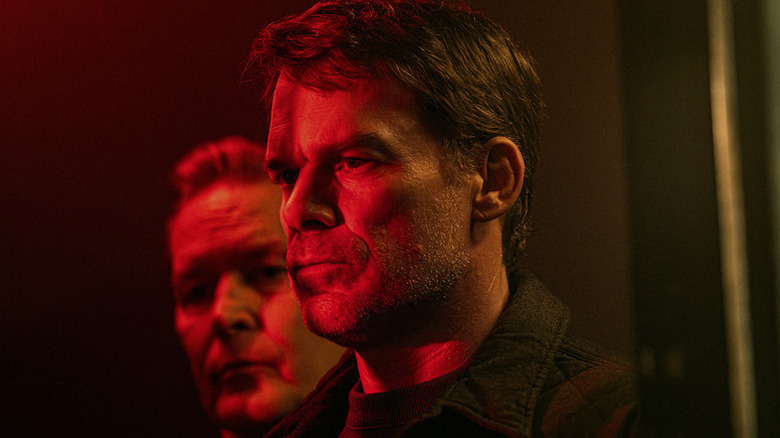
"Dexter: Resurrection" has completely revitalized the franchise by transporting Dexter and Harrison to New York. Season 1 revolves around a fascinating concept about a cult of serial killers. It's a delightfully twisted evolution for Dexter and gives him no shortage of enemies to take down — with some stunning guest stars to boot.
His chemistry with the likes of Krysten Ritter and Peter Dinklage is undeniably captivating, and it feels much more like a genuine continuation of the original series compared to Showtime's previous revival attempt, 2021's "New Blood." That show took place a decade after Dexter's supposed death during the hurricane at the end of the original series, and it saw him living in the middle of nowhere. Aside from bringing Harrison back into his life, it was underwhelming but still showed plenty of promise for Dexter and his son as a new duo.
"Resurrection" makes good on that vow, as the pair tackles some of the best "Dexter" villains in the entire series, like the Gemini Killer (David Dastmalchian). It even finds the time to keep exploring the show's overarching themes of transformative trauma through characters like Dexter's friend and landlord, Blessing Kamara (Ntare Guma Mbaho Mwine). His admission that he was forced to murder people as a child soldier in Sierra Leone had many expecting him to turn out to be the show's mystery Five Boroughs Killer, but in actual fact he's just a kind man trying to make amends and look after his family. It's smaller arcs like that which prove "Resurrection" actually has something to say, and it's exciting to see where it'll go next.