

Why Babylon 5's Creator Considered The Sci-Fi Series The Anti-Star Trek
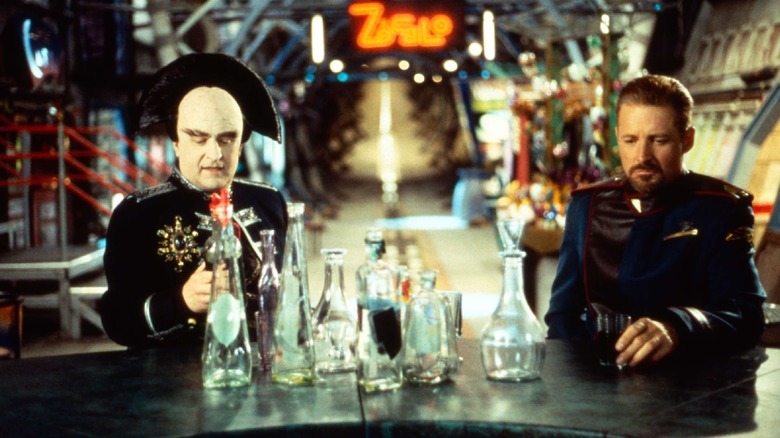
"Babylon 5" and "Star Trek" differ greatly in more than just their story formats — the two approach humanity through very different lenses. That's according to a GamesRadar interview with "Babylon 5" creator J. Michael Straczynski, for the show's 25th anniversary. In it, he discussed how his show embraces every facet of humankind. "The Star Trek universe seemed to say that for us to go into the stars, we have to leave behind important parts of ourselves, the good and the bad: our vices, our avarice, our commercialism, but also our faith and our beautiful fractures," said Straczynski. "And I thought, no, we will still carry that with us."
For the other perspective, "Star Trek" creator Gene Roddenberry shared his views on humanity in the "Inside Star Trek" album, saying, "The whole show was an attempt to say that humanity will reach maturity and wisdom on the day that it begins not just to tolerate, but to take a special delight in differences in ideas and differences in life forms." While the two creators hold optimistic views on humanity, their fundamental difference lies in which elements of humankind should be kept and which we should move on from. In "Star Trek," humanity has largely done away with economic scarcity, and societies have become generally secular. "Babylon 5," on the other hand, presents a future that is still grappling with everyday vices such as addiction, economic inequality, and consumerism.
Straczynski welcomed every aspect of humanity

"Babylon 5" storylines often highlight humanity's more difficult sides. For example, Dr. Stephen Franklin develops an addiction to stimulants, Brother Edward's arc focuses on religious redemption, and Londo Mollari becomes a victim of his own ambitions. In "Babylon 5," the vices we face are integral. "Star Trek," on the other hand, presents a more idealized, post-scarcity future, and civilizations have largely moved on from religion — although religious conflict did exist in "Star Trek: Deep Space Nine," which wasn't helmed by Gene Roddenberry. Instead, honing in on the large-scale challenges that grip humanity, "Star Trek" addresses themes like war, nationalism, imperialism, and extremism.
"Babylon 5" also makes war a central plot point, but views the subject through a different lens. J. Michael Straczynski posits that humanity's faults are just as important as its strengths, while Roddenberry believes in mankind's potential for maturity while preserving the distinct elements that make us diverse. Diversity, though, is something both shows emphasize as one of humanity's strengths, highlighted in "Babylon 5" by showcasing Earth's many religious faiths, and by Mr. Spock, who so beautifully summarizes it, saying, "The glory of creation is in its infinite diversity."