

Leonard Nimoy Invented Mr. Spock's Nerve Pinch To Support His Own Anti-Militaristic Views
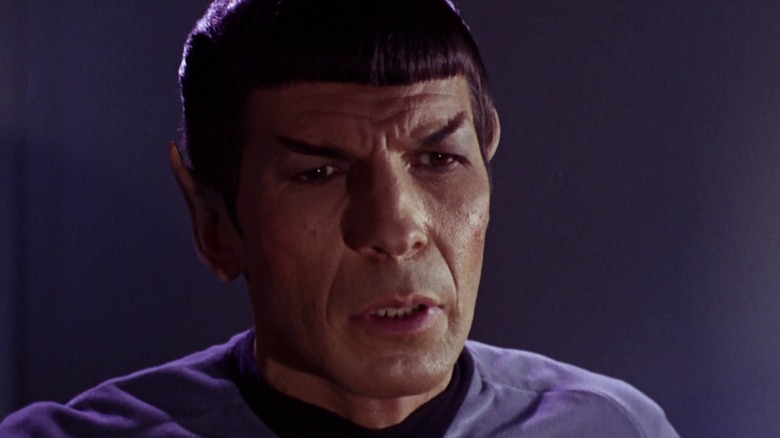
Thanks to the Vulcan nerve pinch, Mr. Spock rarely had to shoot or punch his way through a fight in "Star Trek." This unique ability was created not by the show's writers, but by Leonard Nimoy himself — and it has a deep meaning behind it.
Despite having served in the United States Army Reserve in the 1950s, Nimoy held strong anti-war views. He wanted Mr. Spock to reflect this sentiment in the show, so, when an early episode's script had Spock hit someone over the head with the butt of a phaser, he suggested an alternative: that Spock could make someone lose consciousness by applying pressure to the area between their neck and shoulder. It's a lot less graphic than blasting someone with a gun or stabbing them with a blade, and that's exactly what Nimoy intended.
In a 1968 interview with The New York Times, Nimoy elaborated on why he invented this non-violent move for his character. "Although we are essentially a humanistic show, the Enterprise is heavily armed and a lot of guns get shown," he said. "My way of avoiding participation in the violence was the Spock Pinch. I decided that Vulcans knew so much about the human anatomy that they could knock out an enemy just by pinching a nerve in the neck and the shoulders."
The Vulcan pinch aligned with Star Trek's themes about war
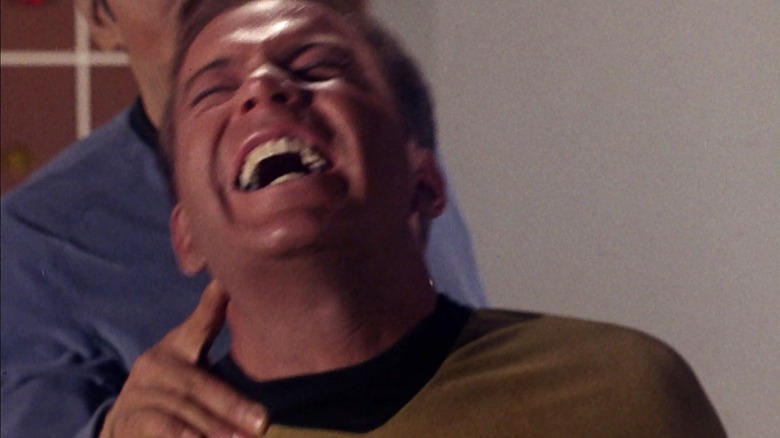
Beyond Leonard Nimoy's creation of Spock's nerve pinch, "Star Trek: The Original Series" more broadly reflected an anti-war sentiment. Airing in the 1960s, during the height of both the Vietnam War and the Cold War, the show explored issues surrounding militarism through its various factions, such as the highly combative Klingon Empire and the more pacifist United Federation of Planets. Captain Kirk (William Shatner), Spock, and the crew of the starship Enterprise often approached armed conflict with extreme caution, only engaging with enemies in combat when diplomacy failed.
Nimoy himself often praised the manner in which "Star Trek" criticized aggressive U.S. foreign policy and advocated for causes like racial equality. In a "Pioneers of Television" interview, the actor described how the series stood out on television at the time. "The writers took good advantage of the show in that way," he said. "If they had something that was heartfelt, that they wanted to say about current conditions, 'Star Trek' was a place where, in the science fiction genre, you could do it. It was one step removed from reality, and you could do shows that had something to say about current conditions on our planet."
Although the Vulcan nerve pinch probably wouldn't be too effective at subduing enemies in real life, Nimoy's opposition to violence fit right into the message of peace that "Star Trek" spread.