

5 Dystopian Sci-Fi TV Shows To Watch If You Like The Hunger Games

If you're a fan of "The Hunger Games," then you're familiar with the exhilaration of watching a plucky underdog defy the odds to overcome a seemingly inevitable defeat. The big screen adaptations of the wildly popular dystopian book series by Suzanne Collins captured the imagination of millions with their gripping action sequences, intricately-designed environments, and memorable characters played by great actors.
The titular games play by some satisfying narrative rules that are mirrored in the shows on this list, stories about camaraderie, ingenuity, and a glimmer of hope despite bleak circumstances. This isn't necessarily a reaping, but we've selected some must-see dystopian sci-fi series that will have you rooting for the protagonists just like you did with Katniss Everdeen. Here are five shows to watch if you like "The Hunger Games."
Silo

One of Apple TV's best sci-fi shows, "Silo" is about a community being ruled by secrets and propaganda in a post-apocalyptic environment. Rebecca Ferguson plays Juliette Nichols, a member of an isolated group that lives underground in what's called Silo 18. Believing the world above is toxic and uninhabitable, people stay holed up in silos. When deaths start happening in the community and Juliette dares to disrupt the status quo by digging deeper into the stories being told, the truth about the silos and the world start coming into focus.
Like "The Hunger Games," "Silo" starts small with a central protagonist and slowly builds, stacking layers of drama, mystery, and character development until you think the narrative might topple over. However, it doesn't give under its own weight. Instead, it creates more action, more surprises, and a sci-fi spectacle that rewards your patience. Juliette comes across as a more mature version of Katniss: She begins as an engineer searching for truth in her silo before eventually becoming an antihero and then a revolutionary.
Ferguson, who's always been an underrated performer, told Awards Daily the working on the show (which is based on the "Silo" trilogy of novels by Hugh Howey) is a collaborative process. "I like the show, I love the scale of the set, I love the team, and I love the fact that I get to sit in on the writer's rooms if I'm allowed to," she said. "I get to be a part of the process. You know, it's a love journey for me. This is a baby; this job is. It's one of the happiest jobs that I've ever done."
The Society
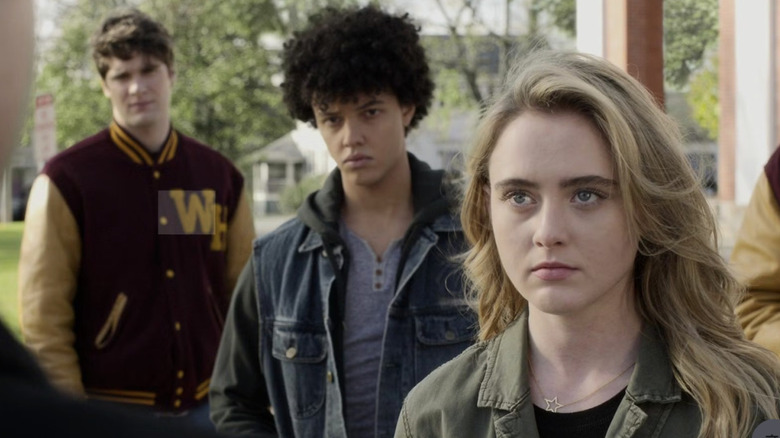
A modern take on "Lord of the Flies," "The Society" centers on some high school teens who return home from a camping trip to discover that all the adults and younger children in their town have disappeared. The teens first see this as an opportunity to party with no supervision, until they eventually realize they can't leave town. Every road out of town is obstructed by a forest, and there's no internet or means of communicating with the outside world. So the teens have no choice but to try to make things work on their own until they figure things out. What's at first thought to be an opportunity to build a teen-run utopia quickly spirals into a nightmarish situation of power struggles and deceit.
"The Society" ran for just one season on Netflix before being axed for COVID 19-related reasons, but it's still worth watching. It does a great job capturing the feelings of dread and fragile stability of an untenable survival situation. Unlike "The Hunger Games," the teens in "The Society" are wealthy, which gives them a false sense of security. Also, there's no visual oppressive force bearing down on the community requiring their compliance. Here, the societal threat comes from within. Teens do lose their lives, but mainly due to their failed attempts at survival. So in a sense, they're living in their own arena. If you're interested in the premise but don't want to be left on a cliffhanger, creator Christopher Keyser has confirmed what would've happened in "The Society" Season 2 had the show continued.
Paradise
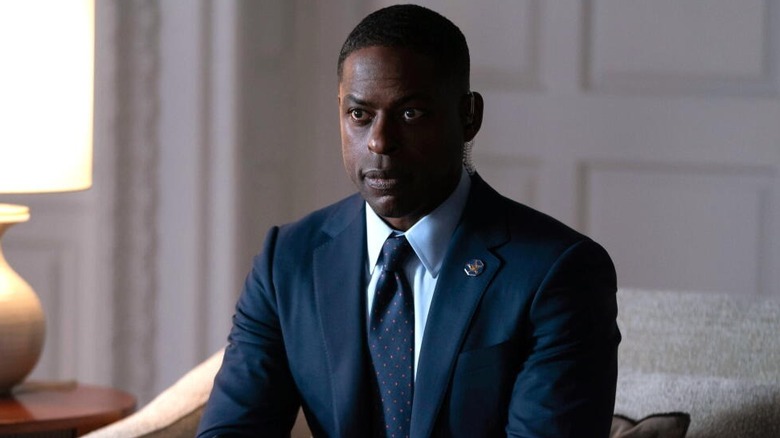
The post-apocalyptic sci-fi thriller "Paradise" follows Secret Service Agent Xavier Collins (Sterling K. Brown), who's charged with guarding U.S. President Cal Bradford, played by James Marsden. All appears to be normal on the surface, but we soon find that instead of living in Washington D.C., they're residents of a massive bunker community that was built to contain the only survivors of the apocalypse. Things are going well until Cal is murdered, and then everything changes.
If you see Season 1 of "Paradise," you should immediately make the connection between the pristine man-made environment and one of the arenas in "The Hunger Games." The community looks like it was crafted by a gamemaker, coming chock-full of hidden cameras along with an artificial sky and sunrise. Viewers follow Xavier as the deeper mysteries of the place are revealed to him, eventually leading to a larger conspiracy he has to unravel.
"I think it is the place of the governed to inherently mistrust the government," Brown told CBC, regarding the show's themes of artificiality and political skepticism, adding that they set out to make a show "that made people think about the world in which they live in, and how are they contributing to its betterment — or to its detriment." Over the first two seasons, the stakes get ratcheted up, until character backstories and mounting consequences boil towards an explosive "Paradise" Season 2 finale.
Snowpiercer
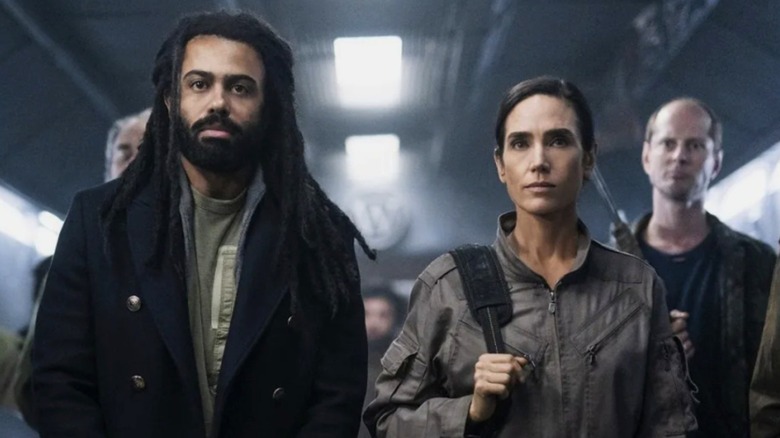
The Polar Express, this is not. In "Snowpiercer," survivors in a frozen wasteland inhabit an ever-moving train with no destination. While doing their best to maintain a sense of order, they have to deal with class warfare and social injustice. The show is an adaptation of the 2013 film directed by Bong Joon Ho starring Chris Evans. It stars Daveed Diggs as Andre Layton, who was a police officer before the freeze and is now investigating a crime aboard the train.
We immediately see how societal oppression is manifested in "Snowpiercer" through the layout of the train cars. Each car represents a different class, with the "tailies" at the end being at the bottom of the social pile. It's reminiscent of the districts in "The Hunger Games," with the poorest ones being far away from the Capitol. Since food and resources are scarce, authority figures are able to maintain power through propaganda. Train conductor Joseph Wilford (Sean Bean) is the President Snow of the show, using cunning manipulation to control perceptions. But what makes Wilford different is he doesn't see the circumstances as a means of punishment, but of necessity.
"He's not doing this because he's cruel or because he wants to punish people. He's got really strong convictions. He's extremely intelligent; he invented this stuff. He can do a lot of good for these people, but he's just quite strict," Bean told Parade. "He's quite blunt about his attitude toward the 'tailies' and the lower classes because he sees them as a bit of a hindrance toward seeking new technology, new power and new means of survival." The critically acclaimed show also stars Jennifer Connelly as Melanie Cavill, the train's influential Head of Hospitality.
3%
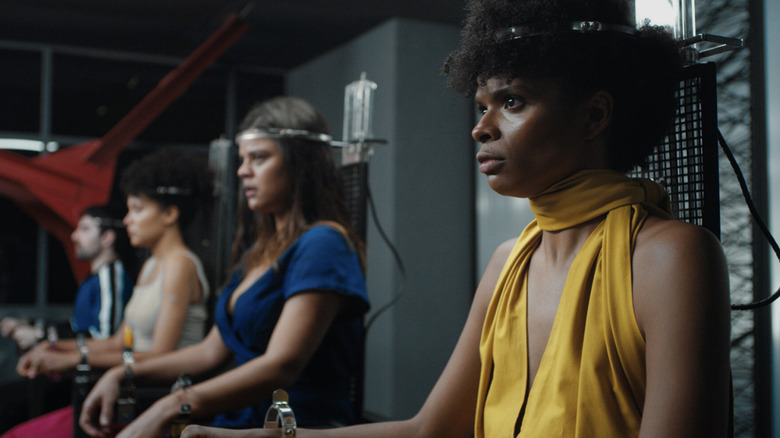
In a future version of Brazil, people are only recognized by their extreme poverty or their elite status. The impoverished live in what's called the Inland, which is basically a slum, while the wealthy elites live in a virtual utopia called Offshore. Each year, 20-year-old Inlanders are given an opportunity to escape their environment if they take a series of endurance tests known as the Process and pass. Only 3% make it, hence the name of the show. Michele Santana, played by Bianca Comparato, enters the Process with no loved ones left and only a single hope of being chosen to join the elite class.
"3%" started as a three-part web series on YouTube before getting snatched up by Netflix to become the streamer's first original production shot in Brazil. The parallels between this and "The Huger Games" are pretty clear upfront, with the lower class being forced to perform for the wealthy. Only these aren't games for entertainment. The Process is more like a grueling job interview full of manipulation and humiliation. Of course, there is an uprising by a group called the Cause, who are striving to eliminate the Process forever and redistribute wealth for all people. As Michele eventually gets pulled into the mission, like Katniss, she's forced to decide how far she's willing to go to rebel against the very system she's looking to for her own survival.