

5 Beloved '90s Sitcoms That Don't Hold Up Today
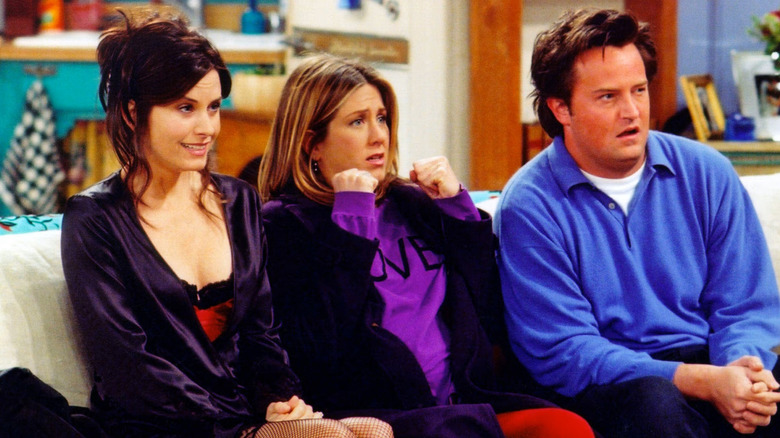
The 1990s gave audiences some of the best sitcoms ever made. This was the decade that shifted situational comedy away from the comforting, lesson-teaching programs families watched together over dinner in the 1980s into something more groundbreaking. But as funny as 1990s television was, it's important to remember that some of those sitcoms simply don't hold up anymore.
In the '80s, funny shows like "Family Matters" and "Full House" featured a great deal of wholesome content that taught us life lessons. But with the end of the millennium nearing, the state of television bean to change, and sitcoms could simply be shows "about nothing" (as "Seinfeld" came to be known). This allowed for unapologetic, often raunchy series that still find current audiences through streaming platforms. But despite the popularity, and the nostalgia, that shift in tone does not always hold up today.
With that in mind, here is an unranked list of five beloved sitcoms from the decade that don't hold up anymore. While these entries are not shows audiences should necessarily avoid, they are ones that should be remembered, for better or worse, as products of their time.
Seinfeld
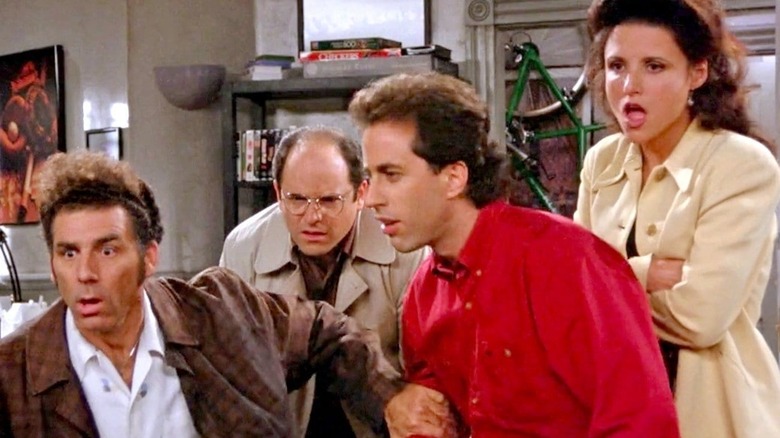
Before audiences fell in love with the self-absorbed gang from "It's Always Sunny in Philadelphia," everyone's favorite TV narcissists were the characters on "Seinfeld." NBC's iconic sitcom aired from 1989 to 1998, spanning nine seasons. It was developed by Larry David and Jerry Seinfeld, who played a fictionalized version of himself. The show centered on the antics of Jerry and his friends Cosmo Kramer (Michael Richards), Elaine Benes (Julia Louis-Dreyfus), and George Costanza (Jason Alexander).
The four friends regularly engaged in antisocial behavior – stalking women, trampling over children during a fire at a birthday party, fighting an elderly woman for rye bread. NBC even briefly pulled an episode that featured Kramer accidentally destroying a Puerto Rican flag. Despite how acclaimed the series eventually became, it has not aged gracefully since its broadcast. While fans can overlook the problematic aspects of the show as products of the 1990s, maybe it's better that "Seinfeld" stay in that decade.
That '70s Show
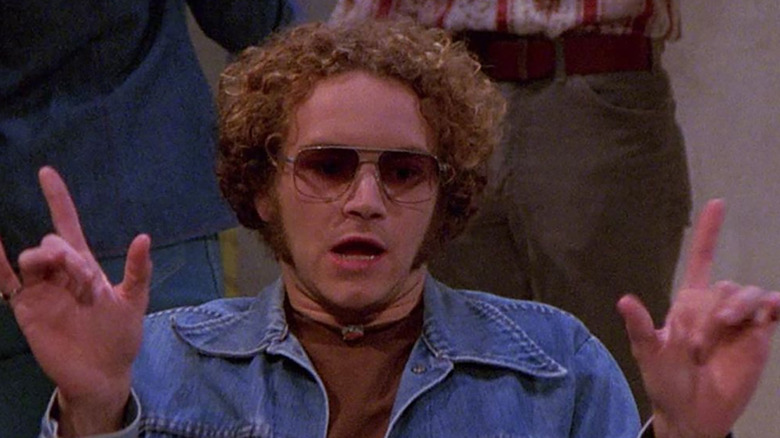
Premiering in 1998 and framed around the late '70s, "That '70s Show" was more self-aware than most series filmed during the actual decade. Fox's period piece sitcom, which originally had a quite different name, ran for eight seasons. It centered on a group of suburban high schoolers growing up in 1970s Wisconsin. The show used its period setting to have hilarious fun with rock music, the political climate of the time, and (a lot) of pot smoking.
But despite the self-awareness, the writers often relied on outdated and sometimes harmful humor. A prime example is the character Fez (Wilmer Valderrama), a foreign exchange student whose home country is never revealed, which was a popular running gag. At one point, he claims the people living back home are outnumbered by lizards. His foreign origins were also a punchline for the character Red Forman (Kurtwood Smith).
A flashback reveals his real name isn't even Fez, but something comically longer, a common way to mock foreign names. Since he says it while the school bell rings, it was inaudible. The characters resort to calling him "Fez." This reduction of his identity, while used for laughs, would likely not fly today. This is to say nothing of the frequent sexist humor and harassment directed at the women in the cast, often by Fez.
The Drew Carey Show
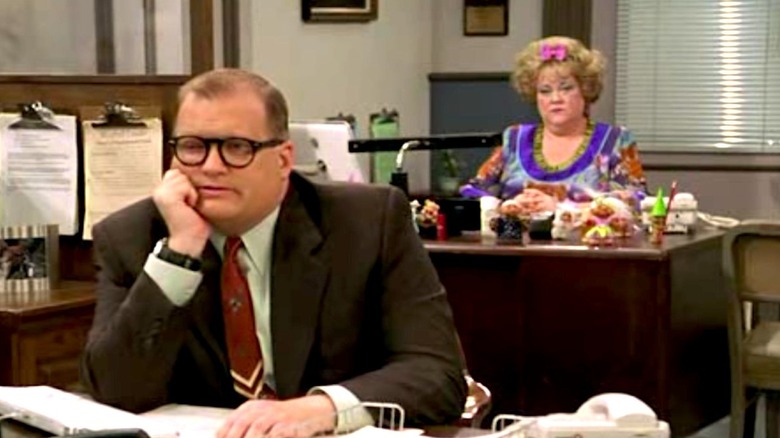
Just a few years before hosting the beloved U.S. version of "Whose Line Is It Anyway?," Drew Carey starred as a fictionalized version of himself on "The Drew Carey Show" where he regularly spends time with his friends Lewis (Ryan Stiles), Kate (Christa Miller), and Oswald (Diedrich Bader). The series is an excellent example of 1990s "everyman" humor, focusing on a group of working-class adult friends and their misadventures. It's also one of the most absurd and strange TV show ever made.
Like many shows from this era, however, "The Drew Carey Show" utilized some humor that simply would not fly today. This is primarily centered on Drew's ongoing rivalry with his office coworker Mimi Bobeck (Kathy Kinney), an overweight and overtly loud secretary. Mimi's physical appearance was a routine punchline, which was attributed to her weight and absurdly overdone makeup. At one point, Drew justifies to a group of scouts that his insults are not directed toward people, before pointing to Mimi and saying "that's not people."
Home Improvement
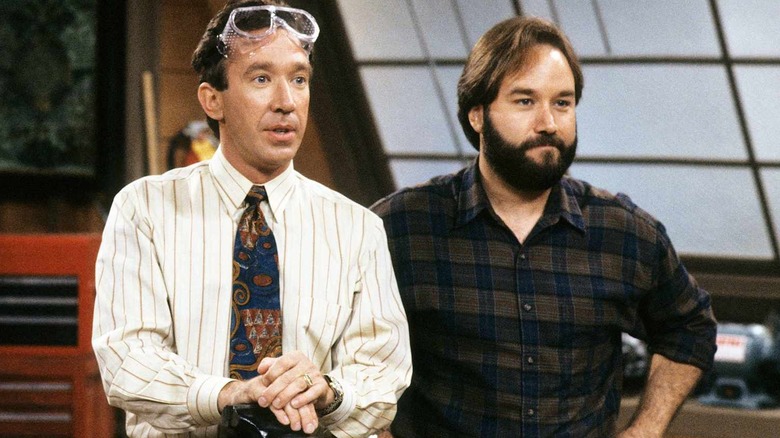
One of the most-watched sitcoms of the 1990s was "Home Improvement," ABC's eight-season series starring Tim Allen. Allen played Tim "The Tool Man" Taylor, the host of a local Detroit home improvement show called "Tool Time." Among other characters on the show were his co-host Al Borland (Richard Karn) and his wife Jill (Patricia Richardson). Many of the antics involved Tim's clumsy, slapstick attempts at his demonstrations on "Tool Time," and never seeing the full face of the family's wise neighbor Wilson W. Wilson (Earl Hindman). Unfortunately, the humor also strayed into more problematic territory.
Tim is often seen as a prime example of the "toxic masculinity" trope. His perpetual desire to always improve a tool or speed up a job, often resulting in destruction that he never cleans up. He enforces his outdated views on masculinity on his sons, as well. In the Season 2 episode "Groin Pains," his son Randy (Jonathan Taylor Thomas) gets the role of Peter Pan in the school play. Tim panics upon seeing him prance around the living room to display his moves for the show, hastily telling him "Men don't prance." In the same vein, the show also has a bad habit of poking fun at Al for being soft-spoken and sensitive, suggesting he isn't a real man like Tim "The Tool Man" Taylor.
Friends
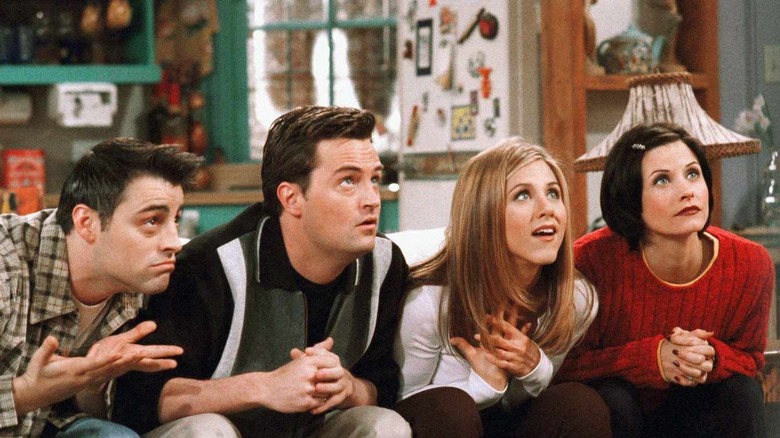
One of the most rewatchable shows of all time, "Friends" was NBC's iconic sitcom that aired from 1994 to 2004. Set in New York City, the series put best friends Rachel (Jennifer Aniston), Phoebe (Lisa Kudrow), Monica (Courteney Cox), Joey (Matt LeBlanc), Chandler (Matthew Perry), and Ross (David Schwimmer) into mundane, but hilarious scenario, like trying to fit a couch into an apartment. Audiences fell in love with the cast over a decade of unforgettable TV moments ... but when looking at the show through a less nostalgic lens, it's easy to spot some problematic aspects with the writing.
Despite being set in the heavily diverse New York City, the entire main cast is white. Most of the recurring characters of color were limited to romantic interests for the white characters, such as Charlie Wheeler (Aisha Tyler), who were always written out after their relationships were done.
While the show was genuinely groundbreaking in how it portrayed a lesbian couple on a mainstream sitcom, episodes still regularly poked fun at Susan and Carol's relationship — to say nothing of how "Friends" handles Chandler's father. How the show depicted Monica's past struggles with her weight is another issue. Flashbacks show she was overweight to the point of near caricature, featuring her literally dancing with a donut. Cox also played her younger self by simply wearing a "fat suit." None of this would fly in a modern sitcom today.