

Euphoria's James Landry Hébert Had An NSFW Vision For Harley's Finale Chase Scene
Warning: This post contains spoilers for the Season 3 finale of "Euphoria." Proceed accordingly.
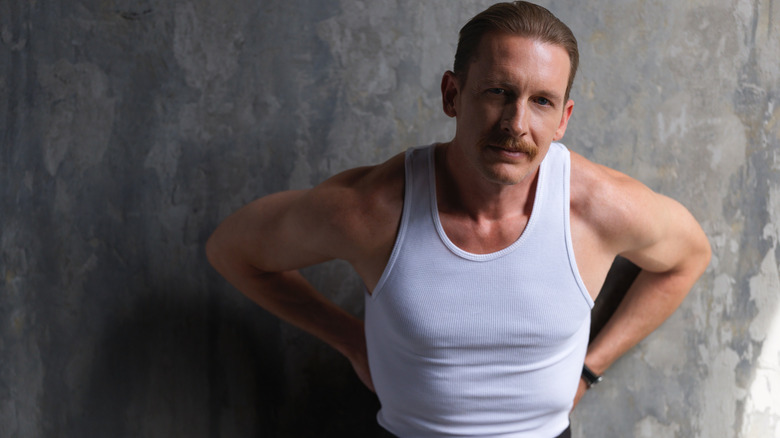
James Landry Hébert had a vision for one of his character's final "Euphoria" scenes, and that vision included his trusty steed, a saddle, a rope... and not much else.
The HBO drama's Season 3 finale, which aired Sunday, includes a scene in which Hébert's Harley pursues Zendaya's Rue as she tries to make a break for it at dawn. Hébert is an accomplished horseman who lives close enough to where "Euphoria" shot that he'd sometimes ride his horse to work. So after a little discussion with series creator Sam Levinson, the scene became Harley chasing Rue on horseback. And, since the drug dealer/overall lowlife would've been roused from bed to handle the situation, "I was like, how sick would that be, if I was butt naked and I would chase her down on horseback?" Hébert tells TVLine. "I was like, that'll just be the most iconic thing ever."
If you watched the episode, you know that the sequence went down in a slightly more PG-13 manner. (Read a full recap here.) For the reason why, and some behind-the-scenes details about what would turn out to be the show's series finale, read on for highlights from my conversation with Hébert, whose long resume also includes "1883" and "Stranger Things." Most of our talk took place before either of us had seen the finale. On Monday morning, he replied to a few questions — you'll see them marked below — that I had after the last episode aired.
TVLINE | I've read that the character of Harley was created for you. Give me a bit about what Sam Levinson told you about him before you started, and what the process was like to get him to what we saw on screen.
JAMES LANDRY HÉBERT | Well, initially, initially I auditioned for Wayne, who Toby Wallace plays. I think everybody read for Wayne. And then [Levinson] liked Toby and I so much that he created Harley for me. And if Sam Levinson's writing for you specifically, I mean, that beats playing something he came up with his head beforehand anyway. Just a dream, you know? He rewrites, he redirects, he changes things on the spot. Like Sydney Sweeney crying over her husband getting beat up in the yellow living room: There was a whole stunt thing where she was trying to fight the guy off of him, and they were like, "I think it's just funnier when she's crying, like, 'It's my wedding!' [Laughs] I just thought that scene was so good. When I found out that they improv'd that on the day and changed everything because of that, I thought that was very indicative and and represents the way Sam works very well.
TVLINE | How much of what you have shot, or that we've seen of Harley, was improv'd?
Improv-wise, I just feel like Sam is just so good at coming up with stuff on the spot. He'll just throw lines at you. I always compare him to working with [Quentin] Tarantino, because I [used to] say you'll never have more fun than working with Tarantino. I now say "until you work with Sam Levinson." Even though Quentin was very accessible [when they filmed "Inglourious Basterds"] and was open to ideas... Sam, like it's just such a loose fun set. You feel like you can go to village, and I'd have like a list of 10 ideas for a line.
Like that first scene when they bring Rue in and she's the drug mule and sh**ting in the tub and Chloe [Cherry, who plays Faye] is standing there, "I had an accident," and my character in the script was like, "What's wrong with you?" I gave [Levinson] this list and he was like, "What's 'mucking'?" I'm like, "Oh, that's when you shovel the horse sh*t." And he's like, "Mucking. I like it." And so as I'm going up the stairs, I'm like, "You better get to mucking." And of course, the [closed] caption said, "You better get a bucket." [Laughs]
'Harley's euphoria was infamy'
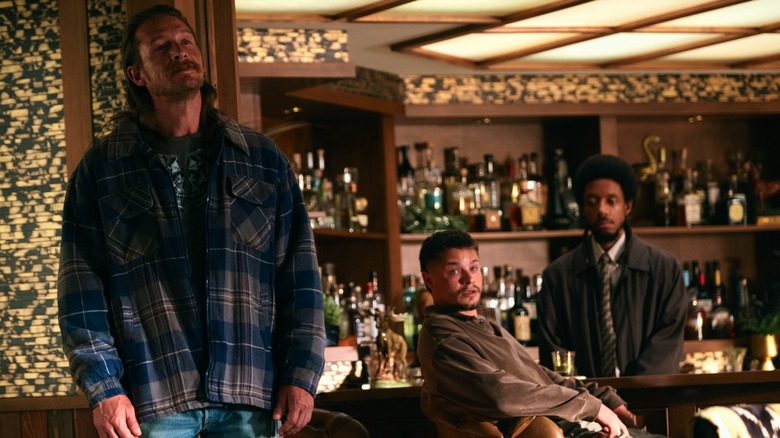
TVLINE | In Episode 7, Harley is very into the idea of Rue paying for "treason" against Laurie and her crew. Some would say he's too into the idea. Talk to me about that.
Yeah. In this show, everyone is chasing their own euphoria and this feeling that they maybe confused with happiness. I think Harley's euphoria, more than drugs or or whatever he's into, is infamy. That was at the root of a lot of the work that I did. I just feel like Harley wants to be feared and respected more than anything. You could probably sense him overcompensating for a lot of insecurity underneath it. [Chuckles] And if his mullet doesn't just tell you everything, or the loud Affliction shirts and and all that. But, yeah, infamy was at the root of it for me. It seemed like he was overcompensating a lot. This drug war between Laurie's crew and Alamo's crew, that's the one thing that Alamo wants that he can't have? That's the the little bit of power that he might have over him, or think he has.
"Euphoria" is just about imperfect people chasing this euphoria and calling it happiness. And Harley's euphoria was infamy.
TVLINE | What can you tell me about the finale?
The the ranch where we filmed, Harley's ranch, is so close to my ranch that I would ride my horse to set and just tie him up in cast parking. Everybody else would be parking their cars in front of the trailers and they're just like,"Is that a horse?" [Laughs]
TVLINE | What's your horse's name?
Moose.
TVLINE | What color?
He's a really dark brow, quarter horse. I did a western with him called "Trail of Vengeance," and I just fell in love with him and his personality. He's just such a people person of a horse. Like, he'll leave the other horses to hang out with people, leave his food to come hang out with you. He just can't be spooked. I mean, they were literally forklifting cars over his head on set, and all he wanted was scratches from the [production assistants...
Sam, once he realized that I could ride and rope, he of course wrote that into my character. I showed up initially, like building Harley, I always show up wanting to be the cowboy, Even in the fittings and stuff, they're like, "No, no, you're not the cowboy. Alamo's the cowboy. You're gonna be this kind of Affliction-, Carhart-wearing oil bruiser. Even with that, I feel like it's kind of him overcompensating for strength and trying to look tough.
... Well, long story short, I ride my horse, and Sam was like, 'If Zendaya tried to get away, could you chase her down on horseback?" And I was like, "I could chase her down and rope her." And a month later, it was this whole sequence in the script.
I'd come in every day at sundown, and we would shoot a little bit of this sequence. I got to do most of the stunts where I'm just hauling a** on the camera car and swinging the rope. Of course, they wouldn't let me actually rope her. And then when it came to dragging her back to the ranch, they used a stunt double and a stuntman actually dragged somebody with the horse.
Harley 'was supposed to die in a blaze of glory'
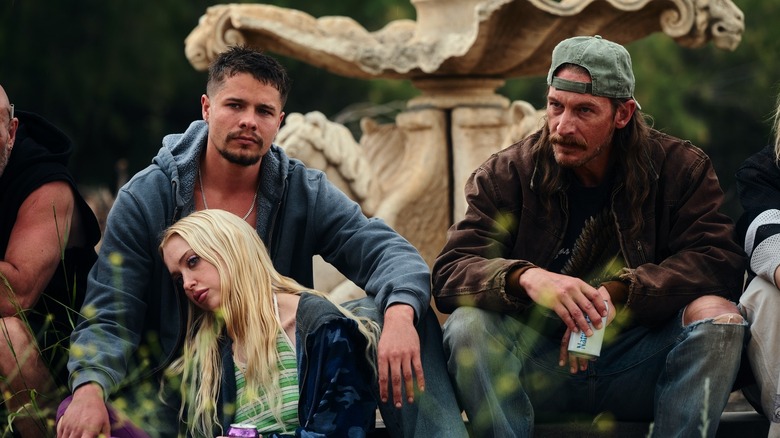
[The] costumes [department] was like, "What would Harley sleep in?" Because he wakes up, she's gone, he hops on the horse, chasing her down. And I was like, "I mean, honestly? He probably sleeps butt-a** naked." And I was like, how sick would that be, if I was butt naked and I would chase her down on horseback? I was like, that'll just be the most iconic thing ever. Costumes loved it. Sam loved it. But of course, [the] stunts [department] and the wranglers were like — because when you rope, you've gotta dally the horn and drag them away. [Editor's note: "Dally" is the action of wrapping the rope around the saddle horn in order to secure what's roped] And they were like, "If you dally your d*ck, the whole shoot's gonna be off." [Laughs] And I'm like, "OK, well, fine."
So they put me in this union suit, which is like a onesie thermal, basically. That was the safer choice. I was like, "Son of a b*tch." [Laughs]
TVLINE | I love that you were willing to go there for your craft, but I'm glad you didn't.
If there's a show to get naked on, it's "Euphoria"! I was like, "This will be so good for business." Unfortunately, I was robbed of that. [Laughs]
TVLINE | Were you riding Moose in the scene?
No, it was a different horse. I wanted to ride Moose, and I pitched it, because I do rope on him. But the wranglers wanted to use their horse and then wanted to have a double for that horse. Ironically, they used a lighter color horse, and they painted him the same color as Moose. and I'm just like, "Well, sh*t, you didn't have to give him a dye job!"
TVLINE | What else can you tell me about the finale?
I will say: [Harley] was supposed to die in a blaze of glory. The DEA was just gonna light me up on the couch as I sang this old Confederate song of rebellion.... We didn't do that scene where I sang the song, but the way we wended up doing it, there was one take where I wasn't prepared to [sing] but [Sam] was like, "Just try singing it here." I'm just like, "Oh, OK!" With Sam, we just try sh*t and see what works."
'No clean exit, just consequence'
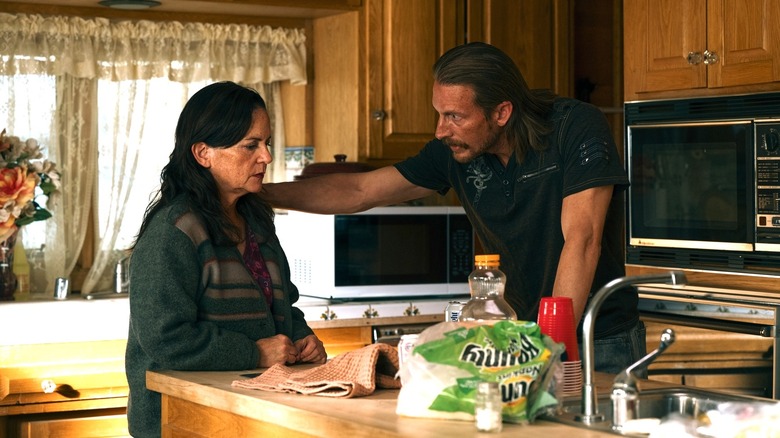
[Editor's note: The morning after the finale aired, Hébert replied via email to a few follow-up questions.]
TVLINE | So Harley didn't die — but he also didn't go out in a blaze of glory like he seemed to want to. Were you surprised he didn't put up a fight as the DEA was closing in on the house?
I was surprised at first, because there was a version where Harley did go out in that full, outlaw blaze of glory. But honestly, I think this ending is stronger.
For a guy like Harley, dying loud might've been easier. Living with consequences is the harder sentence. He's spent the season chasing infamy, being feared, respected, remembered, but in that final moment, I think he realizes if he starts shooting, it's over fast — and then they get to Laurie, Wayne, Bruce, everybody else. So instead of going out guns blazing, he milks the arrest. He buys time for his family to get away.
Asante Blackk, who plays one of Alamo's guys and who I'm working with on Snowfall, saw it and said Harley's ending gave him American History X energy, which meant a lot. Not because I'd ever compare myself to Edward Norton, but because that kind of ending is about consequence. It's about a man being forced to sit inside what he's done instead of escaping through violence.
It's still Harley, so I don't think he suddenly becomes a saint. But for once, he takes responsibility in his own twisted way. He protects his family by living instead of dying for them. And if he survives, that hunger for infamy doesn't just disappear. He might not be King of the Desert anymore, but he'll damn sure try to be King of San Quentin.
TVLINE | Did anything else surprise you as you were watching?
Honestly, a lot surprised me. Even when you're there shooting pieces of it, you don't really know how it's all going to land until you see the whole episode put together...
Emotionally, what really got me was the way Sam kept the spirit of Angus Cloud and Fezco alive. The news of Fez breaking out of prison and disappearing was so beautifully handled. It felt like a tribute without being heavy-handed. I was in tears through a lot of the episode, and I'm sure fans were too.
What happens with Rue is devastating, and I think it connects to what Sam has always been exploring with this show: addiction, grief, recovery, relapse, and how fragile that whole cycle is. "Euphoria" doesn't pull punches. It shows the beauty, the hope, the damage, and the possibility of things going wrong even when you want them to go right. That's why it hurts so much.
And that Colman Domingo and Alamo face-off — to me, that was one of the most epic scenes I've ever seen on television. It felt like a Western, a tragedy, and a reckoning all at once. Colman is just operating on another level.
I was also surprised by how quiet Harley's ending became. There was a version with the song "I'm a Good Old Rebel" and a much bigger death, and I worked on that song a lot. My horses were probably sick of hearing me sing it. But what ended up onscreen felt more painful in a way — no big glory, no clean exit. Just consequence.