

A Fan-Favorite Star Trek: TNG Episode Convinced Audiences The Broadcast Was Glitching
"Star Trek: The Next Generation" was never afraid to tackle a complex topic, including time travel. While this has given us some of the best moments in sci-fi, there is one time-based story that was so confusing, it pulled the wool over the audiences' eyes when it premiered. "Cause and Effect" is a must-watch "Next Generation" episode, but when Episode 18 of Season 5 aired on March 23, 1992, the live audience actually thought it was glitching, and they weren't thrilled about it. (Even though, overall, Season 5 is considered one of the highest-ranked seasons of "Next Generation.")
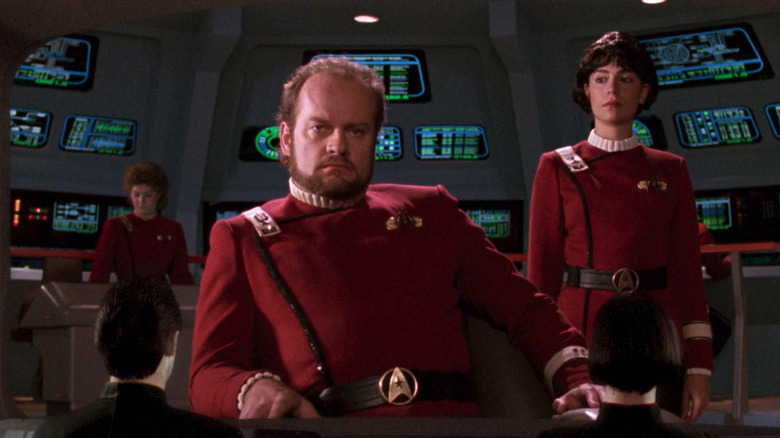
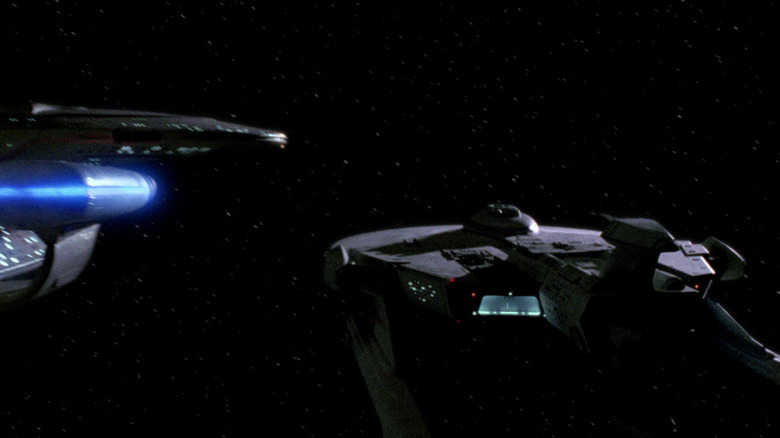
"Cause and Effect" is a time-loop story. That's par for the course in modern sci-fi experience, but back then, it was a novelty. The story is pretty straightforward: The Enterprise-D is destroyed with no survivors, but it's in a space-time anomaly. This traps the crew in a cycle of death. They have to discover the loop through context clues and deja vu, breaking the cycle and freeing themselves and another ship after the Enterprise-D has been caught in the loop for 17 days. The other ship, captained by Morgan Bateson (Kelsey Grammer), reports that they had been caught for 90 years.
When the episode started replaying the same day over and over again, the concept was so new that many members of the audience thought the broadcast had a glitch. They were rewatching the beginning of the episode on repeat. This wasn't a temporary moment, either. Many were so bewildered that they called into the local stations to let them know that there was an issue with the broadcast.
Next Generation was an anthology show
The confusion around "Cause and Effect" extended beyond the audience. It threw off the actors, too. When they got the script, they thought it was a prank. In an interview with The Hollywood Reporter, writer Brannon Braga reflected on the trippy experience, saying, "The early reactions to the script were similar to the reactions that the audience had when watching the episode, which was confusion. Because you're reading that script and you're like, 'Wait a second. There's got to be a mistake here. The acts just keep repeating. Is this a joke?'"
In the end, "Cause and Effect" was a resounding success. After surviving the initial audience confusion, the show has continued to resonate across the years and retains an 8.7 rating on IMDb to this day. It's safe to say "Cause and Effect" aged better than other "Star Trek" episodes, but it almost didn't reach the light of day. The time-related concepts were few and far between on "Star Trek" at the time, and Braga had to do some fancy footwork to side-step creator Gene Roddenberry's dislike of time travel.
They had already touched on traditional time travel in the original series, and Braga had to explain the difference. Straight-up movement backward through time didn't have to be the only approach to storytelling. A loop made things much more interesting. That was just enough to get it approved, and the rest is history — or more accurately, a lovely loop of success that just keeps on entertaining audiences on repeat over the decades.