

The Real Reason Little House On The Prairie Ended By Blowing Up The Entire Town
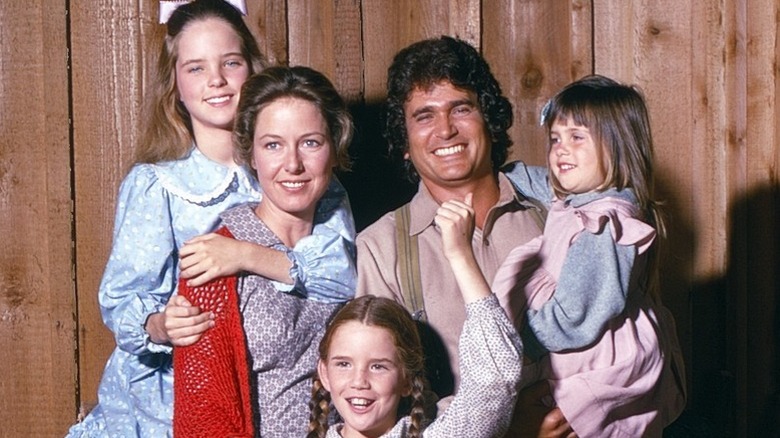
"Little House on the Prairie" always began with an idyllic stroll down a grassy hill, but it concluded with an explosive finale that shook not just the citizens of Walnut Grove, but all who fell in love with the Midwestern town. (Okay, it was really the Big Sky Movie Ranch in Simi Valley, California, but in our minds, it will always be Minnesota.) Viewers may recall that the 1984 series finale, the made-for-TV feature "Little House: The Last Farewell," concludes with the cast coming to the unanimous decision to destroy the whole town — and destroy it they did.
Long before this sort of plot would become commonplace on shows like "Yellowstone," "The Last Farewell," which was both written and directed by Michael Landon, introduced business tycoon Nathan Lassiter (James Karen), who somehow got his hands on the entire deed to Hero Township. With neither the legal system nor violence able to solve this problem, the good people of Walnut Grove are inspired by Laura (Melissa Gilbert) to make such a drastic move of defiance. In the end, they rig everything to explode, except the church and the iconic "little house," of course.
Behind-the-scenes, it's been widely reported that the reason "Little House" ended so spectacularly was due to a deal that the producers made with the real-life landowners. Required to return the land to its original untouched state for the sake of local cattle, Landon thought that the best way to do so was to go out with a big finish. "Mike decided that if the town had to go, he might as well send it out in a blaze of glory on the screen," explained NBC spokesperson Bill Kiley at the time, who also noted that fans would be irate if he had likewise destroyed the little house and the church.
Michael Landon planned to destroy the Little House sets no matter what
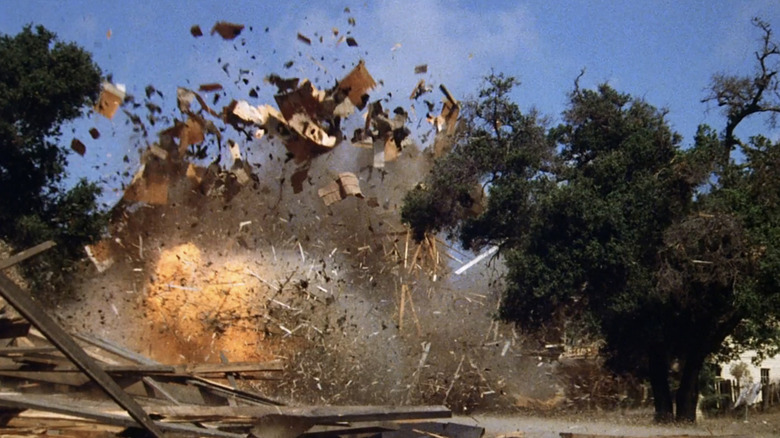
Although NBC's lease agreement forced the producers' hands, Michael Landon saw it as the best possible conclusion. "I think it makes for a good strong pioneer ending," he told The New York Times prior to the airdate. "It was also a nice catharsis for the cast and crew." After several tests, the entire demolition was filmed in a single day. Ironically, the landowners were reportedly already in talks to develop the land by the time the finale aired.
Reflecting decades later, Melissa Gilbert offered further insight into Landon's thought process. "One of the things we talked about was his desire to not have anyone else use our sets," she told Entertainment Weekly in 2025. "Those were ours. We built them." However, she also suggested that part of her on-screen father's motivation for destroying the town was out of spite for the network. "I knew that he wanted to demolish everything because he was so angry that NBC never called him to tell him the show was officially canceled," she explained.
Despite any possible frustrations with the network, however, Landon continued his career-long relationship with NBC. Prior to "Little House," he had earned his spurs by starring in 14 seasons of the hit Western program "Bonanza." Afterward, he and former "Little House" co-star Victor French would reunite for the five-season "Highway to Heaven." Of course, he would always be remembered best as the wavy-haired Charles Ingalls.
Melissa Gilbert was heartbroken by the destruction of Walnut Grove
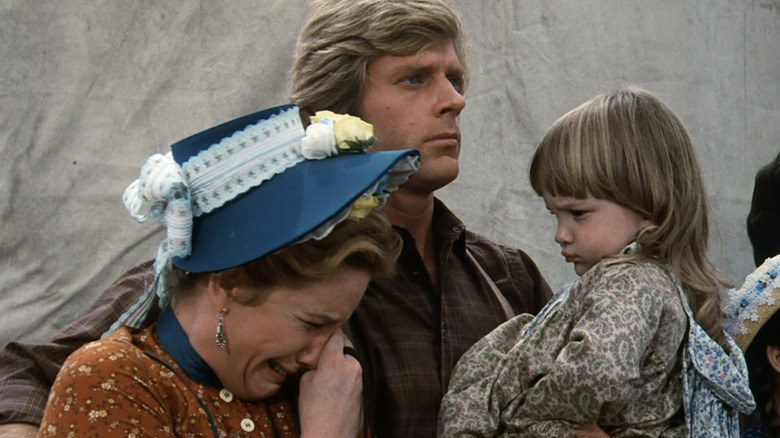
Understandably, the cast of "Little House on the Prairie" wrestled with the series finale. "Every day we had to say goodbye to someone else," Gilbert recalled. "And then when they blew it all up and we gathered that final, final day, it was just devastating and horribly, horribly sad." For many, including Gilbert, it would be the last time that they worked professionally with Michael Landon, who died of pancreatic cancer in 1991. A Christmas special set before the events of the finale, titled "Little House: Bless All the Dear Children," would air that December.
In the retrospective documentary on the series finale titled "Remembering The Last Farewell," Gilbert reunited with co-star Dean Butler, who played her on-screen husband Almanzo Wilder. The two returned to the land where Walnut Grove once stood, which had not been developed after all. There they even found possible remnants of the town. "It was our universe to create; therefore it was our universe to destroy," she recalled (via YouTube). "This was ours, and it should remain ours."
Although "Little House on the Prairie" will never return beyond the rerun, a reimagining of the program based more on the original novels by Laura Ingalls Wilder has found its way to Netflix. Ahead of its premiere, the reboot has already renewed for a second season.