

5 TV Shows To Watch If You Like Cyberpunk: Edgerunners

"Cyberpunk: Edgerunners" Season 2 has recently landed, and while the season is receiving great reviews, it's just as brief as the first. The series dives deep into corporate greed, individuality, resistance, alienation, the ethics of artificial augmentation, and more. These themes are a staple in the increasingly popular cyberpunk genre. It is also quite a feat that a series as short and self-contained became one of the most emotionally charged rollercoasters the genre has to offer.
The neon-drenched landscape, unique character designs, and full-throttle action propelled the show to become one of Netflix's best animated series, and although Rafał Jaki's series is one-of-a-kind, there are a few shows that can offer a similar viewing experience. While these recommendations might not be perfectly in line with the charm of the hit anime, they offer interesting perspectives on the same themes or even share distinct elements of its world.
Westworld

"Westworld" is a dystopian show set in the cruel Westworld amusement park, which is inhabited by humanoid androids called hosts. The park's management allows wealthy visitors to come in and indulge their fantasies on the hosts with no repercussions. The hosts are programmed to have their memories routinely erased and subjected to a cycle of never-ending violence. Dolores Abernathy (Evan Rachel Wood), one of the hosts, gains consciousness and begins questioning the system in place, setting off events that lead to a full-on insurrection from her kind.
While "Westworld" has the same focus on artificial intelligence as "Cyberpunk: Edgerunners," the most interesting similarities lie deeper. Both shows examine the commodification of people and their being exploited by the wealthy. And just like "Cyberpunk: Edgerunners," "Westworld" follows its protagonists as they realize the true depravity of their circumstances before deciding to fight back for their survival.
"Westworld" focuses on literal androids rather than humans, but the underlying connection of corporate exploitation and the desire to rebel is something that viewers will deeply empathize with. It also examines the philosophical fine line that divides humans and artificial intelligence, a theme that is baked into the best TV shows the cyberpunk genre has to offer.
Pluribus

"Pluribus" stars Rhea Seehorn as successful yet grumpy novelist Carol Sturka, who has her life upended when an extraterrestrial virus breaks out and infects nearly everyone on Earth. This virus joins everyone into a shared collective being and turns the victims into a happy and cooperative consciousness. As Carol grapples with the reality of the world and tries to investigate the full picture, she meets up with other survivors and tries to concoct a plan that will undo the virus and restore the world order.
Vince Gilligan's "Pluribus" doesn't have the high-tech cityscape of "Cyberpunk: Edgerunners," and it has a deliberate snail's pace that makes it a complete opposite to the kinetic story of "Edgerunners." However, "Pluribus" serves as a thematic complement because it dives deep into the themes of isolation and alienation that are similarly crucial to David Martinez's character in "Cyberpunk: Edgerunners."
At its core, "Pluribus" is a story about the loss of identity due to a collective hive mind from a god-like being, and this is incredibly similar to how the residents of Night City have their identities stripped away by a megacorp. Both stories feature a protagonist resisting an outside force that threatens to take away what makes them human, as well as liberating those who fell victim to the identity erasure.
The Ghost in the Shell

The recent adaptation of Masamune Shirow's masterpiece "The Ghost in the Shell" proved to be the most vibrant rendition of the manga, and it is a natural follow-up to "Cyberpunk: Edgerunners" because of their aesthetic similarities. It follows the cyborg Major Motoko Kusanagi, who helps to establish the tactical unit Public Security Section 9 and leads investigations into cybercrimes, political corruption, and corporate conspiracies. An investigation into the Puppet Master prompts doubts regarding her identity and if she really is human.
If you loved the vibrant atmosphere of "Cyberpunk: Edgerunners" and its sinister undercurrents, then "The Ghost in the Shell" is the perfect show. While Mamoru Oshii's "Ghost in the Shell" films have traditionally opted for a much more contemplative mood, the 2026 adaptation went full color and its character designs became livelier. The similarities with "Cyberpunk: Edgerunners" extend beyond just aesthetics, as their stories overlap in an interesting manner.
Motoko's arc explores if a cyborg with consciousness can be considered human regardless of their biological makeup, and David's arc focuses on the erosion of humanity after becoming dependent on artificial augmentation. "The Ghost in the Shell" treks into a philosophically potent exploration of humanity through the lens of rapidly advancing technology, a theme that is becoming increasingly relevant.
Psycho-Pass
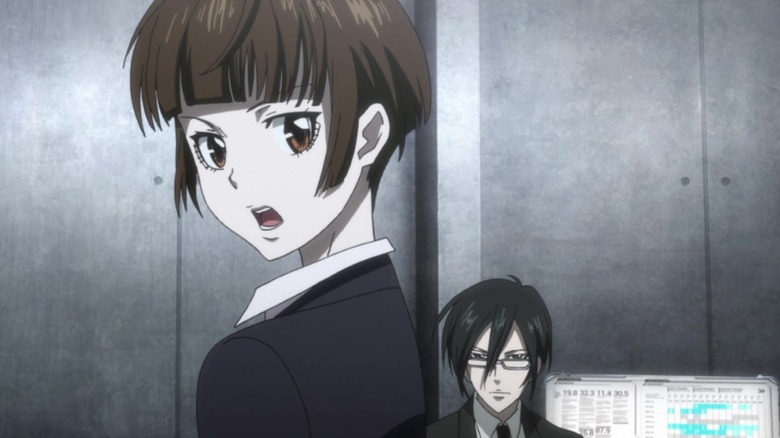
Set in a futuristic society controlled by the Sibyl System, "Psycho-Pass" follows Akane Tsunemori as she joins the Public Safety Bureau's Criminal Investigation Division as a rookie Inspector. The Sibyl continuously monitors the minds of the entire population and uses factors like mental state and personality to calculate the potential for criminality. If a person reaches a certain Crime Coefficient, they are detained or executed before they even commit a crime. Together with veteran Enforcer Shinya Kogami, the strong-willed Akane is confronted with the reality of the "justice" system that she works to enforce.
Whereas "Cyberpunk: Edgerunners" examines the grassroots rebellion of a people crushed by an institution, "Psycho-Pass" follows a protagonist who works for the oppressive system. This is an interesting flip of perspective because both shows have a similar technologically advanced setting but they approach their premises from diametrically opposite but equally intriguing angles. They both question the effectiveness of fighting the system directly or attempting to reform from within — but "Psycho-Pass" takes it a step further and questions whether it's better to keep the status quo that maintains stability despite its glaring flaws.
Mr. Robot

"Mr. Robot" follows Elliot Alderson (Rami Malek), a cybersecurity engineer by day and vigilante hacker by night who struggles with immense depression, anxiety, and loneliness. When he is recruited by the anonymous Mr. Robot to join a hacker group called fsociety, Elliot becomes increasingly entangled in a plot to hack and take down E Corp, the largest conglomerate in the world. During all this, he is forced to confront his inner demons and resolve his deteriorating mental health.
"Mr. Robot" shares several story beats with "Cyberpunk: Edgerunners." The defining characteristic of Elliot and David is their isolation, which is something they grapple with their entire lives. They are both thrust into an underground movement conspiring to take down the dominant corporation, although the resistance in "Mr. Robot" is not nearly as violent. Both shows gradually head toward a climax that wears down the psychological and mental capacity of their protagonists, showing the personal cost that comes with rebellion.
While their similarities are many, "Mr. Robot" homes in much deeper on the emotional toll and the mechanics of revolutionary force. Although the psychological focus of "Mr. Robot" results in a much slower pace than that of "Cyberpunk: Edgerunners," it remains a continuously entertaining show that gave us some of the most mind-bending plot twists in contemporary television.