

10 HBO TV Shows With The Best Finales, Ranked
It's hard to beat HBO's track record for landing the plane, so to speak. The network that popularized the narrative-driven format of what we now call "prestige TV" proved that audiences were ready to consider television series as whole works, rather than a collection of episodes. Thus, it's no surprise they've produced several of the most satisfying series finales of all time.
The episodes below do everything expected of a great series finale. Overarching storylines are satisfyingly resolved, major themes are put to the ultimate test, and characters are granted endings that settle — sometimes in a manner that recontextualizes everything that came before — what the series is trying to tell us about life.
What makes HBO's finales particularly striking is the level of risk involved in elements of the execution — rejecting redemption arcs, climactic showdowns, or final retribution; refusing to acquiesce to expected Hollywood endings, where trust in institutions and leaders is uncritically upheld; deciding to withhold closure when a show wants to explore how we live without it. These qualities make for challenging television — the kind we haven't been able to stop talking about for years after the final credits.
10. Barry
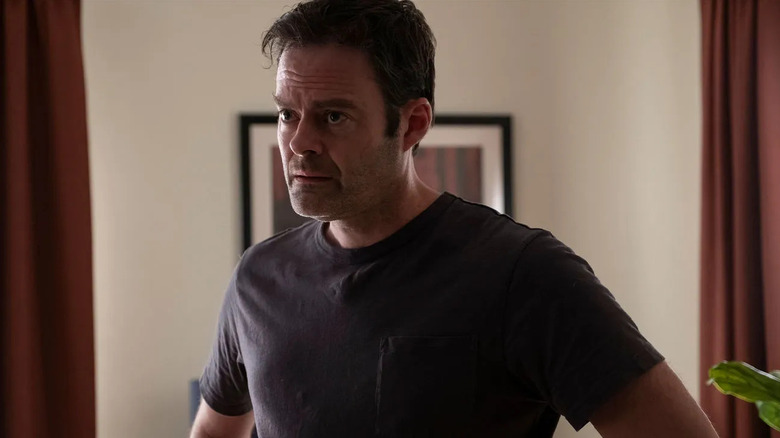
If there was one problem "Barry" was facing heading into its series finale, "wow," it was that the final season had telegraphed where things were heading thematically. Bill Hader and Alec Berg's entertainment industry crime dramedy spends its last episodes carefully stripping down the titular character until he's been reduced to who he truly is beneath his "good guy" act. We could all tell that Barry was not going to regain his self-awareness or compassion, and that he certainly wasn't going to get a triumphant curtain call. Nonetheless, the show surprised audiences one last time by changing course at the last moment, ending on a bleak note that distills the show's overarching thesis.
Ultimately, the dark irony of "Barry" is that nobody can hold Barry accountable for what he's done — not even Barry. When he shows up at Gene Cousineau's (Henry Winkler) house, Barry is shot and killed by his vengeful acting teacher before he can turn himself in. Hollywood rewrites Barry as a slain veteran, while Gene is sentenced to life in prison. The writers orchestrated a scenario where Barry might actually redeem himself by facing the crime, yet took it from him at the last moment. While some might have felt this was less satisfying as an ending, it underscores the show's commentary on how entertainment processes bad men, true crime, and fictional violence. From "Dexter" to "Breaking Bad," the murderous anti-hero always winds up mythologized — at least "Barry" joins the pantheon with a grim wink.
9. Curb Your Enthusiasm
The hallmark of any great series finale is that, structurally, it should stand among the most distinctive achievements of the entire project. In true Larry David fashion, the "Curb Your Enthusiasm" finale accomplishes exactly that by stubbornly repeating a different series ending from 26 years ago.
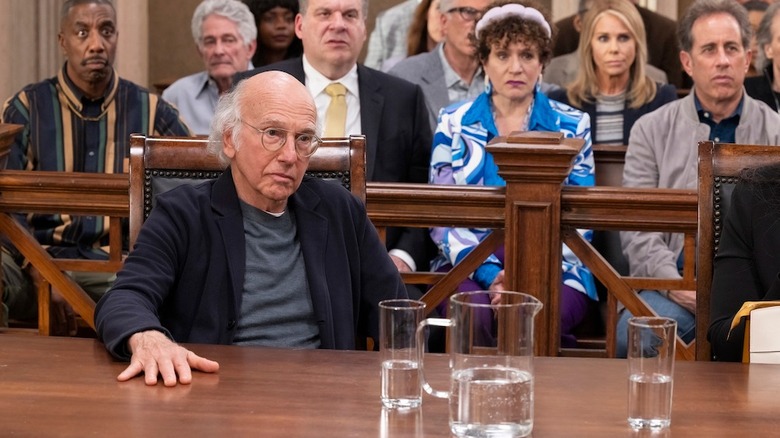
In "No Lessons Learned," the show's fictional Larry David is tried for breaching Georgia's Election Integrity Act. It's a ridiculous use of a real law (so much so that Georgia's secretary of state wrote "Larry" a letter congratulating him on being the first person to be arrested because of it), but it's clearly meant to create the circumstances for Larry to be subject to character testimony based on 24 years of forgotten grievances. In short, it's the exact formula of the "Seinfeld" finale. Most episodes of TV are best when watched for the first time, but there's something singularly hilarious about realizing how David has chosen to end his magnum opus.
At the same time, it also gets to the heart of "Curb Your Enthusiasm" as a comedy. It's a show about a man neurotically dissecting the world one unnecessary conflict at a time, and whose need to be right about the most insignificant things outweighs other basic human needs. Appropriately, "No Lessons Learned" feels like David (in an ironic, self-aware manner) burning his series finale to insist that he was "right" about the "Seinfeld" finale.
8. Silicon Valley

After co-creating "Barry" with Bill Hader, Alec Berg wrote and directed the series finale of HBO's "Silicon Valley." The 2010s sitcom follows the volatile efforts of a tech startup called Pied Piper, which regularly rubber-bands from market dominance to total failure within the span of a few episodes. No TV show has more accurately captured the chaos of the tech industry. Its unprecedented growth toward the end of the decade was actually part of the reason the showrunners opted to end "Silicon Valley" after six seasons, fearing the show would become less funny and believable the more power tech personalities got. Boy, were they right.
The series finale, "Exit Event," has proven to be both unbelievably prescient and depressingly optimistic. The Pied Piper team is forced to sabotage the launch of their own billion-dollar product when they realize they've accidentally created an AI so advanced it will effectively erase digital privacy for good (which sounds like your average AI headline from 2024 onward). Rather than being docked for having a little too much faith in the tech industry, "Exit Event" deserves to be praised for nailing the show's exploration of the Valley's underlying values. It wraps up the series' central themes of failing upward, technological democracy, corporate capture, professional narcissism, and success for its own sake. And one could even argue that the documentary flash-forward justifies its questionable optimism in a quietly, credibly dark way by reinforcing the irreconcilable conflict between ethics and power in the tech world.
7. The Larry Sanders Show
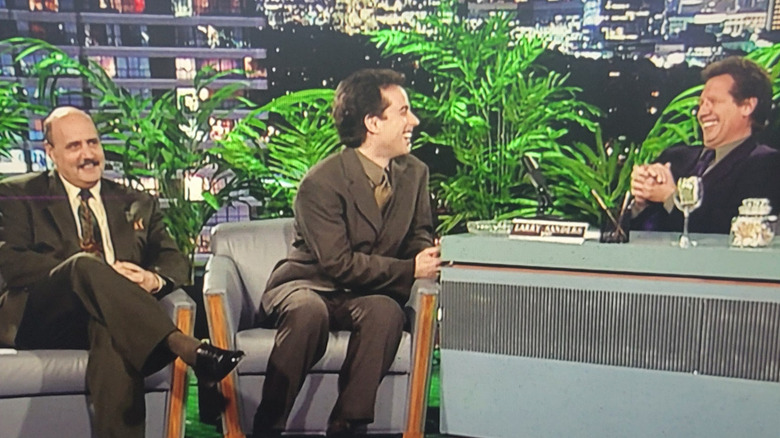
If you've yet to see this classic series almost nobody talks about anymore, "The Larry Sanders Show" ran for six seasons on HBO in the '90s, starring Garry Shandling as a fictional talk show host. It combines the show within a show with behind-the-scenes drama. In the series finale, "Flip," Larry hosts a series finale within a series finale, as he is about to be replaced by none other than Jon Stewart.
The episode is immediately positioned as the antithesis to Johnny Carson's touching farewell to late night. Larry's swan song is loud, chaotic, surprisingly mean-spirited at times, and overwhelmingly mired in ego. The difference can be pretty much summed up by the serenade — instead of Bette Midler, Larry gets Jim Carrey doing a showy rendition of "And I Am Telling You I'm Not Going," after which Carrey says (once the cameras stop rolling) that he's always resented Larry for overlooking him until he got famous enough to be useful. Now, Carrey is using him in just the same way. The entire last season of "The Larry Sanders Show" is audaciously dark, but the series finale uses what should be a moment of triumph to reveal how empty it all was.
6. Veep
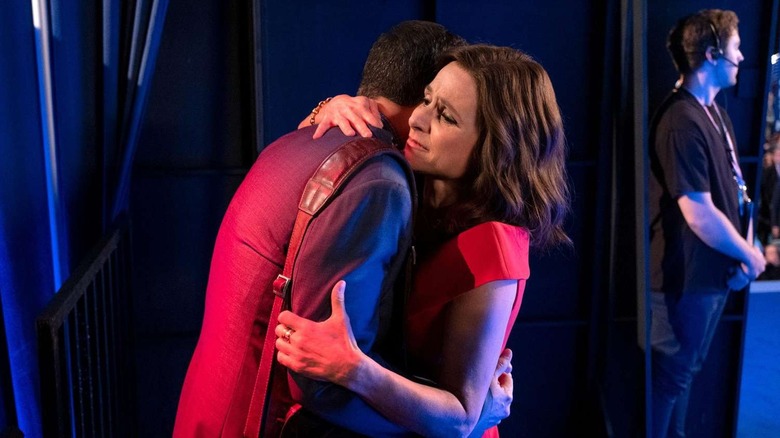
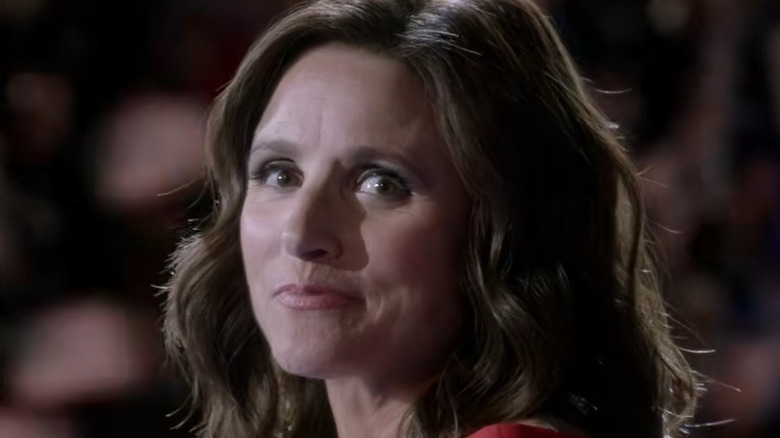
Arguably the best sitcom HBO ever produced, "Veep" remains relevant for its searing satire of the American political machine. In direct contrast to shows like "The West Wing," the series imagines a version of Washington filled with self-serving careerists who are obsessed with power for its own sake rather than wielding it to help anyone. To that end, "Veep" spends its seventh and final season asking how far Vice President Selina Meyer (Julia Louis-Dreyfus) would go to finally win a presidential election. The series finale answered it once and for all in characteristically brutal fashion.
Meyer wins the presidency, but only by betraying every belief and person she held along the way. She sets up her loyal aide, Gary (Tony Hale), to take the fall for her financial crimes, pledges to overturn same-sex marriage (despite her daughter being a lesbian), and selects Jonah Ryan (Timothy Simons), once the useless and entitled White House staffer she openly despised, as her own veep. And, for good measure, she even gives Tibet back to China in exchange for a little election interference.
As far as sitcom finales go, it doesn't get darker than this. More than being about the total moral ruin of a single politician, it paints a picture of irreparable institutional decay that, frankly, gets harder to dismiss every election cycle.
5. The Wire
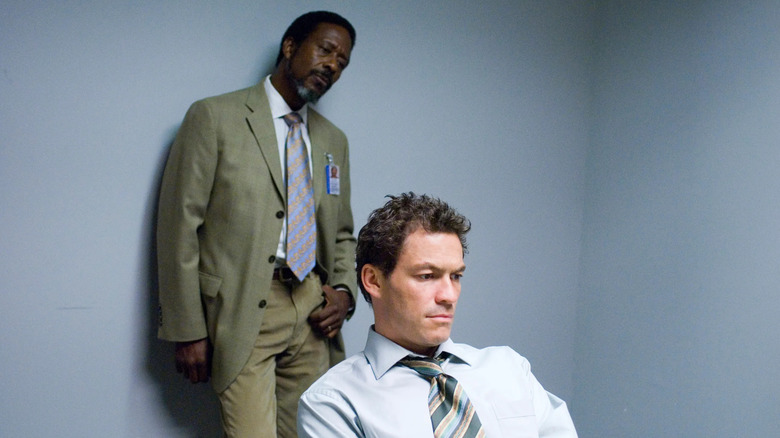
Compared with the rest of the show's widely acclaimed run, the final season of "The Wire" is persistently divisive. It's the only thing that holds it back in conversations about the best TV series ever made. Despite its few remarkable faults, however, it can't be argued that it didn't ultimately give "The Wire" the ending it deserved.
In "-30-," "The Wire" holds true to its core thesis while valiantly searching for good wherever it can. Baltimore's corrupt institutions win out, as justice is served in morally compromising back-room deals. And yet, even Marlo Stanfield (Jamie Hector) — the ultimate villain of the city's drug trade who manages to avoid jail time as the result of one of these very deals — is still trapped in the same life. On both sides of the law, nothing changes. Some people are killed or fired for show, only for someone else to take their place without missing a beat.
It was important for the show to end this way to maintain its credibility. It also challenges the series to find the moments of light, largely in the form of good people choosing to protect themselves from a system that demands their souls. Only Andre Royo's Bubbles gets something close to a true happy ending — it's small, but it feels as cathartic as anything you'd expect from a series finale because "The Wire" earns such small wins through its dedication to reality.
4. Succession
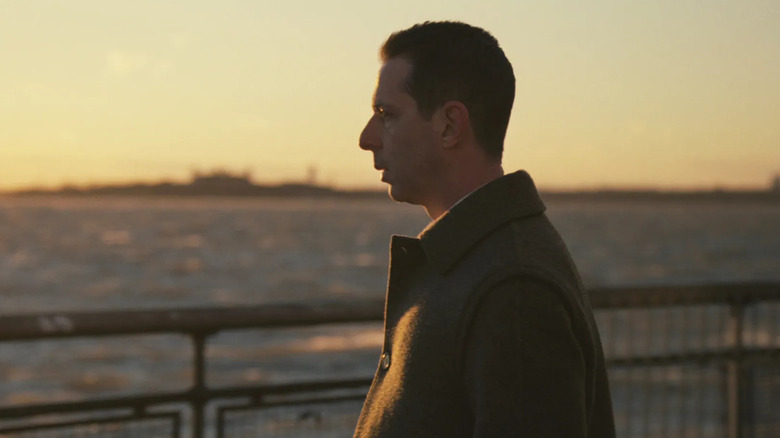
The final episode of "Succession" ranks very high among the best series finales of the decade, period. Jesse Armstrong's satire of an aging American media empire is regarded by its admirers as Shakespearean — thus, "With Open Eyes" plays out like a full-length tragedy that feels all at once inevitable and devastating.
With tech billionaire Lukas Matsson (Alexander Skarsgård) poised to take over Waystar RoyCo from the outside, the three core Roy children (sorry, Connor) finally choose to put aside their differences to save the family business. Then, at the most inconvenient moment possible, they start to realize how much unfinished business they have as a family. What follows the total unraveling of Kendall Roy (Jeremy Strong) is a parade of payoffs and resolutions that are as quiet as they are satisfying — Shiv (Sarah Snook) waiting in a car, passively accepting Tom (Matthew Macfadyen) after his empty victory, is perhaps the most haunting image from the final season; Kendall trudging through Battery Park is a very close second.
Most impressive of all is that the episode proved HBO's more artistically challenging efforts could still be popular hits. In terms of immediate cultural impact and acclaim, it's the strongest series finale of the streaming era (it completely overshadowed "Barry" ending on the same night). It's hard to imagine when a TV event like this will come around again.
3. The Leftovers
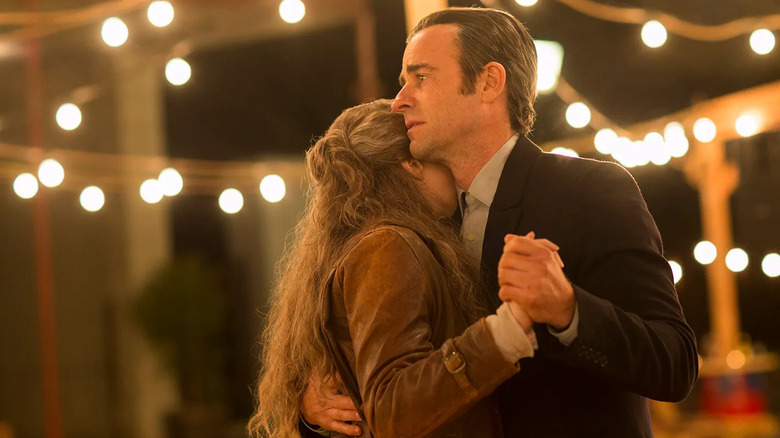
For the entirety of its run, Tom Perrotta and Damon Lindelof's "The Leftovers" was overlooked by broader audiences. If "Succession" was considered challenging for consistently choosing character over climax, "The Leftovers" could be downright alienating. It's a show essentially about a mysterious mass extinction event that asks the audience not to focus on the mystery or the answers. The patient viewers who stuck with the show were rewarded with television's most stirringly bizarre love story.
The series finale, "The Book of Nora," answers what questions are actually important to the series — how does a person move on from tragedy, and how do they learn to trust the world again. Kevin (Justin Theroux) reunites with Nora (Carrie Coon) years after the latter disappeared into a machine that ostensibly showed her what happened to the 2% of the global population that disappeared in the pilot. We never get to see it for ourselves. Instead, Nora simply tells Kevin that it took her to an alternate reality where things were reversed — where all the people they lost are alive and moving on without them.
As Lindelof told TVLine at the time, "The Book of Nora" intentionally keeps Nora's story ambiguous. Withholding that confirmation asks both Kevin and the audience for something even more powerful than trust: having the courage to let go without knowing for certain what happened in the past. The lack of closure would be frustrating if that wasn't the very thing "The Leftovers" was always about.
2. Six Feet Under
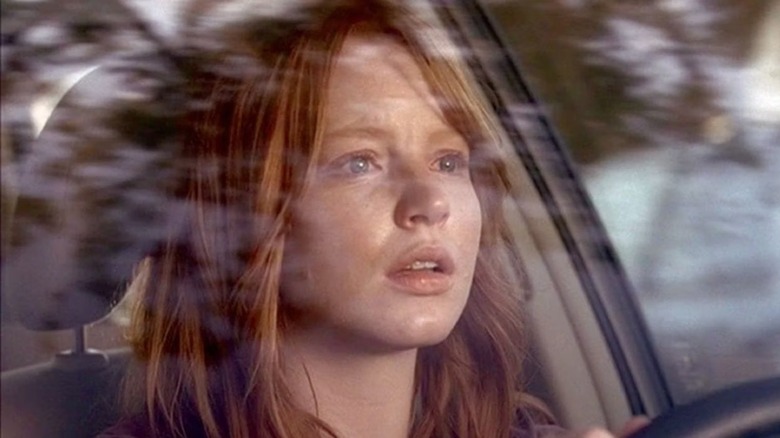
For some of our readers, the No. 2 spot is still too low for "Six Feet Under." It has the contemporaneous acclaim to support a No. 1 finish; for two decades now, it has been widely regarded as the greatest series finale of all time. While we ultimately decided that another show (with a much more controversial finale) deserved the top spot, it's basically a tie between them.
"Everyone's Waiting" is the best of a specific, popular kind of series finale — one rooted in literal storytelling that aims to offer as much closure and narrative catharsis as possible. Nobody does this better than "Six Feet Under," and we aren't going to argue that. And it does so in a way that honors the series' core idea rather than merely fulfilling narrative expectations. After the birth of the daughter of the late Nate Fisher (Peter Krause), the entire ensemble decides to move on from the comfort of their current situations and embrace the risk of the unknown. Even before a single one of them has died, the episode is metaphorically offering an uplifting vision of death.
The show is largely about death as the single human experience that unites us all, regardless of where or how we live our lives. In any other series, an extended flash-forward that procedurally reveals how each character dies would feel silly or indulgent. Here, it feels like the only way the series could truly satisfy what it set out to do.
1. The Sopranos
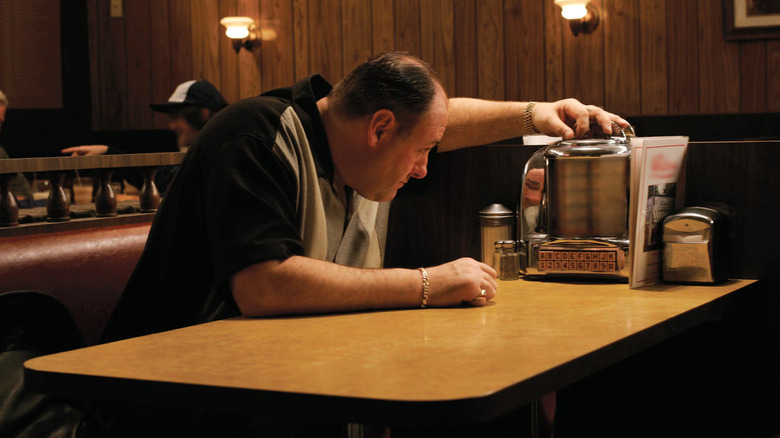
"Six Feet Under" is most people's answer to "the best series finale of all time" both because of 20 years of critical reinforcement and because it was immediately digestible. In contrast, "The Sopranos" needed to sit with broader audiences for a while before it could be appreciated in the same way.
More than "Everyone's Waiting," "Felina" ("Breaking Bad"), or even "Person to Person" ("Mad Men"), "Made in America" leaves the audience with questions they'll have to wrestle with for the rest of their lives. It's tempting (and wrong) to force a black-and-white lens on the finale — James Gandolfini's mobster is an irredeemably evil man who got what was coming to him. But the whole point of the show's gorgeously structured final season is that all of us are made up of contradicting sides, influences, and actions that aren't easily reconciled within our limited understanding of the world around us. The series finale drives this home by drawing the audience's attention increasingly outside the Soprano family — right up to the moment that it asks you to interrogate the histories and intentions of everyone who enters the diner, before snatching away your window into this world for good.
As long as critics have been praising the finale of "Six Feet Under," they've been trying to better understand the finale of "The Sopranos." One explicitly offers a new perspective on life; the other quietly inspires you to search for it yourself. For us, that's the better ending.