

10 Twilight Zone Episodes That Were Way Ahead Of Their Time
"The Twilight Zone" stopped airing in 1964, but that hasn't stopped the show from leaving its mark on television in the decades since. Creator Rod Serling's anthology series offered prescient visions featuring robot companions, erased identities, and younger bodies for sale well before longevity clinics, deepfakes, and AI partners crept into society and made headlines. Fantasy allowed Serling to communicate to viewers what more conventional TV drama of the era simply couldn't, and that creative freedom helps explain why it arguably remains the best sci-fi anthology TV show ever made.
CBS aired 156 episodes across five seasons starting in 1959, and Serling's narration bookended the stories. Many of those episodes feature a reveal that is notable, but for this list, a terrific twist simply isn't enough. Each pick also had to anticipate an argument people are having now. So, by that standard, even "Time Enough at Last," one of the best "Twilight Zone" episodes of all time, had to sit this one out.
Among the episodes that made this list: "The Obsolete Man," where a librarian turns his own execution into live television, and "Long Distance Call," which centers on a boy whose dead grandmother calls him on a toy phone. Both episodes, in their own way, saw the present day coming, along with eight others, listed below in the order that they aired.
The Lonely
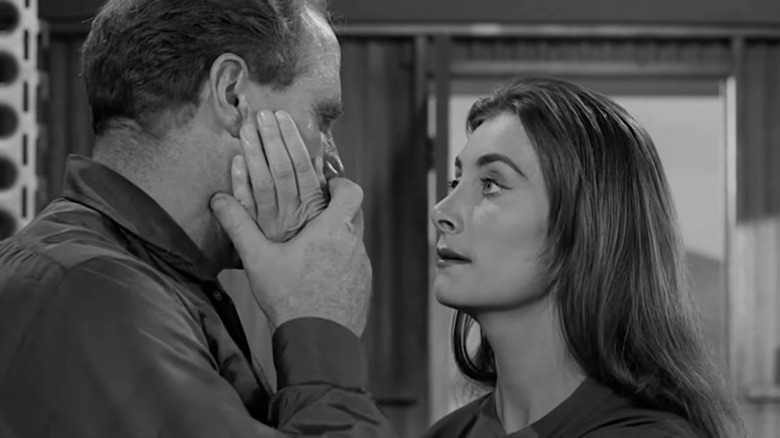
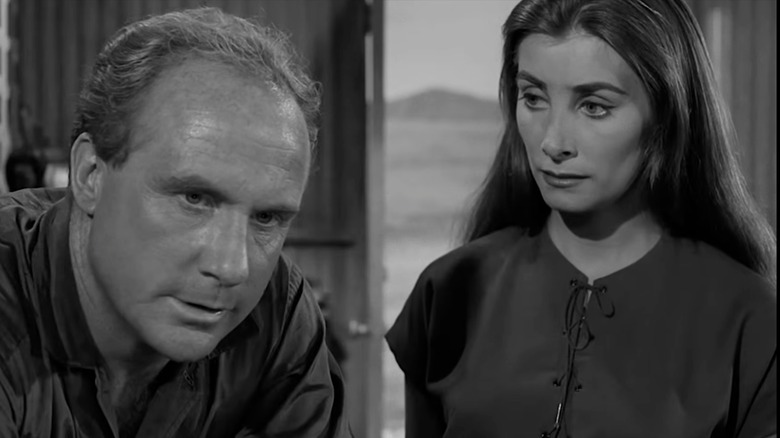
In this Season 1 episode, convicted murderer James A. Corry (Jack Warden) has more than four decades left to serve on an asteroid where his only visitors are the crew of a supply ship. On one stop, they leave him an extra crate, which contains a lifelike female robot, Alicia (Jean Marsh). Corry's first instinct is to treat her as some kind of cruel joke. But the joke ultimately turns out to be on him: He comes to view her as a woman and falls in love with her.
When Corry is eventually pardoned, he faces a dilemma, as the ship's weight limit only allows him 15 pounds of belongings. Taking Alicia isn't an option. Captain Allenby (John Dehner) settles the matter by shooting Alicia in the face.
With "The Lonely," Serling seemingly taps into the burning question we face now of whether AI companion apps really address a human's emotional needs and whether that unconventional kind of companionship is enough. Serling keeps the show's focus on Corry and manages to trace how a man who initially rejected a robot is eventually unwilling to leave her behind. In the end, this "Twilight Zone" episode seems to understand that digital company is at its most dangerous when it works well enough to keep a person from seeking out the real thing.
Eye of the Beholder
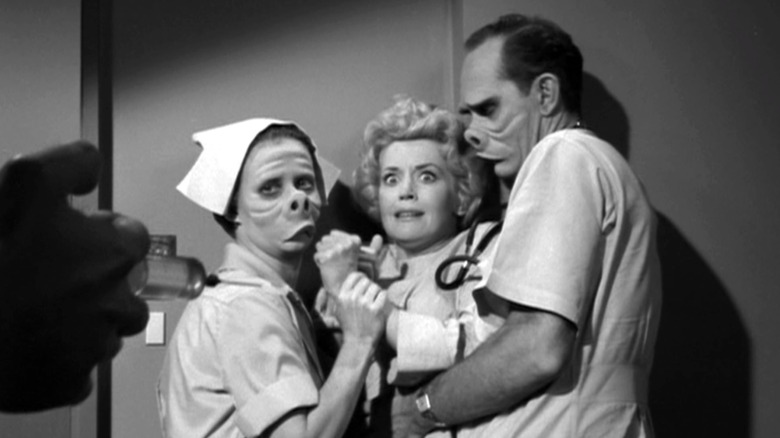
"Eye of the Beholder" spins intrigue from the start, centering on Janet Tyler (Maxine Stuart under the gauze, Donna Douglas after), whose face spends most of this episode bandaged up. Ten treatments on her face, trying to make her look "normal," have already failed, and the State, unfortunately, permits no more than 11. If this attempt fails, Janet will be moved to a separate community. Director Douglas Heyes frames the staff in silhouette and over-the-shoulder shots, so the people deciding her fate stay faceless. When the gauze comes off Janet's face, the staff reacts in horror, and the camera finally shows them. Every doctor and nurse has a pig's snout. Janet's face, ironically, could grace a '60s magazine cover.
It's one of the best "Twilight Zone" plot twists. Serling treats a face like a case file, where Janet's visage is the condition and the doctors and nurses discuss her with the weary voices of people following protocol. Back in 1960, when the episode aired, the scenario played out like a pointed Cold War satire. Now, though, cosmetic injections are pitched and embraced as routine upkeep so people can better conform to current beauty standards. Serling rightly guessed, even then, that beauty would become a matter of compliance, even if the pressure comes today in the form of different degrees of social pressure. But what he didn't guess was how much some of today's patients would want to schedule the follow-ups themselves.
Long Distance Call
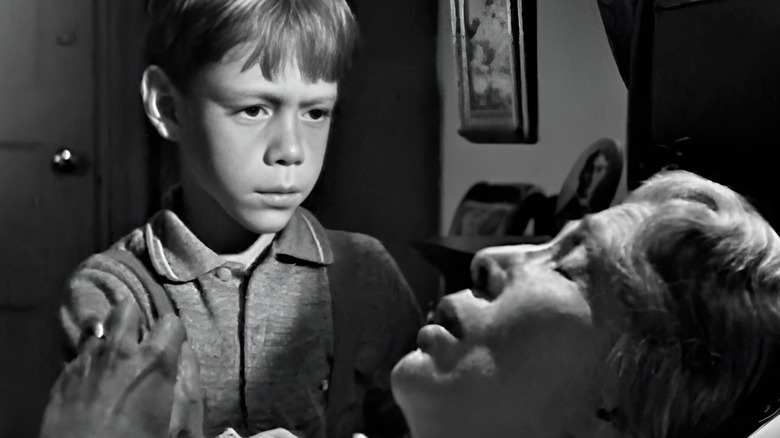
In this Season 2 episode, Grandma Bayles (Lili Darvas) gives her 5-year-old grandson Billy a toy phone for his birthday and dies soon after. Then, Billy (Bill Mumy) starts taking calls on it, chatting away in his room with a mysterious voice that wants Billy to come be with her. The script of "Long Distance Call," which helped launch Bill Idelson's TV writing career, was inspired by a toy phone his mother had given his young son. Billy's father (Philip Abbott) finally takes the receiver and bargains with his own mother for his son — a grown man negotiating with a toy. The scene is moving, and pointed about who does the letting go. Billy, for his part, won't hang up.
Fast-forward six decades, and companies now sell chatbots and voice clones based on the texts and recordings of late loved ones. "Long Distance Call," for its part, explores the moral dilemma of whether a voice from beyond helps someone properly process the loss of a person or whether it just drags them down further. The grieving person doesn't hang up on a voice designed to sound like the person they lost, and nothing on the other end of the line is designed to let them go. In 1961, the episode suggested the off switch belonged to those emotionally ready to move on, and that they might be the only ones willing to use it.
The Obsolete Man
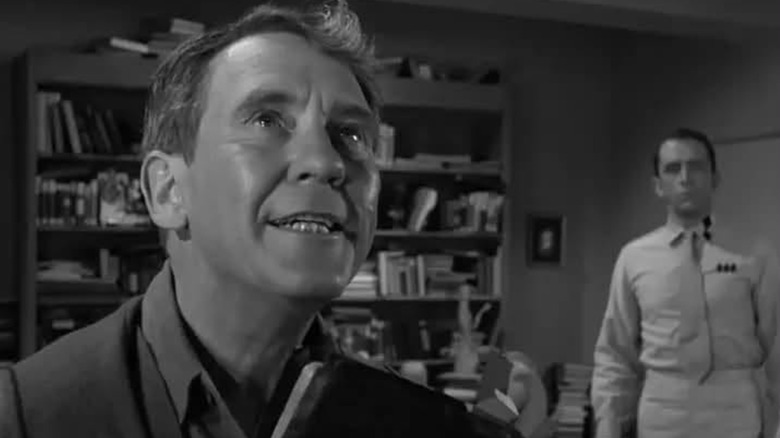
In "The Obsolete Man," society has done away with books and even God, which leaves librarian Romney Wordsworth (Burgess Meredith) with no job and no social standing to speak of. In court, a chancellor (Fritz Weaver) declares Romney obsolete, letting him choose how he wants to die. Wordsworth picks to have a bomb in his apartment with a camera broadcasting the moment. He invites the Chancellor over to watch, then locks the door. Romney, in his way, gets a form of revenge when the State's representative ends up begging, on television, in the name of a God he claimed didn't exist. The Chancellor, who escapes the blast, receives his own sentence; back in court, he's also ruled useless to the State, and the crowd that jeered Romney turns on him. The episode leaves no doubt about which man's fate is worse.
"The Obsolete Man" can be read as a Cold War warning about totalitarianism. Its version of government has decided reading is pointless, and that scenario taps into ongoing concerns around censorship. PEN America logged 11,982 book bans in public schools during the 2025-2026 school year, a record for the group, which started counting in 2021. Today's fights over book banning may not reach the stark life-or-death stakes of those depicted in "The Obsolete Man," but Serling's general logic arguably still holds. After all, once society decides certain literary ideas are expendable, the people who advocate for freedom of expression can be at risk, too.
The Midnight Sun
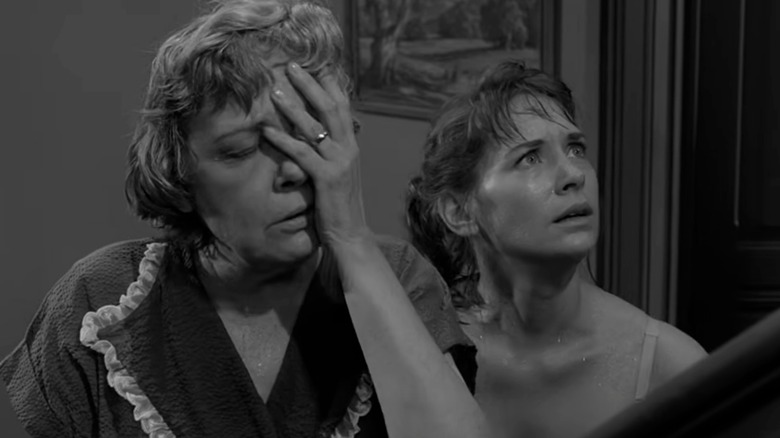
In this sweltering version of the world, the temperature hits 110 degrees, and it's climbing. Earth's orbit has shifted toward the sun, which looms larger by the day and never sets. Norma (Lois Nettleton) paints in a New York City building that has emptied out around her. The other tenants have packed up and gone, leaving her with Mrs. Bronson (Betty Garde), who runs the building. The two women split what water is left until a desperate stranger forces his way in. The heat starts melting Norma's paintings. Then Serling springs the twist: Norma is really sick in bed, burning up with a fever in a freezing city, because the Earth is actually drifting away from the sun.
This Season 3 episode largely stays inside Mrs. Bronson's building, so viewers read events through the increasingly desperate characters and dire radio announcements. The show's twist, swapping fire for ice, underscores that how society crumbles in the face of impending catastrophe is worth paying more attention to than the drastic shifts in weather. That scenario has stopped sounding hypothetical in the decades since the episode aired in 1961, as NASA reported 2024 was the hottest year to date. "The Midnight Sun" pictures the end of the world arriving by a climb in temperature, one degree at a time, which today doesn't sound nearly as far-fetched as it did then.
Five Characters in Search of an Exit
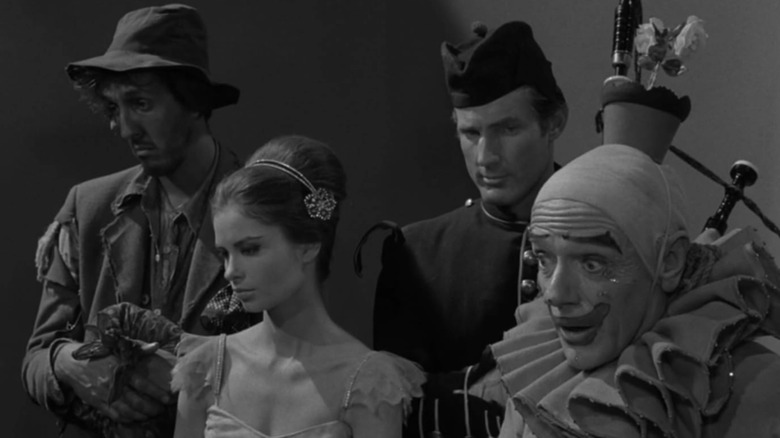
When an Army major (William Windom) wakes up at the bottom of a tall metal cylinder, he can't recall who he is, and neither can the four others already there: a clown (Murray Matheson), a hobo (Kelton Garwood), a ballerina (Susan Harrison), and a bagpiper (Clark Allen). The five of them also, strangely, don't feel hunger or thirst. The major insists on finding a way to escape, but the clown insists there's no point to it. They form a human ladder and the major goes over, only to land in the snow outside a toy donation bin, revealed to be a doll.
This Season 3 episode aired days before Christmas, which earns it one of the top spots among every "Twilight Zone" Christmas episode. The title seemingly riffs on the title of Italian writer Pirandello's "Six Characters in Search of an Author," but the episode's ideas belong to a conversation society might have decades later. The far-flung concept of whether people are living in a simulation wasn't yet a dinner-party topic when the episode questioned what it means to discover that your world was built by someone else for an unknowable purpose. What makes "Five Characters in Search of an Exit" feel modern is a twist that ultimately doesn't free its characters, but instead reveals who built the walls of containment, leaving viewers unsettled in the best possible way.
Person or Persons Unknown
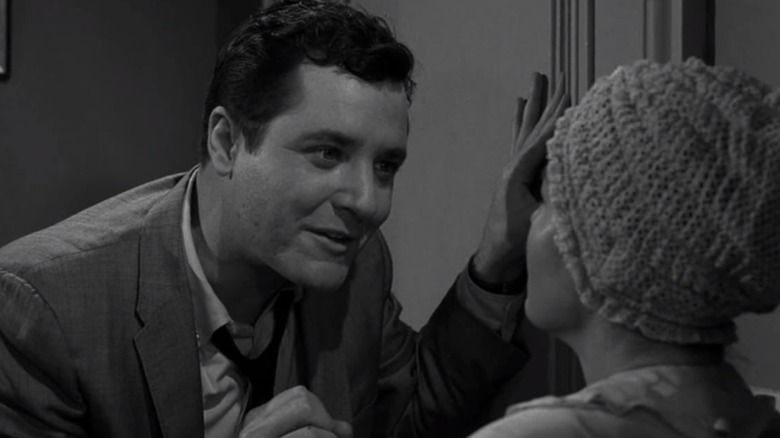
When a hungover David Gurney (Richard Long) rolls out of bed, his wife screams, because to her, he's a stranger. David also isn't recognized at his bank job, at his usual bar, and even on the phone with his own mother. It turns out there's simply no record of him anywhere. When the police bring him to a psychiatrist (Frank Silvera), he receives a diagnosis: David is a character that David himself made up. His one remaining piece of proof, a photo of him with his wife, is now missing his partner.
"Person or Persons Unknown" draws its power from how ordinary David's office, bar, and apartment look. David's world looks the same, but David has seemingly been erased. That idea lands harder now. While losing every trace of oneself overnight may have been an existential fear in 1962, when the episode aired, today, there's also technology to think about. In an era of deepfakes and dueling versions of the truth, the terror of everyone denying someone's reality seemingly hits closer to home. David's situation mirrors what people may experience when they're scammed by technology or their truth is simply not believed. The episode's cruelest twist comes toward the end: David wakes up once again, his world apparently restored, but his wife now has a different face. The ending suggests that when a life is thrust into deep doubt, or even yanked away once, it can never be fully trusted again.
The Trade-Ins
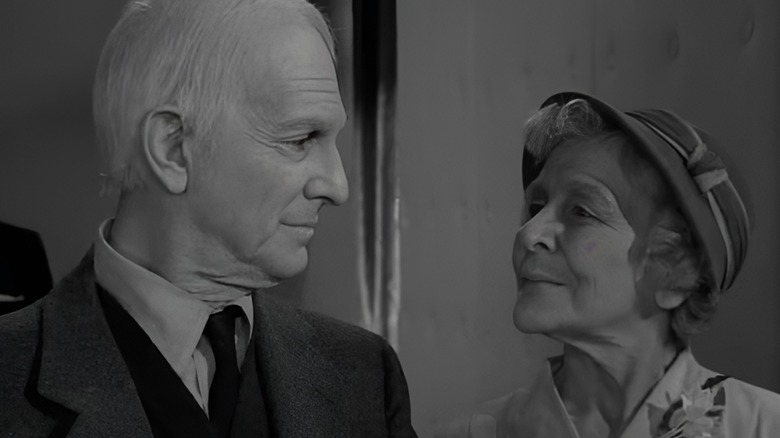
The showroom in "The Trade-Ins" may resemble an auto dealership, but the models on display are anything but cars. An elderly couple, John and Marie Holt (Joseph Schildkraut and Alma Platt), have come to trade in their aching bodies, but their savings only cover one swap. Hoping to pay for a second, John brings the money to a card table, where a gambler (Theodore Marcuse) nearly cleans him out, then lets him walk away with it rather than take it from an old man. John takes the new body, but when he sees Marie's face, he asks the technicians for his old one back.
This Season 3 episode should be remembered just as much for the couple's deep-seated devotion as for the plot which tests it. The company charges per body, so for this couple, their love becomes the strangest kind of financial problem where they must pick who gets the upgrade. It's a smart, early take on the concept of consciousness transfers, and it saw the drawback inherent to today's obsessions over longevity: The rich get to live longer first, because they can afford to. Serling even foresaw then how a market for youth could possibly split up people or bring them closer together.
Steel
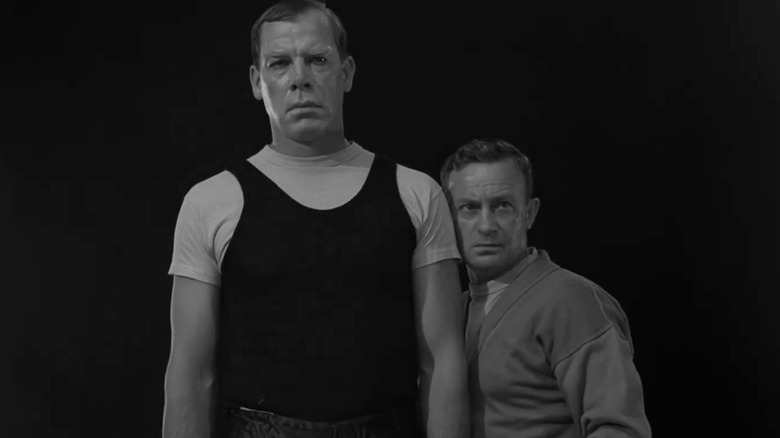
In this version of 1974, prizefighting survives on one condition: both fighters must be robots. Retired prizefighter "Steel" Kelly (Lee Marvin) now travels with a B2 robot named Battling Maxo, a model easily outclassed by newer ones. The pair's first fight in months is threatened when Battling Maxo unexpectedly breaks down beforehand. Without a fight, Kelly gets no money, so he chooses to take Maxo's place in the ring, disguised as his own robot, against a machine designed to hit harder and cause more physical damage than any man ever could. The promoter chooses to pay him half, and Kelly's partner, Pole (Joe Mantell), patches him up.
Marvin, among the movie stars who appeared on "The Twilight Zone," plays Kelly without vanity, and Richard Matheson's story later grew into "Real Steel," a Hugh Jackman sci-fi movie released in 2011. The ending of the episode, which leaves Kelly bruised, battered, and budgeting for robot parts, still feels incredibly relevant. A scenario in which machines are taking over people's work, and people refusing to step aside, arguably resembles the social currents we're seeing today around AI, automation, and human workers pushed out of jobs. As AI creeps into different industries, and workers strive over and over to justify their relevance, the dilemma laid out in "Steel" now makes the episode feel less like a relic than a preview of what may come.
The Old Man in the Cave
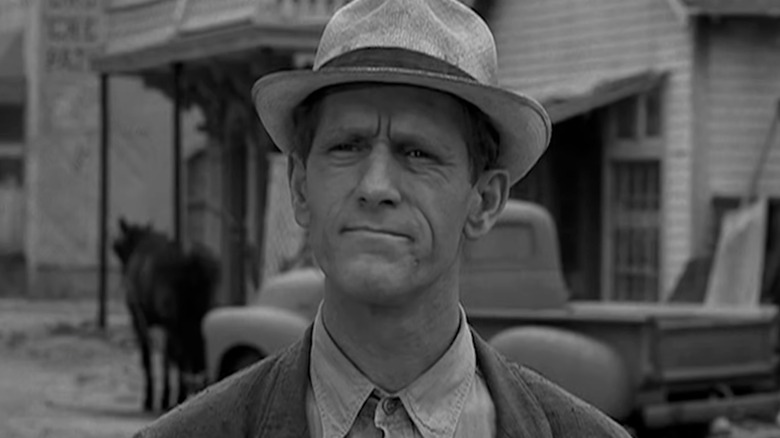
Set a decade after a nuclear war, "The Old Man in the Cave" centers on a desolate town, where the rules, mysteriously enough, come from a cave. Mr. Goldsmith (John Anderson) climbs to the cave, takes messages from an Old Man no one else has met, and returns with answers. In the Season 5 episode, the town seeks a response about canned goods, and the answer is "no," because the food is apparently contaminated. But Major French (James Coburn) and his soldiers arrive and argue otherwise. Egged on by French, the townspeople eat, make Goldsmith open the cave, find a computer, and wreck it. The food, it turns out, was really tainted, leaving Goldsmith, who refused to wolf it down, as the town's last survivor.
The episode's deeply complicated relationship with technology makes it feel especially contemporary. The Old Man's record is spotless, and every survivor in that town is clear proof of that. Given the choice, though, the townsfolk would rather follow a man with a weapon over a detached voice that never steered them wrong. But learning that the steady voice of reason really belonged to a computer instead of a human only makes them angrier, leading to their deaths. Now, in an age of chatbots, the episode's question about how far to trust a machine over others and one's own instincts makes the episode still feel remarkably timely.