

10 Best TV Shows Like The Orville
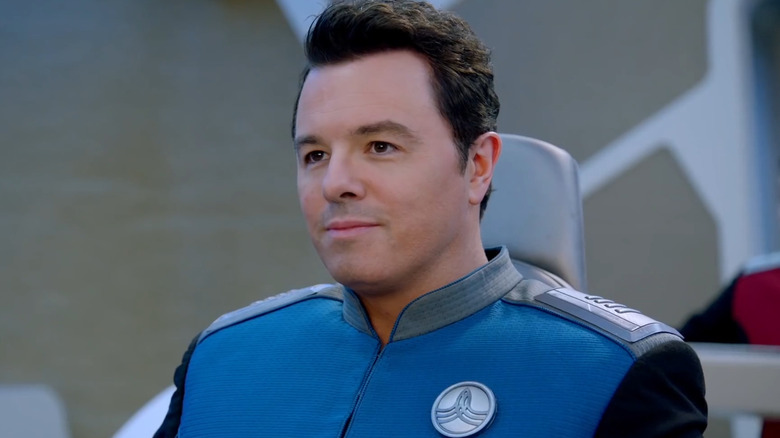
Noted sci-fi fan Seth MacFarlane created his first live-action television series with "The Orville" in 2017. Proudly displaying its genre influences, the show has Captain Ed Mercer (MacFarlane) lead the titular exploratory starship as it ventures across the cosmos on behalf of the Planetary Union. Though the series does include a fair bit of screwball comedy, it also delves into emotional themes and packs quite the emphatic storytelling punch.
However, despite its fans, there haven't been any new episodes of the show since the conclusion of its third season in 2022. As viewers hold out hope for additional updates from MacFarlane about a potential Season 4, there are plenty of similar shows to watch in its place. This ranges from other geek-friendly genre comedies to the series that visibly inspired MacFarlane in the first place. Here are the 10 best TV shows like "The Orville," for those looking for lighter sci-fi and genre adjacent shows.
Star Trek: The Next Generation
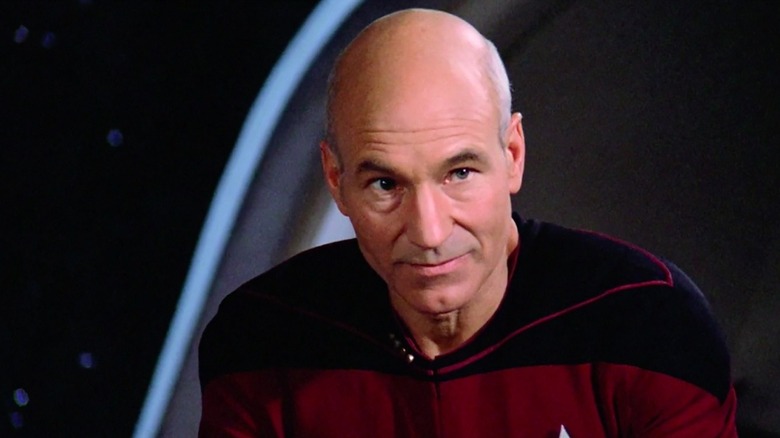
Really, any of the "Star Trek" series from the '80s and '90s could make this list due to their clear influence on "The Orville." For the sake of variety, we're just keeping things to "Star Trek: The Next Generation," which revitalized the franchise on television after premiering in 1987. Set approximately a century after "The Original Series," "TNG" follows the exploits of the Enterprise-D as it explores the galaxy. The starship's captain during this era is Jean-Luc Picard (Patrick Stewart), joined by a set of effective senior Starfleet officers.
Admittedly, "The Next Generation" is a TV show with a bad first season, but the series rapidly improves as it progresses. The show set a template for the franchise moving forward into the '90s, something that "The Orville" visibly took its own cues from decades later. This includes a more nuanced and richer emotional maturity than earlier iterations of "Star Trek" in television and film. Anchored by a strong ensemble cast and sharp writing, "Star Trek: The Next Generation" completely redefined the tone for the franchise.
Red Dwarf
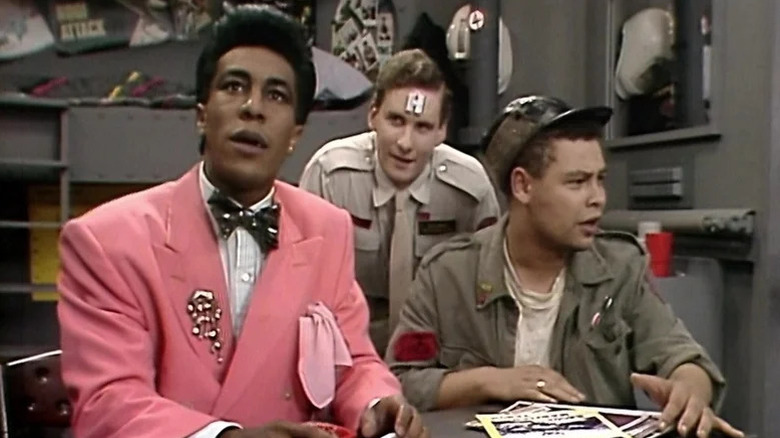
The granddaddy of spacefaring spoofs on television is the British sitcom "Red Dwarf," which premiered in 1988. The show centers on low-level engineer Dave Lister (Craig Charles) who is placed in suspended animation for three million years. Emerging from stasis, Dave discovers that he's apparently the last living human in the universe as he patrols the cosmos while inside the mining vessel, the Red Dwarf. The crew is filled out by other misfit figures, including the evolved humanoid cat (Danny John-Jules) and a hologram of Dave's old bunkmate Rimmer (Chris Barrie).
"Red Dwarf" was a staple on British television for over a decade before coming to an end in 1999, only to receive a revival series in 2009. Throughout this impressive run, the show has maintained much of its principal cast and creative talent, giving it an enduring sense of consistency. Over the years, the series evolves in scope while maintaining its quirky humor, weaving in more ambitious sci-fi elements as the story advances. One of the greatest British TV shows of all time, "Red Dwarf" is a cross-cultural cult classic.
Futurama
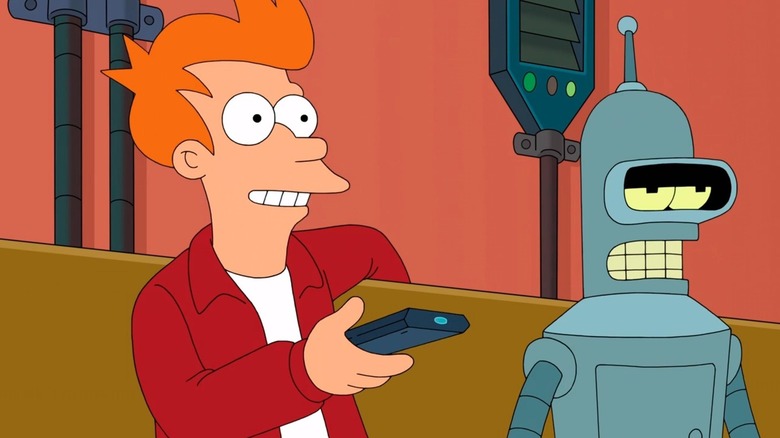
After creating "The Simpsons," animator Matt Groening turned his attention to sci-fi comedy with 1999's "Futurama." The animated series begins with pizza delivery guy Philip J. Frye (Billy West) accidentally being cryogenically frozen at the dawn of the 21st century and revived a millennium later. Despite the futuristic advanced society Frye finds himself in, he still is relegated to becoming a deliveryman, this time on an interstellar scale for the company Planet Express. Frye quickly befriends his co-workers and falls head-over-heels in love with his supremely confident captain Turanga Leela (Katey Sagal).
More than just being a 31st century transposition of "The Simpsons," "Futurama" features its own unique brand of humor. Comparatively, the show featured a more definable narrative, largely revolving around the tentative courtship between Frye and Leela. This highlights how much more sentimental "Futurama" can get than Groening's other work, producing sitcom episodes guaranteed to leave viewers in tears. Revived on multiple occasions, including a resurgence on Hulu, "Futurama" is an enduring sci-fi comedy gem.
Silicon Valley
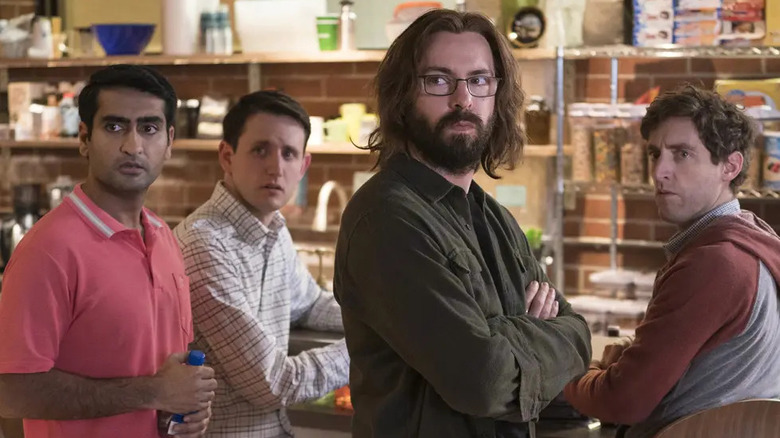
Offering a change of pace from the shows in this article that feature interstellar antics, the 2014 workplace comedy "Silicon Valley" offers a different sort of geek-friendly humor. The show takes place in the heart of the American tech industry in Silicon Valley, California and focuses on a group of ne'er-do-wells who launch their own startup. Leading the group is programmer Richard Hendricks (Thomas Middleditch), who creates a revolutionary data compression algorithm through an app called Pied Piper. Recognizing the algorithm's importance, the predatory corporate tech figure Gavin Belson (Matt Ross) tries to reverse-engineer it and manipulate Richard and his friends to obtain the ground-breaking tech tool.
Using the software tech industry as its backdrop, the real appeal to "Silicon Valley" is in its eccentrically memorable ensemble cast. Whether it's the hilariously deadpan Martin Starr or the reliably funny Kumail Nanjiani, the main characters' bickering and bantering fuel most of the laughs. This is matched by Ross' comedically over-the-top portrayal as the slimy Gavin Belson, who is as clueless as he is conniving. "Silicon Valley" ended at HBO after six seasons, but with so many oversized personalities in the tech industry today, its sense of humor has tremendous staying power.
Future Man
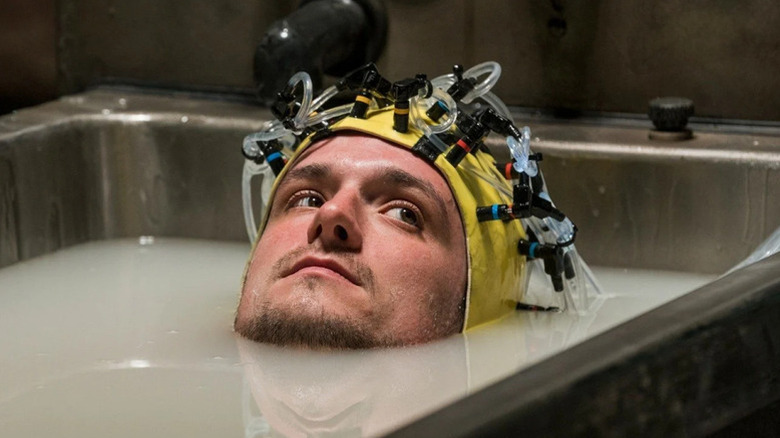
The video game hero premise of "The Last Starfighter" and "Ready Player One" gets a comedic spoof with the Hulu original series "Future Man." The show centers on directionless young janitor Josh Futturman (Josh Hutcherson), who still lives with his parents and dedicates his free time to playing the video game "Biotics Wars." After completing the game, which everyone believed to be unbeatable, Josh is recruited by soldiers from a distant future because of his impressive achievement. Together, the ensemble looks to prevent a post-apocalyptic future from coming to pass where humanity is enslaved by malevolent biotechnology.
Just like the sci-fi movies that it parodies, "Future Man" is gleefully over-the-top and aware how ludicrous its premise is. Hutcherson showcases his sharp comedic chops and willingness to lean into self-effacing humor right from the opening episode and maintains this throughout the series. As the show progresses, it references other classic '80s sci-fi as the story expands to alternate timelines based on the characters' actions. A raunchily funny skewering of gaming-oriented pulp fiction, "Future Man" takes full advantage of mining its genre inspirations for material.
Mythic Quest
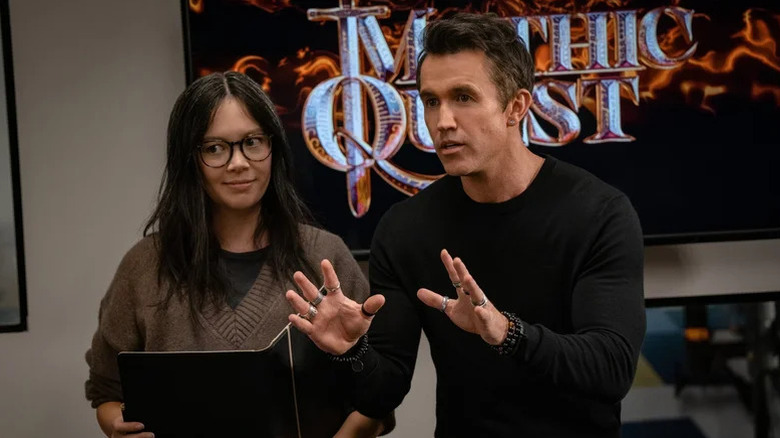
Another workplace comedy dealing with a different aspect of software and technology is the Apple TV original sitcom "Mythic Quest." The show follows the dysfunctional relationships between the developers of the popular online fantasy game "Mythic Quest," initially headed by creative director Ian Grimm (Rob Mac). The staff endures everything from releasing new game updates to an increasingly discerning public to trying to go into business for themselves with their own offshoot studios. This comes as the core group's tricky dynamics evolve, blurring the lines between professional and personal on more than one occasion.
Compared to Rob Mac's unapologetically ribald "It's Always Sunny in Philadelphia," "Mythic Quest" is much more emotionally complex and willing to go into dramatic territory. The show repeatedly gets quite raw with its characters' vulnerabilities, particularly the contentious dynamic between Ian and co-creative director Poppy Li (Charlotte Nicdao). Apple TV pulled the plug on the show after four seasons, making it one of the most disappointing TV cancellations of 2025. But "Mythic Quest" did leave its mark, showing how serious its creative team could take its subject matter while still delivering steady laughs.
Upload
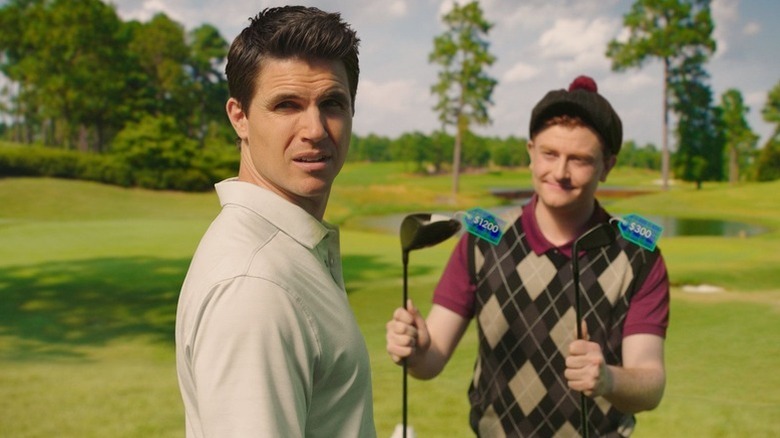
The afterlife turns digital in the Prime Video original series "Upload," which premiered in 2020 and ran for four seasons. The show takes place in a near-future where users can pay to have their own custom virtual afterlife where their consciousness is digitally uploaded into after their death. The story follows young computer programmer Nathan Brown (Robbie Amell) who dies suddenly and is transferred into the virtual afterlife community of Lakeview. As Nathan acclimates to his digital life after death, he grows close to living customer service representative Nora Antony (Andy Allo).
Created by Greg Daniels, "Upload" features a sharper sense of social commentary than his other television work, skewering everything from microtransactions to unfettered materialism. This adds a knowing wink to the show's humor, which can admittedly venture into more surreal territory, given its post-death premise. Tonally, the show grows more diverse as it continues, veering from murder mystery to a tale of full-on corporate conspiracy and malfeasance. Multifaceted in its comedy and backed by a strong ensemble cast, "Upload" is one of the funniest shows that Amazon ever produced.
Solar Opposites
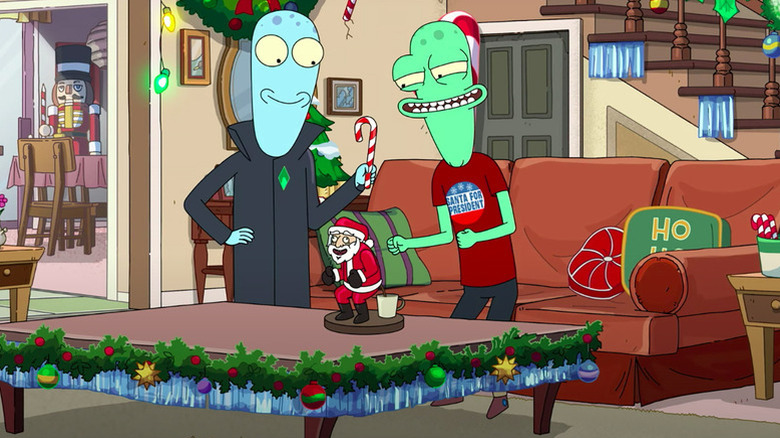
One of the strongest original animated series on Hulu is "Solar Opposites," which pokes fun at picturesque American domesticity. The show features a family of aliens who crash on Earth and begin living a relatively innocuous life in modern suburbia. The family is led by Korvo, initially played by series co-creator Justin Roiland before he was replaced by Dan Stevens, and Terry (Thomas Middleditch). The couple's contrasting views on humanity forms much of the show's comedic foundation while the family deals with threats from the cosmos resurfacing to haunt them.
Despite its extraterrestrial main cast and the ridiculous antics that they regularly get into, there is a surprising sincerity to "Solar Opposites." While moving at a relatively brisk pace, the show knows to build out arcs and the underlying appeal of its characters as outlandish as the proceedings get. To be clear, this doesn't translate to wholesome fun, with the humor often getting quite dark and violent, right within its creative team's wheelhouse. But "Solar Opposites" succeeds in finding the heart in its surreal comedy while delivering its own warm family dynamic.
Star Trek: Lower Decks
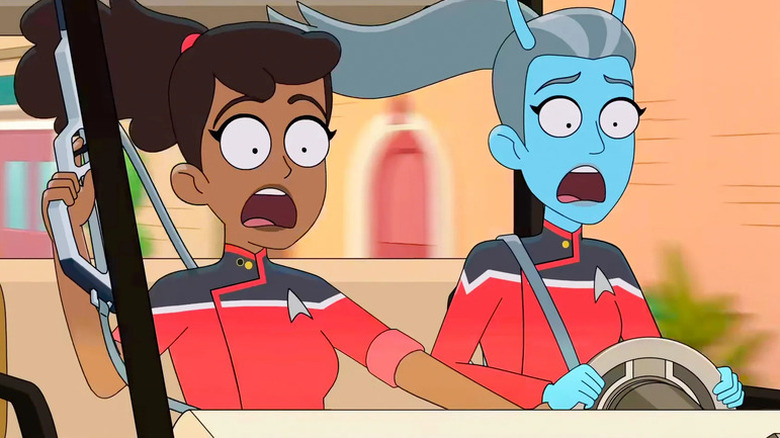
Of the current generation of "Star Trek" shows that began with "Star Trek: Discovery" in 2017, the closest one tonally to "The Orville" is "Star Trek: Lower Decks." The animated series debuted in 2020 and is set shortly after the events of the "Next Generation" movies. The show follows on the Cerritos, a service ship that handles the more menial tasks offered by Starfleet across the cosmos. The story focuses on the Cerritos' junior officers, some who are eager to make a difference in the galaxy and others who buck authority in their own quirky way.
"Lower Decks" is the first overtly comedic "Star Trek" show and it has a lot of mileage to work with, which it takes full advantage of. But series creator Mike McMahan and his cast and also careful to give the colorful crew emotional arcs over the course of the five-season story, providing a sense of progress. This culminates in an emphatic finale that leans hard into the wider "Star Trek" legacy to great effect. Another sci-fi comedy with a genuine emotional core and tangible consequences, "Star Trek: Lower Decks" proves how malleable the franchise's tone can be.
Space Force
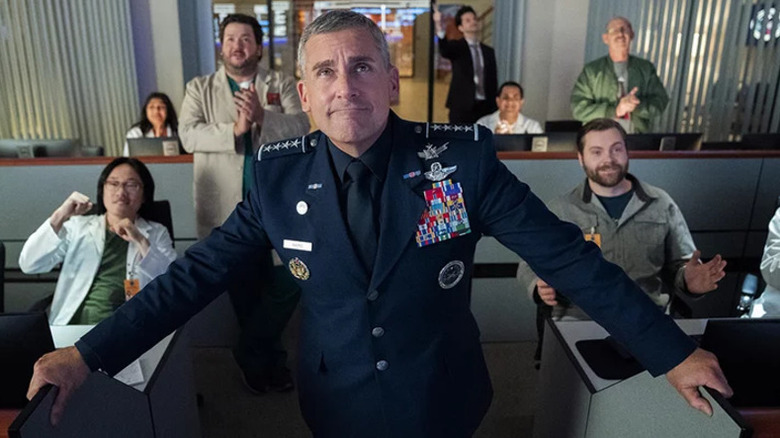
A more grounded space comedy is the Netflix original series "Space Force," also created by Greg Daniels. Steve Carell, who previously worked with Daniels on "The Office," stars as newly promoted four-star general Mark Naird. Given command of the latest American military branch, the U.S. Space Force, Naird finds the organization in complete disarray. As other nations become involved with the militarization of space, Naird moves to complete a lunar landing by 2024 as part of his mission directive.
Starting out as a more military-oriented workplace comedy, "Space Force" is another that steadily improves as it goes along. Carell is right in his element as the often clueless Naird though, at the same time, not just replicating his performance as Michael Scott. Joining him is a strong supporting cast, from Lisa Kudrow to Jimmy O. Yang, each adding new comedic dimensions to the series. A cozy and unassuming sitcom that visibly gets more comfortable with its own voice by its second and final season, "Space Force" is a Netflix show gone far too soon.