

Patrick Stewart's 5 Best Captain Picard Quotes In Star Trek, Ranked

Played with gravitas by the late Patrick Stewart, Captain Jean-Luc Picard always stood as a bastion of goodness, empathy, and moral clarity. The legacy that Stewart forged through his performances in "Star Trek: The Next Generation" and "Star Trek: Picard" (as well as several "Star Trek" feature films) will live on. The character's massive popularity was due, in no small part, to the pearls of wisdom he constantly delivered to settle conflicts and motivate the Enterprise crew.
Of course, some credit for this has to go to the writers, but as a trained Shakespearean actor, Stewart always knew how to make sure a line hit home. You don't need to be a Trekkie to be moved by Picard's measured philosophy or outlook on the world, which redefined what a sci-fi hero could be. The five quotes on this list see the captain at both his most courageous and most vulnerable. They're good lessons for all of us to live by, regardless of our place in the galaxy.
There are four lights!
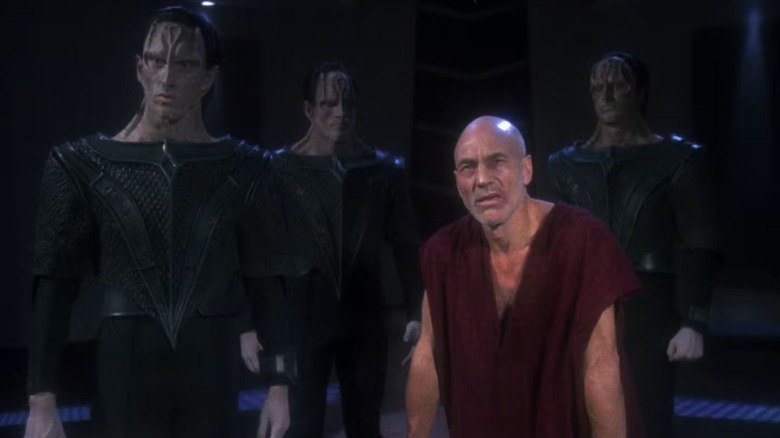
"Chain of Command," a must-watch two-part episode of "Star Trek: The Next Generation," sees Picard at his absolute lowest. While carrying out a covert mission, the captain is taken prisoner by Cardassians and subjected to a truly heinous onslaught of torture, degradation, and physical pain. While he keeps his spirit for longer than most would have managed, even Picard begins to break down under such awful conditions.
It all comes to a head in a scene reminiscent of George Orwell's classic novel "1984," in which a character is coerced under similar circumstances to disregard everything he knows to be true and claim that two plus two equals five. Interrogator Gul Madred (David Warner) deploys a similar tactic by showing Picard four lights and asking him to say there are five.
Despite the effects of his ordeal, the captain stands firm, eventually shouting, "There are four lights!" It's an example of Picard's bravery, but also his vulnerability. In the episode's conclusion, the captain admits he actually did begin to see five lights instead of four. It was an important reminder that for all of his many virtues, Picard was also human.
The road from legitimate suspicion to rampant paranoia...
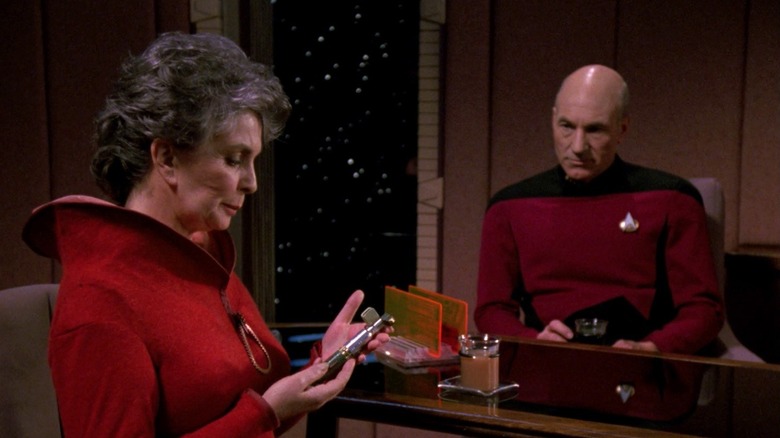
"The Drumhead" is one of many "Star Trek: The Next Generation" episodes that tackles an issue all too familiar in real life — in this case, witch hunts and false accusations. The episode kicks off with an explosion aboard the USS Enterprise, which Starfleet presumes is an act of sabotage. The ensuing investigation, led by the authoritarian Admiral Norah Satie (Jean Simmons), singles out individual crew members based on unrelated offenses and irrelevant aspects of their identity.
Even when Data (Brent Spiner) and Geordi (LeVar Burton) provide evidence that the explosion was merely an accident, Satie doesn't let up. Picard, who at one point bears the brunt of Satie's suspicion himself, is rightfully perturbed by the whole affair. It's the events of this episode that lead him to say, "The road from legitimate suspicion to rampant paranoia is very much shorter than we think." It's a great line and one that rings true in the real world, as is so often the case when it comes to Picard.
The line must be drawn here! This far, no further!
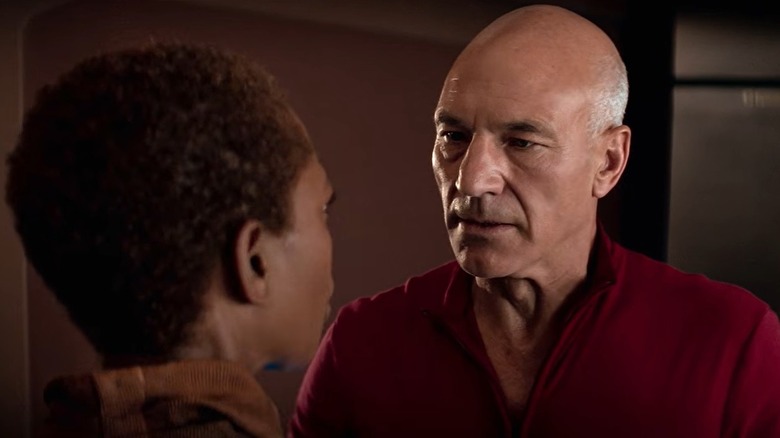
In the 1996 "Star Trek" film "First Contact," Patrick Stewart delivered one of those monologues that made it abundantly clear why he was so in demand as an actor beyond his role as Jean-Luc Picard. In a departure from his usual calm and collected demeanor, Picard stands firm in defense of his ship against the threat of Borg assimilation — a trauma he had endured years prior.
Amid an argument with engineer Lily Sloane (Alfre Woodard), Picard delivers the following speech in full: "I will not sacrifice the Enterprise. We've made too many compromises already; too many retreats. They invade our space, and we fall back. They assimilate entire worlds, and we fall back. Not again. The line must be drawn here! This far, no further! And I will make them pay for what they've done."
Despite the resolve he exhibits in this monologue, the captain stands down after Lily manages to convince him that his obsession with vengeance will endanger his crew. The moment stands out as an example of Picard's grit and determination, as well as his ultimate humility. It reminds us that there are many sides to Picard, which is part of what makes him such a memorable character.
It is possible to commit no mistakes and still lose

In the "Star Trek: The Next Generation" Season 2 episode "Peak Performance," Data undergoes a very relatable crisis of confidence after he plays a game he expects to win and comes up short. When Zakdorn strategist Sirna Kolrami (Roy Brocksmith) boards the Enterprise to observe a combat simulation, Data ends up sitting across from him for a game of Strategema. Despite Kolrami's prowess at the game, Data assumes he'll prevail. He does not.
The android is so distraught by his failure that he starts to assume his software must be compromised. It is easier for him to believe that something is seriously wrong than to admit that he tried his best and still didn't win. After all, at least in his mind, he did not make any mistakes. That's when Picard has to step in to teach him a tough — but important — lesson. "It is possible to commit no mistakes and still lose," he explains. "That is not a weakness. That is life."
Make now always the most precious time
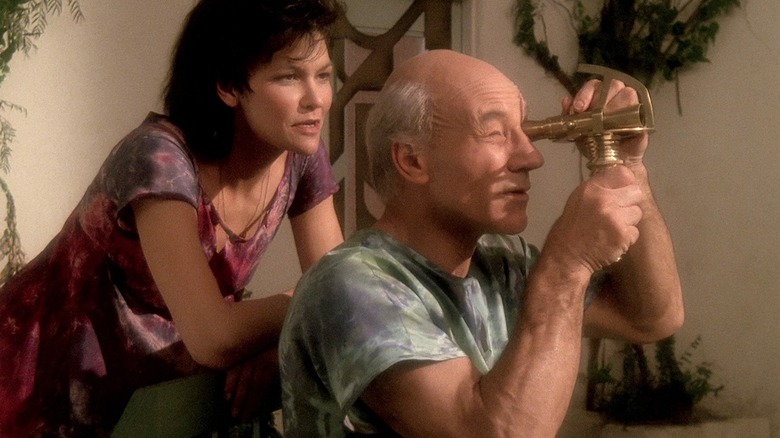
Jean-Luc Picard's best quote comes from Patrick Stewart's favorite "Star Trek: The Next Generation" episode, which is also arguably the best episode of "Star Trek" overall. In the Season 5 episode "The Inner Light," the captain is hit by a mysterious probe that causes him to wake up in a small village he doesn't recognize. There, he's told that he's not actually captain of the USS Enterprise, but a man named Kamin on the planet Kataan. After years, he accepts his new identity and lives his life, complete with a wife and family, on Kataan.
Unfortunately, the planet is dying, and it's later revealed that the probe was created so someone — which happens to be Picard — could remember the lives of its people centuries in the future. While the captain experienced decades within the simulation, only 25 minutes had passed on the Enterprise. Before that major reveal, however, Picard-as-Kamin has the following insight to offer his daughter: "Seize the time, Meribor. Live now. Make now always the most precious time. Now will never come again."