

The Scrubs Episode That Proved The Revival Was The Real Deal — And How It Sets Up Season 2
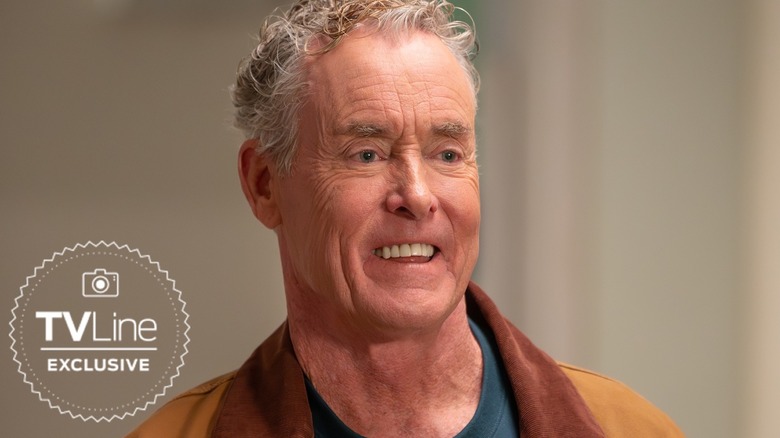
"Scrubs" always knew how to make viewers laugh. But some of the original series' most memorable moments were the ones that left them reaching for a box of tissues. So when the comedy returned to ABC 16 years after its original run ended, the question wasn't whether Zach Braff, Donald Faison, Sarah Chalke, and company could still be funny together. It was whether the revival could still pack the same emotional punch.
It didn't take long to find out.
The premiere saw Dr. Cox (John C. McGinley) hand the reins at Sacred Heart to his former protégé, J.D. (Braff), telling him that the hospital was his now. It also revealed just how deeply burned out Turk (Faison) had become after years as Chief of Surgery, as he opened up to his best friend about the toll the job had taken on him.
Faison tells TVLine that he felt the weight of being given that material as soon as he read the script. "They trusted me with a lot of the story's emotion," he says. "I didn't want to f–k it up."
Braff, who directed the pilot, says even he didn't anticipate quite how demonstrative Faison would become when they shot the scene. "It wasn't written with necessarily that much emotion to it," he tells TVLine. "I was directing it and didn't know that he was going to bring that emotion to it. And it was very moving."
Then in Episode 3, Elliot (Chalke) broke down and admitted to ex-husband J.D. that, despite their difficult divorce, she couldn't bear the thought of losing him as a friend.
"You can hope to have chemistry with people... but the one thing you can't manufacture is history," Chalke says. "They played such a big part of each other's lives, and they never expected to be working together after a hard divorce."
Episode 7 turned the focus to Carla (Judy Reyes), who was forced to confront the fact that she couldn't carry as much as she used to as she dealt with menopause. When showrunner Aseem Batra asked if Reyes was comfortable incorporating it into Carla's story, her answer was an emphatic yes.
"We started having conversations [about] how hilarious and intolerable it is and how it changes you no matter what," Reyes tells TVLine. "That's the thing that's amazing about working on the show: It's fearlessly emotional, just like it's fearlessly silly and ridiculous. You go equally for both of them at the same time."
Together, those moments showed that the revival could still tap into the emotional side of "Scrubs." But "My Odds," the season's penultimate episode, proved it could still hit as hard as the original series. Cox and viewers alike learned that he was suffering from an incurable autoimmune disease. By the end, the seemingly indestructible doctor was lying in a hospital bed, facing an uncertain future, with J.D. sitting beside him.
How Dr. Cox Became the Patient
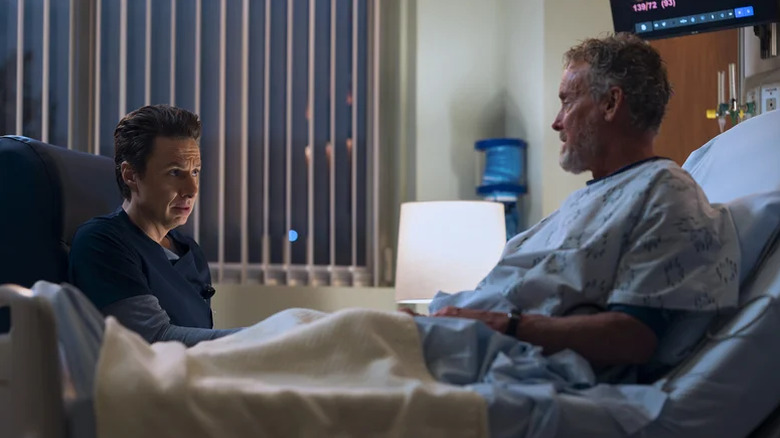
For showrunner Aseem Batra, putting Cox in that position raised an obvious question. "Will audiences be OK that we're doing this?" she recalls wondering. "It was a little bit scary."
While the writers never seriously doubted that they should pursue the storyline, she says, they did wrestle with how to calibrate it so that Cox's illness didn't fundamentally change the character viewers had known for decades: "It gives us an angle on him, and also J.D., that we haven't seen before."
Some of that concern eased at the table read. "You kind of knew we were all on the same page at that point — that people were feeling what we were feeling," Batra says. And when the episode eventually aired, "getting the audience's reaction to it was so satisfying because we're all together on this — the way we feel about [Cox]. And that last scene with J.D. and Cox, it really just felt like an arc that had started 20 years ago."
When TVLine spoke with McGinley shortly before "My Odds" aired, he believed it belonged in the same conversation as the show's most celebrated episodes — including the Season 3 classic "My Screw-Up," which culminated in the reveal that Cox's best friend and former brother-in-law, Brendan Fraser's Ben, had succumbed to cancer and died. Five months later, "My Odds" ranks among the top dozen of all 191 "Scrubs" episodes rated by IMDb users. But McGinley doesn't take the credit for the scene that closes it.
"I thought Zachy was so magnificent," he says of Braff. "He has to drive that scene. Zachy is the initiator, I'm the responder. I get to pay off all the histrionics... but Zachy has to do the nuance stuff. If you have two birds in the nest competing for the worm in a scene, it never works. And he was just magnificent in that scene."
Braff sees it differently. For him, much of what made the scene work was sitting across from McGinley. "You have to understand that Johnny and I have such a history together," he says. "There's a lot of overlap with our history and the characters."
When the original series began, McGinley was already an established actor, while Braff had a handful of credits to his name but was still waiting tables to get by. And much like Cox became for J.D., McGinley became his mentor: "He taught me a lot about performing and about bringing it every single take. He's the most committed, hardworking actor I know."
More than two decades later, that history followed them into Cox's hospital room. "We were sitting there really being versions of ourselves," Braff says. "We're both getting older, and our bodies are creaking more. And it wasn't just the mentor and mentee from 'Scrubs.' It was old friends — the mentor and mentee in life."
Braff hadn't planned to get quite so emotional. Then he looked over at McGinley and couldn't hold back: "I was so moved by John. It was happening for us on multiple levels in that scene. And I think that's why it resonated with people."
For Batra, Cox's diagnosis also served one of the revival's larger themes: The doctors who once needed him were now in a position to take care of their former mentor. "The kids become the grownups, right?" she says. "We have J.D., Elliot, [and] Turk, and they were all... these interns who knew nothing. And now they're taking care of their mentor. It's yet another way to show this passing of the baton."
There was a practical storytelling consideration, too. Having established in Season 1 that Cox had retired from Sacred Heart, the writers wanted any continued role for McGinley to feel organic. Batra credits co-executive producer Mathew Harawitz — who penned Chalke's Episode 3 showcase — with first suggesting Cox's illness as a way to accomplish both goals. "The impetus was, we love Johnny C. so much," she says. "How do we get him back organically without it feeling like, 'Oh, we made him retire. Now he's back?'"
Making Cox the patient also allowed the revival to explore a question that original series creator Bill Lawrence found especially compelling at this stage in the characters' lives. "What does it look like as the people that we love age and [they] become patients?" he asks. "I thought it was fascinating."
For Lawrence, stories like Cox's are also what keep the revival from simply playing the greatest hits. The characters are well aware of their age and where their lives have taken them.
"It feels fresh and of the time," Lawrence says. "That's the coolest thing that I think they nailed [with this revival].... It feels very relevant to now, and not a throwback to what it used to be."
After all, J.D., Turk, and Elliot couldn't return to Sacred Heart with the same problems they had as twenty-something interns. They aren't the same doctors anymore, or the same people. And Cox's illness gives the revival an opportunity to turn one of its defining relationships on its head: J.D. can now be there for Cox in the way Cox has always been there for him — which, unsurprisingly, is where the revival picks up in Season 2.
Dr. Cox, Meet Your Doctors
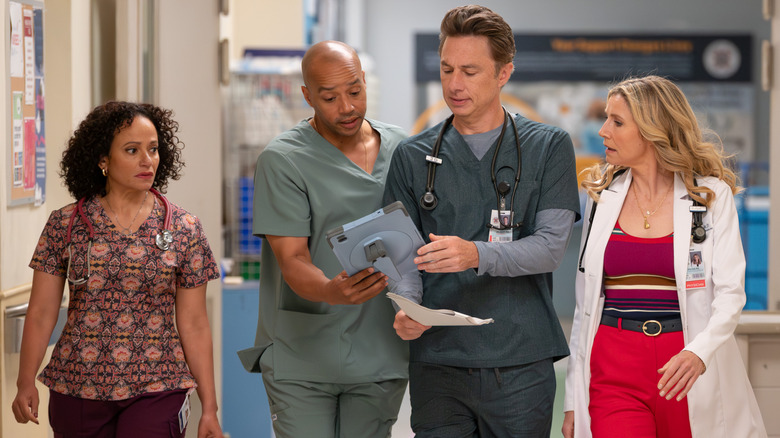
When Season 2 begins, Cox is back in the hospital, where his deteriorating condition forces his former protégés, led by J.D., to reconsider his treatment.
"The most interesting layer that the writers are exploring with Cox is being scared to death," McGinley tells TVLine. "Cox as a frightened patient is compelling stuff. The tone of the piece isn't all hijinks and unicorns and butterflies. One of the reasons 'Scrubs' resonates is because we've all been in the hospital. We've all been scared to death. We don't know what the outcome is going to be." And in the season opener, directed by Braff, it's up to J.D., Turk, and Elliot to save the former chief.
"J.D. is having trouble just cracking the case of why the particular treatment isn't working," Braff explains. "And so he gathers the top docs at the hospital who are his friends and says, 'I need your help on this. We've got to circle the wagons. I want to run more tests. I need you guys to help push all these tests through. I don't want them in 48 hours. We need them as soon as possible.'"
Braff sees Cox's illness as an ideal launching pad for Season 2. "It allows us to really see our stars collaborating and working together, not necessarily just going off into their own stories," he says. "We really focus on the legacy cast... working together on their beloved mentor."
For Cox, though, accepting that help is another matter. McGinley says his character still wants to be useful, even as his illness forces him into a role he's spent his career avoiding: "He wants to be part of something bigger than himself." And for Cox, "the only place that can happen is Sacred Heart."
Cox's return also gives the revival an opportunity to spend more time on his friendship with Carla. As she helps care for him in Season 2, Reyes and McGinley share their first scenes together in the revival — and substantial ones at that.
"Johnny C. did his thing and I did mine," Reyes says. "And just like he and I have that connection, Cox and Carla have that connection. You're wrapping your head around aging — it's [nearly] 30 years later and [I'm] sitting here with this incredible actor and responding to him."
And the feeling is mutual. For McGinley, their off-screen history is what allows Cox and Carla's relationship — which predates J.D., Turk, and Elliot's arrival at Sacred Heart — to feel so lived-in nearly three decades later.
"When Judy and I are in the frame together, we're talking about things that matter," he tells TVLine. "I love Judy like I love my sisters. I've spent 11 years of my life with her. She's one of the greatest people on the planet."
For McGinley, the revival works for the same reason the original series did: Beneath all the heightened comedy, the emotion has to be real.
"That's where 'Scrubs' lives," he says. "You got to frame it in that hyper comedy, which is also very hard. But where you ground it is when people tell the truth."
"Scrubs" Season 2 premieres Wednesday, September 30, with back-to-back episodes starting at 8 p.m. on ABC (and streaming next day on Hulu).